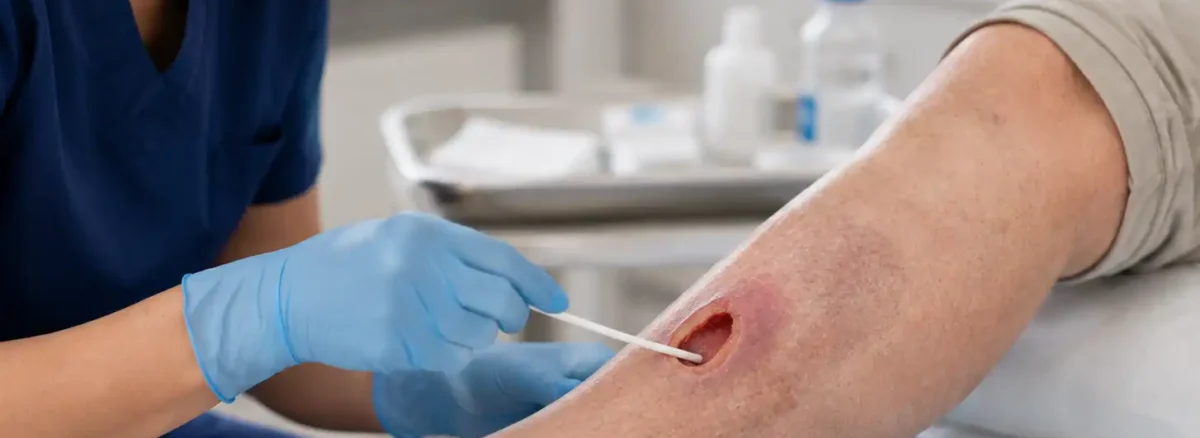
What is tunneling in a wound? It is a narrow channel running from the wound bed off into the tissue beside or beneath it, which means the opening you can see is only the entrance to something longer.
Depth is the one part of a wound nobody can judge by looking at it. A small opening can sit on top of a large cavity, and a wound that appears to be shrinking can be doing nothing of the sort underneath. This guide explains what tunneling is, how it differs from undermining and from a surgical wound coming apart, how clinicians measure something they cannot see, why wounds develop these spaces in the first place, and what treatment does about them.
On this page
- What is tunneling in a wound?
- Why the opening tells you so little
- Three findings that get confused
- How depth actually gets measured
- Why a wound starts to tunnel
- When depth points to something serious
- How these spaces are treated
- What not to do
- Living with a wound that runs deeper than it looks
- When to book an assessment
- Questions patients ask
- The short version
What is tunneling in a wound?
A tunnel is a channel with a dead end. It begins at the wound bed, the tissue surface you can actually see, and travels off in one direction into the tissue around it before stopping. Clinicians often write sinus tract for the same finding, and on a wound chart you may see either word.
What follows from that shape is the whole reason tunneling has its own name. A tract holds volume the visible wound does not account for. An opening a centimeter wide at the skin can sit at the mouth of a channel running four or five centimeters underneath, angled sideways beneath skin that looks perfectly healthy. Nothing about the opening advertises this.
Tunnels turn up most often in wounds that have been open for weeks, and they tend to follow paths of least resistance already present in the body: the seams between muscle groups, the plane between skin and the tissue below it, the space alongside a tendon. Infection travels those routes, dead tissue breaks down along them, and pressure combined with movement can pull them apart.
The clinical consequence is simple to state. A wound cannot close over a space that is still open. The cavity has to fill in from its far end outward, and until it does, a surface that stays open is the wound doing the right thing.
Why the opening tells you so little
Most people track a wound by the size of the hole. It is the measurement you can take yourself, it is what shows up in photographs, and it feels like progress when it gets smaller. For a shallow wound that reading is fair enough. For a deep one it can be close to meaningless.
Consider two wounds with identical openings. One is a shallow crater a few millimeters deep with nothing beneath it. The other opens into a tract running several centimeters under the skin. In a photograph they look the same. In terms of how long they will take to heal, how much dressing material they need and how likely they are to become infected, they are not remotely comparable.
A surface opening that shrinks while the tunnel underneath stays the same size is not improvement. It is a wound closing over a cavity, which is how an abscess forms. Clinicians would sooner hold a small opening open than watch skin seal across an unfilled space and trap fluid and bacteria inside it.
This explains something patients find genuinely confusing: being told a wound is doing well while the measurements written down have barely moved, or being told it needs to stay open when it looks nearly closed. Both make sense once you know that the number being watched is the one you cannot see.
Three findings that get confused
Tunneling, undermining and dehiscence all describe a wound that is bigger or more open than it first appears, and the three words get swapped around by people who do not write wound notes for a living. They are separate findings with separate implications.
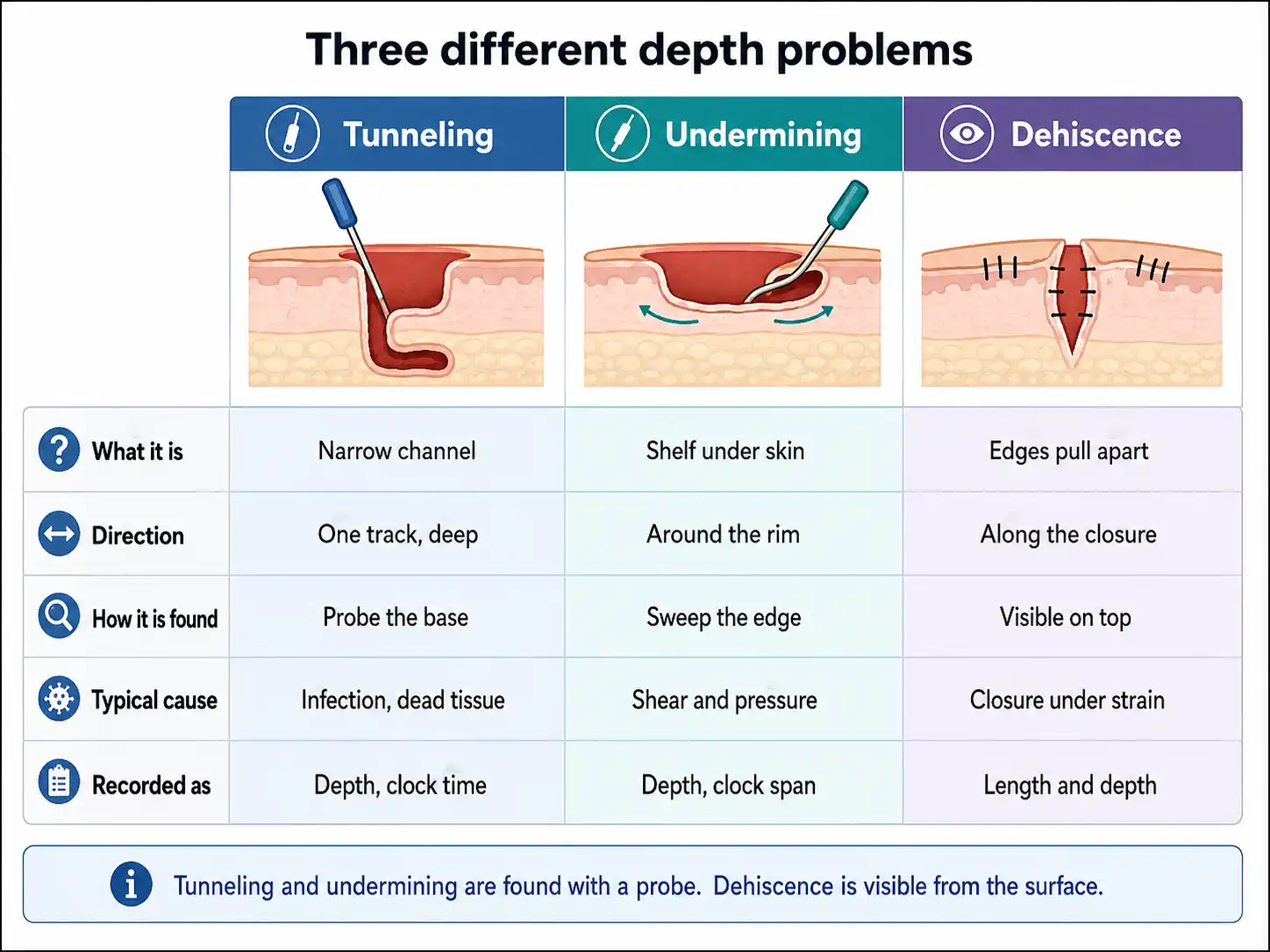
Tunneling
One channel, heading in one direction, ending in a blind pocket. On a chart it appears as a depth and a position, for example 3.5 cm at 7 o’clock. The channel is narrow, which is exactly what makes it easy to miss and awkward to treat: dressing material has to reach the far end without being forced in.
Undermining
Tissue loss underneath skin that is still intact, so the wound edge overhangs a wider cavity like the lip of a saucer. Where a tunnel goes off in one direction, undermining runs around part or all of the circumference. A clinician finds it by passing a probe gently under the edge and feeling how far it travels before meeting resistance.
Dehiscence
A wound that had been closed coming apart again along the line where it was joined. This is a surgical term and it applies to incisions, not to chronic ulcers. The separation may involve only the skin layers, or it may run deeper through the tissue holding the abdominal wall together, and those two situations are managed very differently.
How depth actually gets measured
With a sterile applicator, a clock face and a written record. Routine assessment involves no imaging and no clever equipment, which surprises people given how much rides on the numbers.
The clinician moistens a sterile swab, introduces it into the wound and lets it travel until it stops of its own accord. No force is applied. A gloved finger marks the swab at the level of the skin, the swab comes out, and the marked length is measured against a ruler. For undermining the same swab is passed under the wound edge and walked around the circumference, so the record captures how far the cavity extends and across how much of the rim.
Position is described using a clock face laid over the wound, with 12 o’clock pointing toward the patient’s head and 6 o’clock toward the feet. That orientation stays fixed regardless of which way the patient is lying or which part of the body the wound is on. A note reading “tunneling 4 cm at 11 o’clock, undermining 2 cm from 2 to 5 o’clock” therefore means the same thing to every clinician who reads it afterward, which is the entire point of the convention.
Two habits make the record trustworthy. The same reference points get used every time, and the measurement is taken after the wound has been cleaned, since debris and old dressing material sitting in a tract will stop a probe short and produce a falsely reassuring number. Reading the tissue in the wound bed is a separate job, and the colors that describe it are set out in our guide on what color a healing wound should be.
Depth also complicates staging. A pressure injury full of dead tissue cannot be assigned a stage until its base is visible, a situation described in our guide to unstageable pressure ulcers, and tunneling frequently travels with it.
Why a wound starts to tunnel
Wounds do not tunnel at random. Each of the usual causes leaves the same signature: tissue destroyed in a plane below the surface while the skin above it holds on a little longer.
Shear drives most undermining, and it is poorly understood outside clinical settings. Shear happens when layers of tissue slide across one another in opposite directions. Picture someone propped upright who gradually sinks toward the foot of the bed: friction pins the outer skin against the sheet while the bones, and everything attached to them, travel on. Small vessels bridging those two layers stretch until they tear, and the tissue they fed dies from the inside out. Pressure by itself tends to produce a crater. Pressure with movement produces a shelf.
Infection spreads along tissue planes because those planes offer the least resistance, and a spreading infection dissolves tissue as it goes. This is the mechanism most likely to lengthen a tract quickly, and a tunnel that has grown noticeably between two visits deserves attention for exactly that reason. The signs to watch for appear in our article on how to tell if a wound is infected.
Dead tissue liquefies as the body breaks it down, and the space it occupied becomes a cavity. Wounds carrying a lot of slough, the soft yellow or tan tissue that clings to a wound base, often reveal tunnels only once that material has been cleared, which is why depth measurements sometimes increase after a debridement. The wound has not deteriorated. It has finally been seen properly.
Retained material keeps a tract open indefinitely. A fragment of suture, a piece of gauze left behind at a dressing change, or a splinter of foreign matter from the original injury will sustain a small draining channel for months, and no dressing regimen will close it while the object is still in there.
Poor blood supply, uncontrolled diabetes, low protein intake and smoking make every one of these worse, since each of them slows the tissue repair that would otherwise fill the space back in.
When depth points to something serious
Most tunneling is managed in an outpatient clinic over a period of weeks. A few situations change the urgency entirely.
A tract that reaches bone. If a probe passed into a foot ulcer contacts a hard, gritty surface, infection in the bone becomes considerably more likely, and imaging or a specialist referral usually follows. That connection between depth and bone infection is set out in our article on osteomyelitis and foot ulcers.
A tract heading toward a joint or an implant. Channels running near a replaced joint, a plate or a screw are treated cautiously, because an infection reaching hardware rarely resolves with dressings alone.
Deep separation of a surgical wound. The National Library of Medicine’s StatPearls chapter on wound dehiscence puts the usual timing at five to eight days after surgery, while healing is still in its early stages, and it draws a firm line between two versions of the problem. Superficial separation involves the skin edges, with extra bleeding or drainage. Separation through the fascia, the tough layer holding the abdominal wall together, is a surgical emergency, because abdominal contents can push out through the opening. Anyone whose surgical wound suddenly leaks a large volume of fluid, opens visibly, or produces a popping or giving-way sensation needs assessment straight away.
Sudden change in any direction. A tract that lengthens between visits, drainage that increases sharply, pain that climbs, or a raised temperature alongside any of it moves this out of routine care and into same-day assessment.
How these spaces are treated
Treatment works from the bottom of the cavity upward, and every element of it serves that one aim.
Clearing dead tissue comes first, since a tract lined with breaking-down tissue will not build new tissue of its own. Depending on the wound this may be done with an instrument by a clinician, with a dressing that lets the body’s own enzymes soften the tissue over several days, or with an ointment that dissolves it. The slower methods are described in our guides to autolytic debridement and enzymatic debridement.
Filling the dead space is the part that defines this kind of wound care. Dressing material is placed loosely into the cavity so its walls stay separated and healing tissue grows in from the base. Loosely is the operative word: material forced into a tract presses on the very blood vessels meant to be rebuilding it, and tight packing holds wounds back. The material also goes in as a single piece with an end left visible outside the wound, and the count is written down, because anything left inside becomes the retained foreign body described earlier.
Negative pressure therapy may be used on some larger cavities. A sealed foam dressing connected to a pump applies gentle suction, drawing the walls of the cavity together and removing fluid continuously. It suits some wounds and not others, and the decision depends on the cause of the wound, the tissue in it and whether infection is under control.
Removing the force that made it counts as much as anything applied to the wound itself. Undermining driven by shear keeps extending while the shear continues, so repositioning, seating adjustments and support surfaces belong to the treatment and not to the afterthoughts. Our guide to pressure ulcer stages covers how these wounds are classified as they deepen.
Where a tract is long, branching or heading somewhere it should not, a surgeon may open it along its length so the whole channel can heal as an open wound. That sounds drastic and it often shortens the total healing time considerably.
What not to do
Do not probe the wound yourself to find out how deep it goes. A cotton swab pushed into a tract can perforate the end of it, drive bacteria further in, and create a false passage that then has to heal as well. Curiosity about depth is entirely reasonable; satisfying it at home is not.
Do not pack a cavity tightly, even when it seems that more material must be better. Firm packing compresses the tissue trying to grow and can turn a healing cavity into a stalled one.
Do not cut dressing material into small pieces or use anything that sheds fibers. Small pieces get lost in tracts. If you are changing a dressing at home, put in one piece, leave a tail outside the wound where you can see it, and check that everything you put in comes back out. Writing the number down beats trusting your memory a week later. General technique for home dressing changes is set out in our guide to wound care at home.
Do not flush a deep tract with a syringe unless a clinician has shown you how and asked you to. Fluid driven into a channel under pressure has to go somewhere, and it can push infected material into tissue that was clean.
Do not let a surface opening seal over a cavity that is still there, and speak up if it looks like it is happening. A wound that closes on top while a space remains beneath is the classic route to a collection of pus that then has to be opened again.
Living with a wound that runs deeper than it looks
The hardest part of a tunneling wound is rarely the pain. It is the arithmetic of it.
Progress arrives in millimeters recorded by somebody else. Nothing visible changes for weeks at a stretch, and then a measurement goes up after a debridement and feels like a defeat even once it has been explained. People describe losing their bearings entirely: a wound they could see would at least tell them something, and this one refuses to.
The practical intrusions add up too. Packing changes take longer than a simple dressing and can be uncomfortable while the material is being placed. Showering gets complicated. Deep wounds tend to drain more, which means more frequent changes and more planning around appointments. Anyone caring for a family member at home has to learn a procedure that carries real consequences if it is done carelessly, and that responsibility sits heavily.
A few things genuinely help. Ask for the numbers at each visit and keep your own note of them, because a run of measurements over two months shows a trend no single appointment can. Ask what the plan looks like if the depth has not moved by a given date, so there is a decision point instead of an open-ended wait. And if packing changes hurt, say so plainly. Timing pain relief before a change, or switching to a material that does not adhere to the tissue, is a straightforward adjustment that often goes unmade because nobody mentioned the problem.
When to book an assessment
Arrange an assessment if a wound feels deeper than its opening suggests, if you can see a gap under the wound edge, if a wound that had closed has started to open again, or if a small opening has been draining for weeks without getting any smaller.
Get seen the same day if a wound arrives with a temperature, sweats or shivering, if redness is creeping away from the wound edge, if pain has escalated over a few hours, if drainage has jumped sharply, or if a surgical wound gapes or leaks without warning. Each of those suggests infection or a separation that no dressing change will settle.
Any wound still open after a month without clear progress warrants a specialist opinion, and that applies with more force where depth is involved, since a tract can persist long after the surface has stopped changing at all. Our chronic wound treatment service assesses depth as part of working out why a wound has stalled.
Questions patients ask
Is tunneling in a wound serious?
It is a significant finding, though not usually an emergency on its own. Tunneling means the wound is larger than it appears and will take longer to heal, and it needs a treatment plan that reaches the whole cavity. It becomes urgent when a tract reaches bone or hardware, when it lengthens quickly, or when it appears alongside a temperature or redness that is spreading outward.
What is the difference between tunneling and undermining?
Tunneling is a narrow channel heading in one direction from the wound bed. Undermining is tissue loss beneath skin that is still intact, spreading around part of the wound edge like a shelf. A clinician records tunneling as a depth at a single clock position, and undermining as a depth across a range of clock positions.
Can a tunneling wound heal on its own?
Some shallow tracts do close with good general wound care. Many do not, because the cavity holds fluid and bacteria and the surface tends to seal before the depth has filled. Assessment is worthwhile either way, since the treatable causes, dead tissue, ongoing pressure, infection and retained material, are not things a wound resolves by itself.
Why did my wound get deeper after debridement?
Usually because the depth was always there and dead tissue was hiding it. Clearing slough and eschar exposes the true dimensions of a wound, so the recorded measurement can increase while the wound itself is in better shape than before. Ask the clinician to confirm that is what has happened, since the same question has a different answer if a wound is genuinely extending.
Does packing a wound hurt?
It can be uncomfortable, particularly when material has dried onto the tissue and is being removed. Moistening the dressing before removal, choosing a material that does not stick, and timing pain relief ahead of the change all reduce it. Persistent pain during packing is a reason to review the method, not something to put up with.
How long does a tunneling wound take to heal?
Longer than a shallow wound of the same surface size, and the honest answer depends on the depth, the cause, blood supply to the area and whether infection is present. Weeks to several months is a realistic range for a chronic wound with tunneling. A clinician tracking depth at each visit can give you a far more useful estimate than any general figure.
The short version
Tunneling is a channel leading from the wound bed into deeper tissue, so the opening you can see understates the wound. Undermining is the related finding under intact skin at the wound edge, and dehiscence is a closed surgical wound coming apart, which is a different problem again.
All three are recorded with a probe and a clock face, and those numbers matter more than the appearance of the opening. Healing works from the base of the cavity outward, which accounts for clearing dead tissue, for filling the space loosely, and for the trouble a surface causes when it closes too early. Depth that reaches bone, grows quickly, or arrives with a raised temperature changes the timescale from routine to urgent.
Not sure how deep your wound actually goes?
Depth is measurable, and knowing it changes the dressing, the plan and the timescale. An assessment can map the cavity, clear what is lining it, and set a treatment that reaches the whole wound.
Where an incision has separated, the wound is managed through our surgical wound care service, which also covers wounds deliberately left open to heal from the base.
This article is general education and does not replace a clinical assessment. Wound depth should be measured by a trained clinician, and a wound that suddenly opens, drains heavily or reaches bone needs prompt professional review.