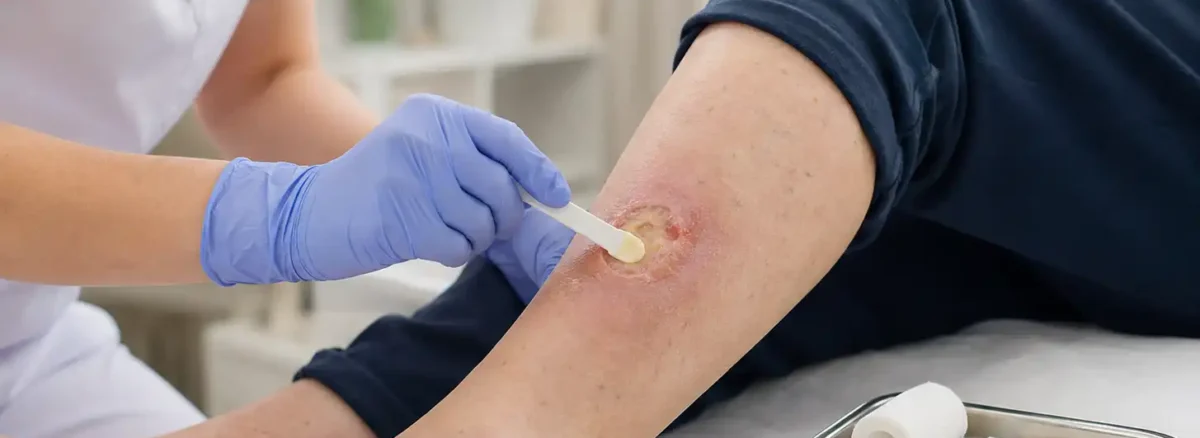
Enzymatic debridement is the clearing of dead tissue from a wound with a prescription ointment, spread on the wound bed once a day, with nothing cut and no anesthetic involved. In the United States one product does this job: collagenase.
The method is straightforward on paper and quietly easy to sabotage. Collagenase is an enzyme, and an enzyme is a protein doing chemistry under conditions it needs. A silver dressing over the top, an iodine wipe before it goes on, or a thick dry crust nobody has scored can leave a course running for weeks with almost nothing to show. This guide covers what the ointment does, the six things that stop it working, how it is applied, the point at which it should be stopped, and the wounds where it is the wrong choice.
On this page
- What is enzymatic debridement?
- The one ointment used in the US
- What the enzyme actually cuts
- Six things that stop it working
- How the ointment is used day to day
- How long it runs, and where it ends
- Wounds where it is not the answer
- What to avoid
- Living with a once-a-day routine
- When to call the clinic
- Questions about the ointment
- The takeaway
What is enzymatic debridement?
It is the chemical removal of dead tissue from a wound using a manufactured enzyme, supplied as an ointment and applied to the wound bed daily. The enzyme loosens dead material’s grip until it separates on its own or lifts away easily at a dressing change.
Debridement of any kind means getting dead tissue off a wound. Clinical notes usually call it necrotic tissue, or name the two forms separately as slough, the soft yellow or tan layer, and eschar, the dry dark one. Living tissue cannot grow across either of them, so clearing them is often the step that decides whether a stalled wound starts closing.
Enzymatic debridement was never designed to be the quickest way to do that. A clinician with a curette clears a wound in a single sitting. What the ointment offers is clearance that continues every day, in a person’s own home, on wounds too tender or too fragile for repeated cutting and in patients for whom a blade is a poor idea: someone on anticoagulants, for instance, or a person who cannot tolerate a bedside procedure.
It also differs from the approach that leaves the job to the patient’s own biology, where a moisture-retentive dressing traps wound fluid and lets the enzymes already in it do the work. We cover that slower route separately under autolytic debridement. Enzymatic debridement supplies the enzyme from outside instead, which is why it keeps running in people whose own repair machinery is not contributing much.
The one ointment used in the US
Only one enzymatic debriding ointment is on the market in the United States, and it is collagenase, a prescription product, not something available over a pharmacy counter.
Reading around this subject turns up plenty of descriptions of enzyme ointments made from papaya, usually papain paired with urea. Those are no longer marketed here, and any article still explaining how to use one is explaining a product a US pharmacy cannot supply. If a caregiver has been told to expect a choice of enzyme products, that expectation belongs to an earlier era of wound care.
Collagenase is produced by fermenting a bacterium, Clostridium histolyticum, and the purified enzyme is blended into a white petrolatum base at 250 units per gram. Its approved use is debriding chronic dermal ulcers and severely burned areas, a broad indication that covers pressure injuries, venous and arterial ulcers, diabetic foot wounds and burns. The full prescribing information sits in DailyMed, the National Library of Medicine’s public register of drug labeling, and it is short enough to read in one go.
Being a prescription product has consequences the clinical description skips over. It has to be prescribed, dispensed and re-supplied, coverage varies between plans, and a tube that runs out on a Friday stops the treatment as effectively as any clinical problem. Sorting the supply chain is part of making the method work.
What the enzyme actually cuts
Collagen, and specifically the collagen strands that tether dead tissue to the wound underneath.
Dead tissue does not lie loose on a wound waiting to be lifted off. It is anchored down by collagen, the structural protein that gives skin and connective tissue their tensile strength, and those anchors are the reason slough and eschar stay put. Collagenase cuts collagen apart. Cut enough of the anchors and the dead layer detaches, which is why the visible result of this treatment is tissue that separates and comes away, and not tissue that dissolves into nothing.
The property that makes this usable is where the enzyme concentrates its effect. It acts on the degraded collagen holding devitalized tissue in place while leaving healthy tissue largely undisturbed, so healthy granulation is not stripped out along with the dead layer. The labeling reports no toxic reactions in clinical use when the ointment is used as directed. The local effect it does describe is a mild, temporary redness in the skin bordering the wound, seen mainly where the ointment strayed outside the wound margins.
Two conditions govern how well the enzyme performs. Activity is highest between pH 6 and 8, and pushing the wound surface much more acidic or much more alkaline than that band slows the reaction down. The enzyme also has to make physical contact with dead tissue to act on it, which sounds obvious and turns out to be the single most common reason a course fails on a wound covered in thick, dry eschar.
Six things that stop it working
Most failed courses are not failures of the drug. They are cases where something else applied to the wound switched the enzyme off, or where it never reached the tissue it was meant to act on.
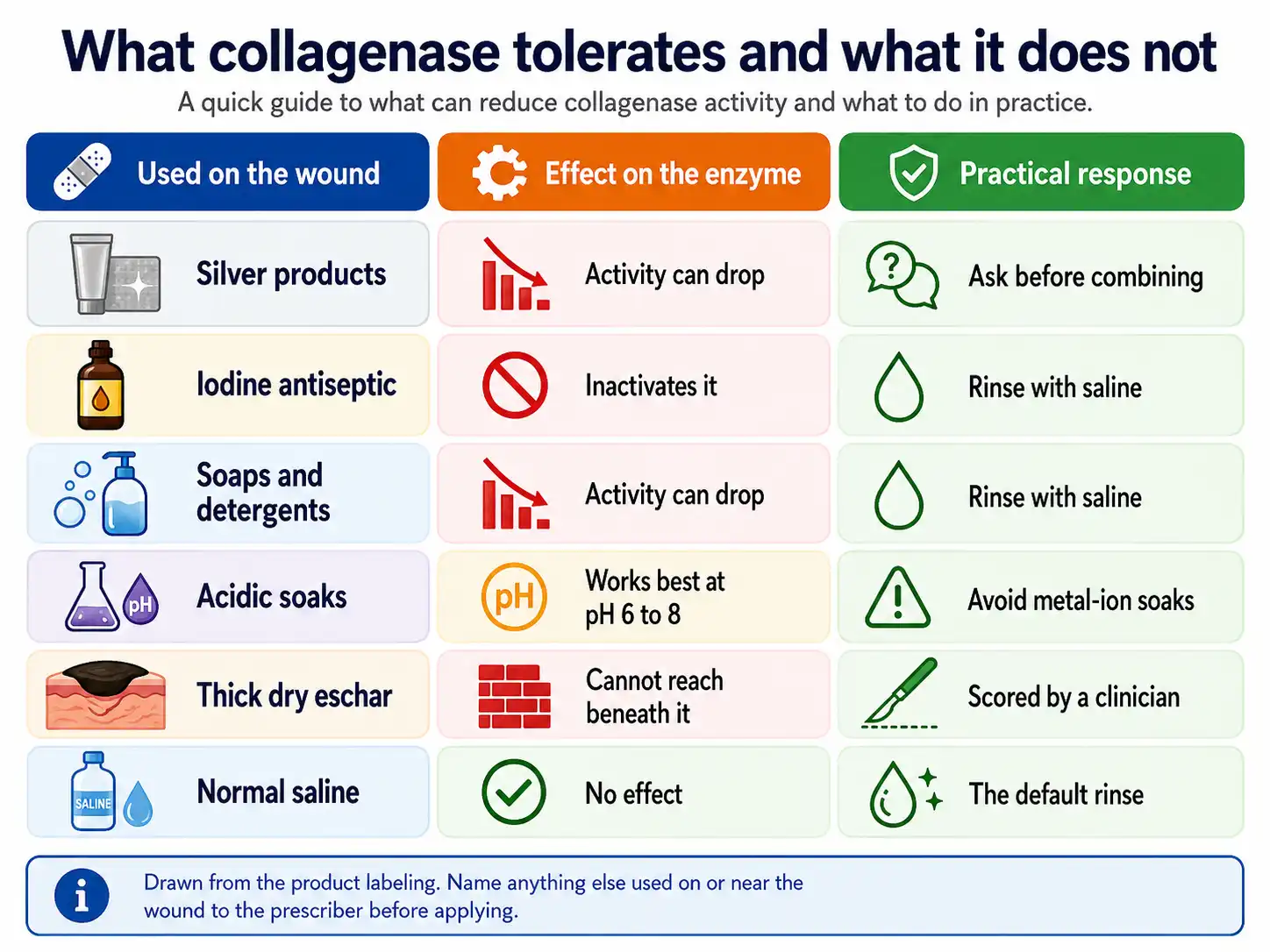
Silver comes first because silver dressings are everywhere. Heavy metal ions used in antiseptic products, silver and mercury among them, are recorded in the labeling as adversely affecting enzyme activity. A silver foam laid straight over a freshly applied dose is a combination to raise with the prescriber, not one to assume is fine because both products are treating the same wound.
Iodine is the clearest case of the six. Povidone iodine does not merely reduce the enzyme’s activity: washing the area with it is the method the labeling gives for deliberately shutting the enzyme down after an overdose. An iodine swab used to prep a wound minutes before the ointment goes on is not a minor deviation from the plan.
Detergents cause quieter trouble. Certain detergents interfere with enzyme activity, and household soap on a washcloth is a detergent whatever the label on the bottle says. Where anything of that kind may have touched the wound, repeated washing with normal saline before the next application is the recommended fix.
Acidic soaks fail on two counts at once. A soak carrying metal ions brings the metal problem with it, and an acidic solution drags the wound surface below the pH band the enzyme needs. Both effects point the same way, and soaks of that type are best kept off a wound being treated this way.
Thick dry eschar is a physical obstacle, not a chemical one. The ointment sits on the surface of a hard plate and never contacts the necrotic material beneath. The labeling’s answer is crosshatching: a clinician scores the eschar in a grid with a scalpel blade, giving the enzyme far more surface to work against. That is a clinical procedure, and scoring a crust at home with anything to hand is a good way to turn a closed problem into an open one.
One widespread assumption needs correcting: not every antiseptic is off limits. Normal saline and Dakin’s solution are both named in the labeling as compatible with the ointment. Households that have quietly stopped cleaning a wound properly, on the theory that anything beyond water might ruin the treatment, have usually made things worse instead of safer.
How the ointment is used day to day
Once a day, on a wound that has just been cleaned, inside the wound margins and nowhere else, under a cover. That sentence is most of the routine.
The application interval is once daily, and the one recognized reason to go more often is a dressing that has become soiled, incontinence being the usual cause. Cleaning comes first: gently rubbing the wound with a gauze pad soaked in normal saline, or another cleansing agent known to be compatible, then rinsing with saline. That step removes the previous day’s ointment along with the digested material it produced, and skipping it leaves a fresh dose working on top of yesterday’s residue.
The ointment can go directly onto the wound bed or onto a sterile gauze pad that is then laid over the wound and secured. Either way it is confined to the wound itself. Smearing it across the border of intact skin wastes ointment and is the situation in which that transient redness shows up. Protecting the surrounding skin matters for a second reason as well, since a wound being actively debrided produces more fluid than it did, and skin kept wet for days softens and breaks down in its own right, the pattern described under moisture associated skin damage.
Loosened debris does not have to wait for the enzyme to finish it. Tissue that has clearly detached is removed at the dressing change with forceps and scissors by whoever has been trained to do it, which speeds the whole thing up considerably. Where infection is present in the wound, the labeling directs that a suitable topical antibiotic powder goes on before the ointment, and that treatment is suspended altogether if that infection does not settle.
A secondary dressing goes over the top to hold everything in place and manage drainage. Which one depends on how much fluid the wound is producing, a decision covered more fully in our discussion of whether a wound should be covered.
How long it runs, and where it ends
Days to several weeks, depending on how much dead tissue is present, and it ends at a defined point that has nothing to do with the wound being closed.
That last part catches people out more than anything else about the timeline. The labeling says to stop using the ointment once debridement of dead tissue is complete and granulation tissue is well established. Collagenase is a debriding agent, not a healing agent. It clears the obstruction and hands the wound back to whatever is going to close it, so a clean red wound bed is where this particular product stops. It is not a cue to carry on applying until the skin knits over.
Reaching that point takes longer on a heel covered in thick eschar than on a small patch of soft yellow slough, which is the largest single variable. Blood supply is the next one, since a limb that is short of circulation heals slowly and clears slowly with any method. Where a wound sits on the leg or foot, that circulation gets measured before much else is decided, and the usual first test is explained in our piece on the ankle-brachial index. Consistency is the third variable and the one most under a household’s control: a course applied five days out of seven is running at five sevenths of its intended dose.
Fix a review date before the first tube is opened. Ask at the outset what difference should be visible by the following appointment, and what the plan becomes if there is none. Two weeks of daily applications leaving the dead layer as firm, as extensive and as firmly stuck down as it was at the start is a prompt to reconsider, not a reason to order another tube.
Wounds where it is not the answer
Gentle and selective does not mean suitable everywhere. Several situations rule the ointment out, and a couple of them are urgent.
A previous reaction to collagenase is the outright contraindication: anyone who has shown local or systemic hypersensitivity to it should not be given it again. Beyond that, spreading infection changes the priority entirely. Dead tissue then acts as cover for bacteria and has to go quickly, which usually means a clinician clearing it with an instrument, not an ointment working over days. A wound carrying a little slough looks different from a wound turning infected, and how to tell if a wound is infected sets out the distinctions.
Dry, hard, firmly attached eschar on a heel or toe deserves particular caution, because deliberately breaking that seal on a limb with poor circulation can convert a stable situation into an open wound that has no realistic prospect of healing. Eschar of that description is frequently preserved on purpose, and why that is the safer call runs through our page on the unstageable pressure ulcer. The decision follows a circulation assessment, and it is not one to reach at home.
Deadlines rule it out too. Where a graft, a flap or another surgical repair is scheduled, the wound bed has to be clean by a fixed date, and a daily ointment working at its own pace is not a plan that can promise that. Frail and debilitated patients need closer monitoring for infection traveling in the bloodstream while any debriding enzyme is in use, a precaution the labeling states explicitly. And safety and effectiveness in children have not been established, so the ointment is not a routine option in pediatric wounds.
What to avoid
Do not add anything to the wound that was not prescribed alongside the ointment. Silver creams left over from an earlier dressing, an iodine antiseptic from the bathroom cabinet, hydrogen peroxide, alcohol wipes. Each of these either damages the cells doing the repair or blunts the very enzyme the prescription was written for. A wound on this treatment gets saline and what the clinic specified, and nothing improvised.
Keep the ointment off the skin around the wound. It belongs on the wound bed, and the border of intact skin gains nothing from it except the risk of soreness.
Do not stretch the tube by applying every other day. A missed application is a missed dose, and rationing supply quietly is one of the more common reasons a course produces less than expected. Running short is a reason to call for a refill early, and where cost is what drives the rationing, saying so gets the problem solved. Hiding it does not.
Leave loosening tissue alone. Material that has begun to detach at one corner invites a tug, and pulling strips healthy tissue out with the dead. Debris that has fully separated belongs to whoever does the dressing change, who has instruments for it.
Finally, do not treat the ointment as the whole plan. Clearing dead tissue does nothing about the force that made the wound in the first place. A foot ulcer still needs the weight taken off it, which is the whole subject of offloading a diabetic foot ulcer, and a leg ulcer driven by venous disease still needs its swelling controlled. A spotless wound bed under continuing pressure simply produces the next wound.
Living with a once-a-day routine
A daily dressing change sounds modest written on a care plan and lands differently in a household that has to do it every single day.
It shapes the day around itself. Someone has to be free at roughly the same time, with clean hands, saline, gauze, the tube and a cover, and that someone is usually a spouse or an adult child who did not train for it. Work shifts, school runs and weekends away all have to bend around the schedule. The person doing the changing also sees the wound at close range daily, which is its own strain when the wound is unpleasant to look at, and the patient reads their face every time.
The wound itself gets more demanding for a while. Debridement liberates fluid, so dressings fill faster, laundry piles up, and odor may become noticeable through the middle stretch. Most households absorb that quietly, on the assumption that it will pass and the clinic has bigger problems to handle.
Naming any of it changes what gets offered. Charcoal-containing dressings exist specifically for odor and can be added at a single visit. A cover a family can manage quickly beats an elegant one that keeps getting postponed. And where the daily application genuinely is not happening (because of cost, because of travel, because nobody available is comfortable doing it), say so plainly. A clinician who knows the ointment goes on four days in seven can work with that. A clinician who believes it goes on daily will spend a month puzzling over why the wound has not responded.
When to call the clinic
Book a review if two weeks of daily applications have produced no visible change, if the skin bordering the wound has turned sore, red or itchy, if a dressing is saturating long before the next change is due, or if the supply of ointment is running out before the next appointment.
Stop the ointment and call if a rash, itching or swelling develops in the skin around the wound after applying it. Reactions to collagenase are uncommon, and they are a reason to have the product reviewed, not to press on.
A handful of findings should not wait for a scheduled visit. A temperature, or the shivering that tends to arrive ahead of one. Redness that has begun to travel outward from the wound margin. Pain that has shifted from steady to climbing across a day or two. Drainage that has thickened, or an odor still present once the wound has been rinsed clean. A dark area that was dry and hard and is now soft or damp. In an older adult, a sudden change in alertness or ordinary behavior, which can appear before any temperature does.
Those point at infection extending past the wound itself, and the response is a same-day assessment, not a note for the next visit.
Questions about the ointment
Does enzymatic debridement hurt?
Not in the way a blade does, since nothing is being cut. Some people report stinging or a burning sensation while the wound is exposed and the ointment is being spread, particularly on a sensitive wound bed, and removing a dressing that has adhered can be briefly uncomfortable. Discomfort that grows steadily from one day to the next is a separate signal and should be reported, because it more often reflects infection developing than the product itself.
How does it differ from letting the body clear the tissue?
By where the enzyme comes from, and by what that costs in time and money. Collagenase arrives in a tube, manufactured outside the body, and it goes on daily whether or not the patient’s own repair system is up to much. The alternative depends entirely on enzymes already present in wound fluid, needs only a dressing that holds moisture in place, requires no prescription, and moves considerably more slowly. Choosing between them turns on how urgently the tissue has to go, the state of the wound bed, and what a household can realistically sustain.
Can it be used with a silver dressing?
Only on the say-so of whoever prescribed it. Heavy metal ions including silver are documented as reducing the enzyme’s activity, so pairing the two is a decision for the prescriber and not an assumption to make at a dressing change. Where a silver product may already have touched the wound, washing repeatedly with normal saline before the next application is what the labeling advises.
What happens if a day is missed?
One missed application slows progress slightly and nothing more. A pattern of them is different, and it is among the commonest explanations for a course that appears to have failed. Resume the next day at the normal schedule, and mention the gaps at the next appointment so the timeline is being judged against what actually happened.
Will it dissolve healthy tissue?
It is targeted at the degraded collagen anchoring devitalized tissue, so healthy granulation is largely spared. The local effect described in the labeling is a slight, temporary redness in surrounding tissue, noted mainly where the ointment was not kept inside the wound. Applying it carefully within the wound margins is the practical safeguard.
How do you know when to stop?
When the dead tissue has gone and healthy granulation is well established across the wound bed. That is the endpoint the labeling specifies, and it is a clinical judgment made at a review, not a call to make at home. Carrying on past it does not accelerate closure, and the wound at that stage needs a plan aimed at healing instead of one aimed at clearing.
The takeaway
Enzymatic debridement uses a prescription ointment to dissolve the collagen anchoring dead tissue to a wound, applied once a day, without cutting. Collagenase is the only such ointment on the US market, and the papain products described in older material are no longer available here.
Most disappointing courses have an explanation outside the drug. Silver, iodine, detergents and acidic soaks all reduce or eliminate the enzyme’s activity; thick dry eschar blocks it physically until a clinician scores the surface; and doses skipped to make a tube last are doses that were never given. Normal saline and Dakin’s solution, by contrast, are compatible, so cleaning the wound properly is not the risk people take it for.
Set a review date at the outset, keep the ointment inside the wound margins, protect the skin at the border, and remember that the finish line is a clean granulating bed, not a closed wound. Keep treating whatever caused the wound, because a spotless wound bed under unchanged pressure is a wound that comes back.
Is the ointment not shifting the dead tissue?
Two weeks of daily applications with nothing to show usually has a findable cause: a product working against the enzyme, eschar that needs scoring, or circulation that has not been measured. An assessment can identify which.
Matching a debridement method to a particular wound, and auditing everything else being applied to it, sits inside our advanced wound care service, alongside the work of finding out why the tissue died in the first place.
This article is general education and does not replace a clinical assessment. Collagenase is a prescription medicine, its suitability depends on infection, blood supply and the nature of the dead tissue present, and no debriding ointment should be started, combined with another product, or stopped without the advice of the clinician managing the wound.