
Pressure ulcer stages describe one thing: how far down the damage goes. Stage 1 is skin that is still intact. Stage 4 has reached muscle, tendon or bone. The two in between are set by which layer has been lost.
That single measure is useful, and it is misread constantly. A stage number says nothing about how long a wound has been open, how much it hurts, how likely it is to close, or how urgently someone needs to be seen. It is a description of depth taken at one moment.
You will also see these called pressure injuries, pressure sores or bedsores. Pressure injury is the term in current clinical guidance, because the first stage is not an ulcer at all: the skin has not broken. The staging system is identical whichever word appears in the notes. This guide covers what each stage looks like, the two injuries that carry no number, why a higher number is not automatically the worse wound, and what the stage does and does not change about treatment.
On this page
- How deep does each pressure ulcer stage go?
- The four stages, layer by layer
- Two injuries that get no number
- Why the bigger number is not always the bigger problem
- A stage 4 that heals is still a stage 4
- Taking the pressure off is the treatment
- What the stage changes about the plan
- What not to do
- Living with a pressure ulcer
- When it needs medical attention
- Questions caregivers and patients ask
- The takeaway
How deep does each pressure ulcer stage go?
Each stage corresponds to a tissue layer. Stage 1 stops at intact skin that has changed color. Stage 2 has lost the outer layer and exposed the dermis, the layer of skin directly beneath it. Stage 3 has gone through the full thickness of the skin into the fat below. Stage 4 has passed the fat into muscle, tendon, ligament, cartilage or bone.
The system comes from the bodies that publish the international pressure injury guideline, and it exists so that two clinicians examining the same wound a week apart record it the same way. A stage is a shared vocabulary for depth, not a verdict on the patient.
One limit gets missed regularly. The stages apply only to damage caused by pressure and shear. A surgical wound, a burn, a skin tear or a leg ulcer is not staged, even when it looks similar on the surface. Putting a stage on a wound that was never caused by pressure sends the treatment sideways, because the label implies a cause that is not there.
The four stages, layer by layer
The numbered stages track the deepest tissue that has been lost, and nothing beyond that.
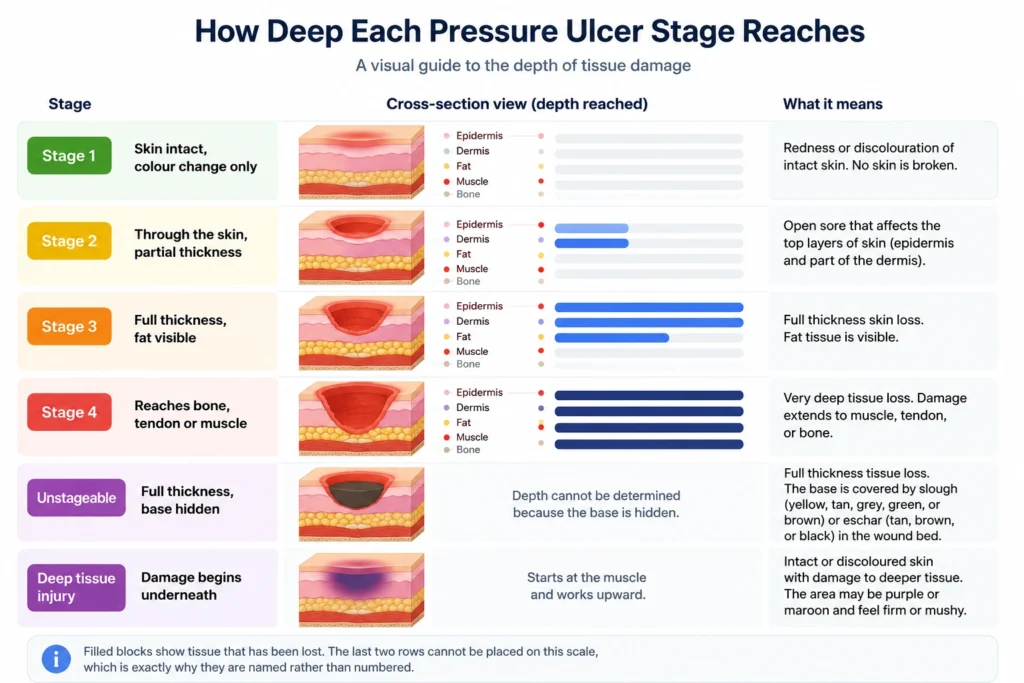
Stage 1: intact skin that will not blanch
Stage 1 is unbroken skin with a patch of discoloration that does not pale when pressed. That last part is the whole test. Press a finger on the area for a few seconds and lift it: healthy skin goes white and then refills. Stage 1 skin holds its color.
On brown and Black skin the change may not read as red at all. It can look purple, blue-gray, or simply darker than the surrounding skin, and judging whether it blanches is often impossible. Temperature, firmness and sensation carry the diagnosis instead: an area that feels warmer or cooler than the skin around it, firmer or unusually boggy, or tender when nothing is pressing on it. Stage 1 is missed far more often on darker skin, because the classic description was written around what redness looks like on pale skin.
Stage 2: the skin has broken
Stage 2 is the first stage with an actual open wound. The outer layer has gone and the dermis underneath is exposed, so the base looks shallow, pink or red, and moist. An intact or burst blister filled with clear fluid counts here too.
What stage 2 excludes matters as much as what it includes. There should be no yellow slough, no dead tissue and no visible fat. If any of those are present the wound has gone deeper, however small it looks from above. Stage 2 also gets applied wrongly to skin damaged by moisture, from incontinence or from sweat trapped in a skin fold. That damage is real and it needs treating, but the cause is wetness, not pressure, and mislabeling it points the plan at the wrong problem.
Stage 3: through the skin into fat
Stage 3 has lost the full thickness of the skin, and fat is visible in the base of the wound. Yellow slough or a patch of dead tissue may sit inside it, provided the base can still be seen. Wounds at this depth often develop rolled edges, and they can spread sideways underneath intact skin, so the opening on the surface is smaller than the cavity below.
Depth at stage 3 varies enormously with the site. There is almost no fat over the bridge of the nose, the ear or the back of the head, so a stage 3 in those places is shallow. A stage 3 on the buttock can be deep enough to take a gloved finger.
Stage 4: structure is exposed
Stage 4 reaches structure. Muscle, tendon, ligament, cartilage or bone is either visible in the wound or can be felt directly at its base. Slough, dead tissue, rolled edges, tunnels and pockets under the surrounding skin are all common at this depth.
Bone that is visible, or that an instrument reaches at the base, raises a separate question: whether the bone itself has become infected. The signs clinicians weigh are much the same wherever the wound sits, and osteomyelitis foot ulcer works through them.
Two injuries that get no number
Some pressure damage cannot be staged, and the two categories that fall outside the numbers are the ones most likely to be underestimated.
An unstageable pressure ulcer is a full-thickness wound whose base cannot be seen, because slough or a hard layer of dead tissue is covering it. Underneath is a stage 3 or a stage 4, and nobody can say which until the covering comes away. Clearing that tissue is normally what happens next, and the stage gets recorded once the base is in view. Unstageable is not a fifth, worse category. It is a statement that the measurement cannot be taken yet.
There is one exception, and it runs against every instinct to clean a wound up. Dry, hard, firmly attached dead tissue on a heel, with no redness, swelling or fluid around it, is generally left alone. It is acting as a lid over the tissue beneath, and on a foot with a poor blood supply, lifting that lid can create a far bigger problem than it solves. Whether the circulation will support opening it is the deciding factor, and that is the situation described in our guide to the arterial ulcer.
A deep tissue pressure injury looks mild and is not. The skin may be entirely intact, showing an area of deep red, maroon or purple discoloration that does not blanch, or there may be a blister filled with dark blood. The damage did not begin at the surface. It began where muscle meets bone, the point at which pressure is highest, and it works upward.
Some of these settle without the skin ever breaking. Others open within days and reveal a stage 3 or stage 4 that was already present under a closed surface. Which way it goes cannot be predicted from how it looks on the first day, and that uncertainty is exactly why a purple patch over a bony point is treated as urgent even though it does not yet resemble a wound.
Why the bigger number is not always the bigger problem
A stage 2 on the heel of someone whose foot has a poor blood supply can be a more serious situation than a stage 3 on the buttock of someone otherwise well. The number describes the wound. It does not describe the person, the site, or whether the pressure that caused it has actually been removed.
Location does much of the work. The sacrum, the area at the base of the spine, has fat over it and some room to absorb load. The heel has almost none, so damage there reaches bone quickly and heals slowly. Blood supply counts for at least as much: tissue cannot be rebuilt without an adequate supply arriving, and heels and toes are where a shortfall shows up first. And a wound still being pressed on has not really begun healing, whatever the dressing on top of it is doing.
It cuts the other way too. A stage 1 that is spotted, offloaded and watched can resolve within days on pressure relief alone. A stage 1 that keeps taking weight becomes a stage 2 and then a stage 3. The stage number was never the thing deciding which of those happened.
A related trap is assuming that a wound on the lower leg belongs to this system because the person is immobile. Ankle and calf wounds are more often venous or arterial in origin, and our guide to leg ulcer types walks through what separates them.
A stage 4 that heals is still a stage 4
Staging runs one way only. A stage 4 that improves does not become a stage 3, then a stage 2, then a stage 1. It is recorded as a healing stage 4 for as long as it exists, and this is more than a paperwork convention.
The reason is what fills the gap. Muscle, fat and dermis do not grow back. What fills a deep wound is granulation tissue and then scar, which never regains the strength or the padding of the tissue it replaced. Describing a healing stage 4 as a stage 2 would imply the deeper layers had been rebuilt, and they have not been.
This carries a practical edge worth holding onto. Scar over a bony point breaks down faster than the original skin did, and under less load. A site that has healed once is the site most likely to open again, which is why the pressure relief there continues long after the wound has closed.
Taking the pressure off is the treatment
No dressing closes a pressure ulcer while the pressure is still on it. This is the part that attracts the least attention and does the most work.
Pressure relief means moving the load around often enough that no area stays squeezed long enough to lose its blood supply. In bed that usually involves repositioning on a schedule and a mattress designed to spread weight. In a chair it means shifting position far more frequently than most people expect, since sitting concentrates most of the body’s weight onto a small area around the sitting bones. Heels are commonly lifted clear of the bed altogether, with a pillow supporting the calf, because no surface spreads load across a heel well enough to be relied on.
How often to reposition, and which mattress or cushion to use, are decisions made for the individual after the skin, the level of mobility and the wider medical picture have been assessed. A schedule that suits one person is wrong for the next. The underlying logic is the same one behind offloading a diabetic foot ulcer, where whether the wound closes depends almost entirely on whether the foot can be kept off the ground.
Pressure is not the only force at work. Shear, the dragging that happens when someone slides down a bed raised at the head, damages tissue below the surface while leaving the skin looking untouched. It is a frequent explanation for a deep tissue injury appearing on the sacrum of someone who has been repositioned diligently.
What the stage changes about the plan
Pressure relief, skin care and nutrition apply at every depth. What shifts with the stage is what happens to the wound itself.
At stage 1 there is no wound to dress. The work is taking the load off, protecting the skin and keeping an eye on the area, and most stage 1 injuries settle when that is done early enough. At stage 2 the exposed dermis needs a moist covering that shields it and will not tear the surrounding skin on removal; blisters are usually left intact where that is possible.
Stage 3 introduces dead tissue to clear and a cavity to manage. Removing dead tissue is called debridement, and it may be done surgically, with an ointment that dissolves it, or with dressings that let the body break it down over days. Deeper wounds are sometimes considered for negative pressure therapy, a sealed dressing under gentle suction that draws the edges inward and pulls fluid away. Our advanced wound care service covers that end of the range.
Stage 4 brings the same measures on a larger scale, plus questions about the bone, about antibiotics, and about whether the wound needs surgical closure. Some stage 4 wounds are closed with a flap of the patient’s own tissue, and that is planned only once the pressure problem underneath has been solved, because a flap laid over a spot that will keep taking weight fails.
Nutrition runs alongside all of it. Building new tissue takes protein and calories, and a deep pressure ulcer loses protein continuously through its drainage. Someone eating poorly will heal slowly no matter how good the rest of the plan is, which is why appetite and weight get asked about at appointments that appear to be about a dressing.
What not to do
Do not rub or massage a discolored area over a bone. It was standard advice for years and it turned out to be wrong: the tissue underneath is already injured, and rubbing injures it further. Keep ring cushions and doughnut-shaped supports out of the picture for the same reason. They relieve the middle by concentrating load into a circle, and they choke the blood supply in the ring of tissue they sit on.
Do not pick at, cut or deliberately soften dry, hard dead tissue on a heel unless a clinician has said to. On a limb with poor circulation, that covering is doing a job that nothing else can do.
Do not treat the dressing as the plan. A wound with an excellent dressing and no pressure relief will sit there unchanged, and the dressing makes it look as though something is being done. Do not drag or slide someone up the bed either. Lift, or use a slide sheet, because dragging is precisely the shear that produces the damage nobody can see forming.
Do not stop the pressure relief the day the wound closes. That site is now the weakest skin on the body and it needs the same protection it needed before. And do not dismiss a stage 1 as too minor to mention. It is the only stage where the whole thing can still be undone in a few days, and that window closes quietly.
Living with a pressure ulcer
A pressure ulcer reorganizes the day around itself, and that part rarely gets much air time in the appointment.
The most immediate loss is time out of the chair. Somebody told to limit sitting to short spells is being told, in practice, to stop doing the things that happen sitting down: meals at the table, visitors, outings. For a wheelchair user the restriction can remove independence outright for weeks at a stretch, and there is no dressing that compensates for that.
Sleep goes next. Repositioning through the night wakes the person being turned and whoever is turning them, and for a family caregiver that accumulates quietly across months. Caregivers often arrive at appointments more depleted than the patient and say nothing, on the reasonable assumption that the appointment is not about them.
There is a dignity cost running underneath all of it. Wounds on the sacrum and buttocks mean daily skin checks and dressing changes in the most private part of the body, frequently carried out by a son or daughter, and frequently for somebody who was managing independently a month earlier. Drainage and odor keep people away from company, and the withdrawal tends to happen without anybody naming it.
None of this is separate from the medical problem. A person who stops repositioning because they are exhausted, or who sits longer than advised because they cannot face another day flat, has a wound that will not close. Saying so plainly usually produces a better plan than one drawn up assuming everything is being followed. A different cushion, more help at home, or a realistic schedule instead of an ideal one are all adjustable once somebody describes what is actually happening.
When it needs medical attention
Report any new patch of skin over a bony point that stays discolored after the pressure has come off it, and report a purple or maroon area the same day even when the skin is unbroken.
Seek care the same day for a raised temperature alongside a pressure ulcer, redness moving outward from the wound edge, pain that is climbing, drainage that has thickened or turned discolored or foul, or an area that has become hot and swollen. Those suggest infection that has moved out of the wound into the tissue around it.
One warning sign is specific to older adults and gets missed repeatedly. New confusion, unusual drowsiness or an abrupt change in behavior can be the first indication of infection, showing up before any temperature does. In somebody with a deep pressure ulcer, a change of that kind is a reason to be seen, not a reason to wait and watch.
A wound that has not changed at all across two to four weeks of proper treatment also warrants a fresh look, for a different reason. Something is holding it up, and the usual suspects are pressure that has not genuinely been removed, blood supply, nutrition, or an infection that has settled in without announcing itself.
Questions caregivers and patients ask
How long does a pressure ulcer take to heal?
It depends on the depth and on the pressure far more than on anything else. A stage 1 caught early can settle within days. A stage 2 often takes a couple of weeks. Stage 3 and stage 4 wounds are measured in months, and some will not close without surgery. Every one of those timelines assumes the pressure has genuinely been taken off, which is the variable that moves them most.
Can a pressure ulcer go from stage 1 to stage 4?
Yes, and faster than most people anticipate. Where the injury started deep, beneath intact skin, the surface can look nearly normal one day and open to expose muscle inside a week. That is less a wound deteriorating at speed than the true extent of it finally becoming visible.
Why has my relative’s wound been called unstageable?
Because slough or dead tissue is covering the base and nobody can see how deep it goes. The wound is a stage 3 or a stage 4, and the covering has to come away before which one can be recorded. The exception is stable, dry tissue on a heel, which may be safer left in place while the circulation is assessed.
Does a healing wound get restaged to a lower number?
No. It keeps the stage it reached and is described as healing. The deeper tissue does not regrow, and the gap fills with scar. Restaging downward would suggest a recovery that has not taken place, and it would disguise how vulnerable that site now is.
Are bedsores and pressure ulcers the same thing?
They are. Bedsore, pressure sore, pressure ulcer and pressure injury all name the same damage. Pressure injury is the phrase used in current clinical guidance, chosen because the earliest stage involves no ulcer at all.
Can this be prevented once someone is bed-bound?
Often, though not in every case. Regular repositioning, a suitable mattress or cushion, keeping skin clean and dry, managing incontinence and paying attention to food and fluid intake all reduce the risk substantially. Some people carry risks that cannot be removed, and the goal then shifts to catching damage at stage 1, while it can still be reversed.
The takeaway
Pressure ulcer stages measure depth, and nothing else. Stage 1 is intact skin that has changed color and will not blanch. Stage 2 has broken through to the dermis. Stage 3 reaches fat. Stage 4 reaches muscle, tendon or bone. Two more carry no number at all: unstageable, where the base is hidden, and deep tissue injury, where the harm began underneath skin that is still closed.
The number is a starting point and a poor summary. Where the wound sits, what the blood supply is like, and whether the pressure has actually come off decide what happens next far more than the stage does. And a wound that improves keeps its number, because the site stays weaker than the skin it replaced for as long as it exists.
Not sure what stage a wound has reached?
Staging a wound accurately means seeing the base of it, and the plan that follows depends on a good deal more than the number. An assessment can establish the depth, work out what is keeping the wound open, and build the pressure relief around it.
Pressure damage is handled as a long-running problem in our chronic wound treatment service, where the dressing, the support surface and the reason a wound has stalled are dealt with as one question instead of three.
This article is general education and does not replace a clinical assessment. The stage of any particular wound is established by examining it in person, and dry dead tissue on a heel should never be removed or softened on the strength of a web page. New confusion, a raised temperature, or redness spreading from a pressure ulcer needs attention the same day.