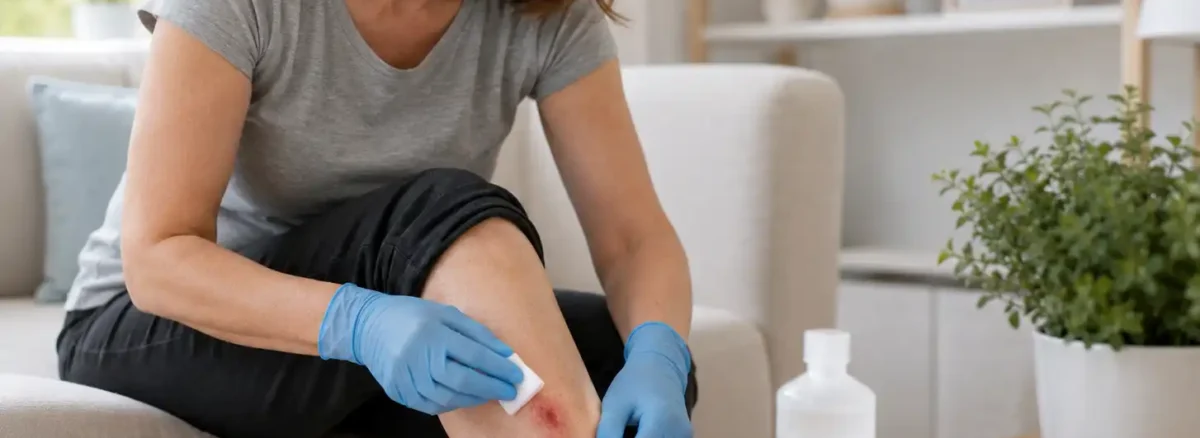
Wound care at home is one task repeated on a schedule: clean the wound, look at it, cover it again. Most families manage it perfectly well. The difficulty is rarely the technique. It is doing it alone on a Tuesday evening with nobody nearby to say whether what you are seeing is normal.
This guide walks through what the job actually consists of, why home care deliberately uses clean technique instead of sterile technique, the order a dressing change runs in, the thirty seconds of looking that make a caregiver genuinely useful to the clinic, the things outside the dressing that decide whether a wound closes, and the point at which something needs a phone call instead of another dressing.
On this page
- What wound care at home actually involves
- Clean, not sterile, and that is on purpose
- The seven steps of a dressing change
- The thirty seconds that make you useful
- The other twenty-three hours
- Signs that need a call today
- Setting up a routine that survives a bad week
- What to avoid
- The caregiver’s side of it
- When to get it seen
- Questions caregivers ask
- The takeaway
What wound care at home actually involves
Three jobs, in order of how often people get them wrong. Keep the wound clean and covered on the schedule you were given. Protect the skin around it, which fails more often than the wound itself. Notice change early, because you are the only person who sees this wound every day.
Everything else is arrangement. Somebody at the clinic decides what dressing goes on, how often it changes, and what the wound is being treated for. You carry that plan out between appointments. How much of it falls to the family varies a great deal: some people have a nurse visiting several times a week, some have a review visit every other week with the family doing every change in between, and some manage the whole thing themselves with a phone number for questions. Ask which arrangement you are in, because the answer changes how much you need to learn.
Establish two things on day one. Find out exactly what the dressing is called and where to get more of it, since running out mid-week is a common reason a change gets skipped. And get a phone number with the hours attached to it, so that a question at 7pm on Saturday has somewhere to go.
Clean, not sterile, and that is on purpose
Home dressing changes are usually done with clean technique, not the sterile technique used in an operating room. This surprises people, and it is one of the biggest sources of unnecessary anxiety in home wound care.
Clean technique means washed hands, clean gloves, fresh supplies straight from their packet, and a surface you have wiped down. It does not mean a sterile field. The National Library of Medicine’s home instructions for caring for an open surgical wound tell patients in plain terms to use a clean, not sterile, medical glove when taking an old dressing off.
The reasoning is straightforward once someone explains it. An open wound on a person’s leg is not a sterile environment and never was. It already carries bacteria from that person’s own skin, and it will carry them tomorrow too. The realistic aim at home is to avoid introducing anything new and to keep the amount of contamination low, which washed hands and unopened supplies achieve. Chasing sterility in a kitchen is not achievable and is not the standard you are being held to.
Some wounds and some procedures do call for sterile technique, and a clinician will tell you directly if yours is one of them. In the absence of that instruction, clean technique carried out consistently beats sterile technique attempted badly. What actually causes trouble at home is not the missing sterile field. It is hands washed once instead of twice, a dressing left on an extra two days, or a packet that has been sitting open on a shelf since the last change.
The seven steps of a dressing change
The order matters more than the speed. Working through it the same way every time is what stops steps going missing on the evenings when you are tired.
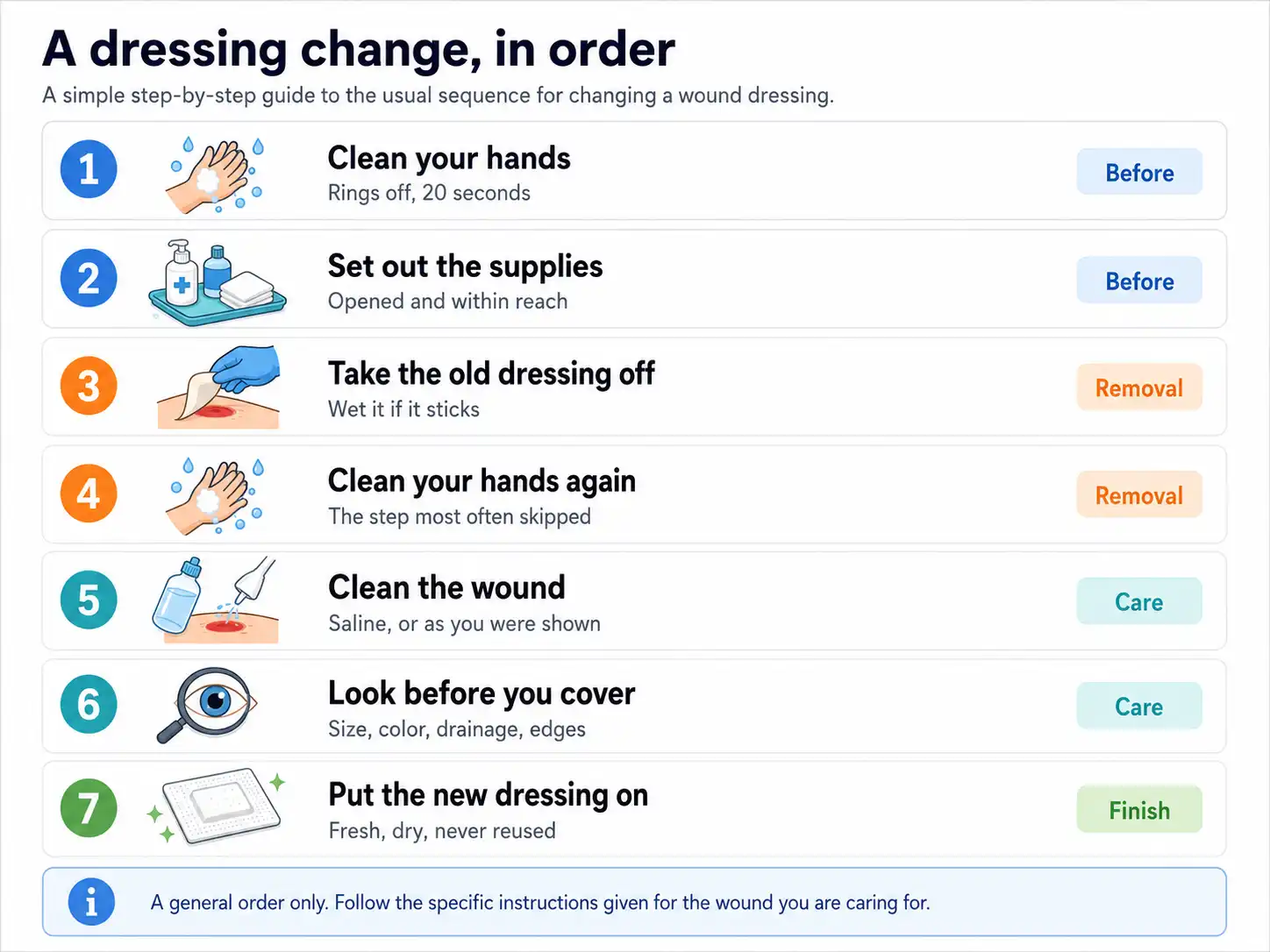
Hand washing bookends the whole thing, and the second wash is the one people drop. Twenty seconds of soap and warm water, rings removed, nails included, is the standard; an alcohol rub works when hands are not visibly soiled. The reason for washing again after removal is that the used dressing is the dirtiest object in the room, and you have just held it.
Laying supplies out first sounds fussy and saves a great deal of trouble. Open every packet you will need before you start, so that you are never reaching across an uncovered wound with a hand that has to open something. A dressing that sticks on removal can usually be loosened by wetting it, unless you were specifically told to take it off dry.
Cleaning is where the most damage gets done with the best intentions. Saline or mild soapy water is what most wounds want. Skin cleansers, alcohol, hydrogen peroxide, iodine and antibacterial soaps are specifically discouraged for routine home wound cleaning because they injure the cells doing the repair. If you were shown how to irrigate with a syringe, hold it a few inches from the wound and use enough pressure to carry away drainage, then pat the area dry with clean gauze.
The new dressing goes on exactly as you were taught, and some types need moistening first. Use each dressing once. The old one, the gloves and the used gauze go into a plastic bag that gets sealed and put inside a second bag before it reaches the trash, and anything the change has soiled goes through the wash separately from the household laundry. Whether a wound is covered at all is a clinical decision and not a matter of preference, a question our page on whether a wound should be covered takes apart in full.
The thirty seconds that make you useful
Step six is the one that changes outcomes, and it is the one no one is really trained in. A clinic sees this wound once a week or once a month. You see it every time it is uncovered, which puts you in the only position from which slow change is visible at all.
What you are doing is comparing today against last time, not against a textbook. Is the wound wider or narrower at its longest point? Is the base a different color? Is there more fluid on the old dressing than there was, or has it changed color or thickness? Does the smell survive cleaning? Is the skin around the edge sore, wet, white and soggy, or newly red? Is it hurting more than it did?
A photograph beats memory by a wide margin. Take one at the same point in the change each time, in the same light, from the same distance, with a ruler or a coin beside the wound for scale. Three photographs a week apart will settle an argument that four weeks of impressions cannot, and they give the clinician something concrete to work from. Write the date on your phone note alongside anything you noticed.
Pay particular attention to the border. Skin that sits against wound fluid for days becomes waterlogged, pale and fragile, and it breaks down in its own right, which enlarges the wound from the outside in. That process has a name of its own and a short list of remedies, which moisture-associated skin damage goes through. A dressing that is soaked through well before the next scheduled change is usually the wrong absorbency for the amount of fluid, and that is worth reporting.
The other twenty-three hours
A dressing change takes fifteen minutes. What happens in the remaining twenty-three and three quarter hours generally decides whether the wound closes, and families are seldom told this plainly.
Pressure is the clearest example. A wound on the sole of a foot that is walked on all day is being reinjured between every dressing change, and no dressing can outpace that. Taking the load off the wound is a treatment in its own right, and offloading a diabetic foot ulcer makes that case at length. The same principle governs wounds over the tailbone, hip or heel in someone who is in a bed or a chair for most of the day, where regular position changes and the right support surface do the work. Preventing bedsores deals with the practicalities.
Swelling is the next one. A leg that stays down all day fills with fluid, and fluid under pressure keeps a wound open. Elevation helps, and compression helps a great deal in the specific circumstances where it is appropriate, though compression can be harmful when circulation is poor and it should only be used when a clinician has assessed the leg and prescribed it.
Then there is the raw material. Building new tissue requires protein, calories, fluid and a range of nutrients, and appetite in an older or unwell person is often the first thing to go. Blood glucose control affects healing directly in people with diabetes. Smoking narrows the small vessels feeding the wound bed. None of them shows anything visible within a week, and that is exactly why they lose out to the dressing, where the effort at least feels productive.
Signs that need a call today
Most changes in a wound are slow and can wait for the next appointment. A short list cannot.
Contact the care team the same day for a raised temperature of 100.5°F or above alongside the wound, redness that is traveling outward from the edge, pain that is climbing when it had been settled, drainage that has suddenly increased or turned thick and tan, green or yellow, a bad smell that is still there after cleaning, or a wound that has visibly grown, deepened or darkened since the last change. Feeling suddenly and generally unwell counts on its own, particularly in an older person, where confusion or unusual drowsiness can appear before any obvious fever.
Redness spreading quickly, severe pain out of proportion to the wound, or someone who is shivering, confused or clearly deteriorating needs emergency assessment, not a message left for the morning. For the wider pattern, and for what separates a wound carrying bacteria from one that has become infected, read how to tell if a wound is infected.
Balance that list against the ordinary case. A wound that looks much the same as it did last week, with unchanged pain and drainage, is not an emergency and is not evidence that you are doing it wrong. Chronic wounds move slowly. Direction over a month tells you more than any single evening’s look.
Setting up a routine that survives a bad week
Home wound care fails at the logistics far more often than at the technique, so the setup deserves real thought at the start.
Keep everything in one box, somewhere dry, away from the bathroom where humidity gets into packaging. Reorder when the box is a third empty instead of when it is empty, because supply gaps and skipped changes tend to arrive together. Put the schedule in writing on the fridge, with the dressing name and the days marked, so that the plan does not live only in one person’s head.
Teach a second person. One caregiver with flu, a work trip or a hospital appointment of their own is otherwise enough to interrupt a wound’s treatment for a week. Have the phone number, the hours, and the out-of-hours instruction written on the same sheet as the schedule.
If the timing is genuinely impossible, say so at the next appointment. Dressing frequency is not fixed by nature. Some modern dressings are designed to stay in place for several days, and moving from a daily change to twice a week is a legitimate clinical option where the wound allows it. A dressing that is being changed on schedule three times a week beats a daily plan that is missed half the time.
What to avoid
Keep the household antiseptics out of it. Hydrogen peroxide, rubbing alcohol, iodine, bleach solutions and antibacterial hand soap all kill the new cells rebuilding the wound bed as efficiently as they kill bacteria, and a wound with fewer working cells heals more slowly, not faster.
Do not add creams, lotions, ointments, powders or herbal preparations that were not prescribed for this wound. Products that are perfectly good on intact skin behave differently in an open wound, and some interfere with the dressing that is already doing a job.
Never reuse a dressing, cut a larger one down to size unless you were shown to, or stretch supplies by leaving a dressing on longer than instructed. Do not cut, scrape or pick at dead tissue in the wound, however loose it looks; removing it is a clinical procedure with several methods and a reason for choosing between them, the gentlest of which autolytic debridement walks through day by day.
Try not to put adhesive tape down on the same strip of skin every single time. Fragile skin gives way under repeated tape removal, and a tape injury beside a healing wound is an avoidable second wound. And do not sit on a change you have noticed because an appointment is coming up in nine days. The appointment can be moved.
The caregiver’s side of it
Very little wound care advice acknowledges what this is like for the person doing it, and the omission is strange, because the caregiver’s capacity is one of the variables the outcome depends on.
The schedule takes over the week. Plans get arranged around dressing times, and a daily change makes a weekend away complicated. Many caregivers describe the hardest part as causing pain to someone they love, and the flinch at step three is genuinely difficult to get used to. There is often a private fear of having done something wrong, which grows every week the wound fails to shrink. And a wound that leaks or smells shrinks the household’s social life quietly, usually without anyone naming it.
Chronic wounds stall for reasons that live in circulation, pressure, infection and underlying illness, and a wound that is not closing is very rarely the caregiver’s doing. When the load has become unsustainable, the clinical team needs to hear that as a fact about the treatment plan, not as a confession. Home nursing visits, a longer-wear dressing, a change to the schedule and respite arrangements exist, and none of them can be offered to a family that has not said it is struggling.
Ask about pain relief timed before a dressing change, too. Taking regular pain medication half an hour beforehand is a normal and reasonable request where changes are painful, and it makes the whole routine easier to sustain for both people.
When to get it seen
Book a review if the wound has grown, if drainage has increased or changed character, if pain has risen, if the surrounding skin is breaking down, or if the dressing is soaking through well before it is due to be changed.
A wound that has been open for a month with no meaningful progress justifies a specialist opinion on its own, whatever the home routine looks like. Wounds that stay open past that point usually have a specific obstacle behind them, and identifying the obstacle is a different task from changing the dressing more carefully. Knowing when a wound can stop being covered altogether is a separate question, taken up in when to stop covering an open wound.
Fever, fast-spreading redness, rapidly worsening pain or sudden confusion in an older person needs same-day medical attention.
Questions caregivers ask
Can a family member manage wound care at home without a nurse?
Often, yes, for straightforward wounds and once someone has been shown the routine in person. Complex wounds, deep wounds needing packing, and wounds that are being actively treated for infection usually need a clinician involved at least some of the time. The clinic managing the wound decides which category applies, and that decision can change as the wound does.
Do I need sterile gloves to change a dressing?
Usually not. Clean gloves and properly washed hands are the standard for most home dressing changes, and patient instructions from national health libraries say so explicitly. Certain wounds and procedures call for sterile technique, and you will be told directly if yours is one of them.
What should I clean a wound with at home?
Sterile saline or mild soapy water covers most situations, unless a specific cleanser has been prescribed. Hydrogen peroxide, alcohol, iodine and antibacterial soaps are discouraged for routine cleaning because they damage the cells doing the healing. Check what was recommended for this particular wound before substituting anything.
How often should a dressing be changed at home?
It depends entirely on the dressing and the wound. Some are built to stay put for several days and do their job less well if disturbed daily; others need changing every day, or whenever they become saturated. Follow the interval you were given, and ask for it to be revisited if the dressing is consistently soaking through early or staying dry for days.
What do I do if the dressing is stuck to the wound?
Moisten it with saline and wait a moment before easing it off, unless you were told to remove it dry. Pulling a stuck dressing away tears out new tissue and sets the wound back. If it happens at every change, the dressing type is probably not right for this wound and the team should know.
Can I shower with a wound?
Frequently yes, though it depends on the wound, the dressing and how recent any surgery was. Some dressings are waterproof, some need covering, and some wounds are better cleaned during the shower. Ask about this specific wound instead of assuming either way, since both unnecessary avoidance and soaking a dressing that was not built for it cause problems.
The takeaway
Wound care at home comes down to a consistent routine, clean technique carried out the same way every time, and a caregiver who looks properly before covering the wound back up. Sterility is not the target and never was, which removes a good deal of the fear people bring to it.
The dressing is the visible part of the work and rarely the decisive one. Pressure kept off the wound, swelling controlled, enough protein on the plate and glucose in range are what let a wound close, and they happen between changes. Watch for the short list of changes that need a call the same day, keep the supplies and the schedule somewhere robust, and tell the team when the routine has become more than the household can carry.
Not sure the routine at home is working?
A review can check the wound, confirm the dressing suits how much fluid it produces, and adjust how often it needs changing. Bringing photographs and your notes makes that appointment considerably more useful.
Where traveling to a clinic is difficult, our mobile and home health wound care service brings the assessment to the patient, and longer-standing wounds are managed through chronic wound treatment.
This article is general education and does not replace the instructions given for a specific wound. Follow the dressing plan supplied by the treating clinician, and contact the care team promptly if the wound changes, if fever develops, or if the routine at home has stopped being manageable.