
How to tell if a wound is infected comes down to a question no single glance can answer: which way is it heading? Redness, warmth, swelling and soreness all turn up in wounds that are healing exactly as they should. What separates ordinary repair from infection is timing and direction: when those changes appeared, and whether they are settling or building.
Most of the confusion traces back to a list. Almost every source names redness, heat, swelling, pain and drainage as the signs of infection, and a normal wound on day two has every one of them. This guide sets out what actually distinguishes inflammation from infection, a pen-and-clock check that resolves most worries at home, the seven signs and what each is really telling you, the whole-body changes that carry more weight than anything visible on the skin, the situations where the classic signs never appear at all, and the point at which a wound stops being something to watch and becomes something to report.
On this page
- Is the wound infected, or is this normal healing?
- Why the usual list of signs misleads
- The check that settles most of it
- Seven signs, and how to read each one
- The signs that outrank the wound itself
- When the usual signs never show up
- Bacteria on a wound is not an infection
- What you can do
- What to avoid
- Living with the not knowing
- When to get it seen
- Common questions
- The takeaway
Is the wound infected, or is this normal healing?
In the first two or three days, redness, warmth, swelling and tenderness around a wound are expected. They are the visible part of inflammation, which is the opening phase of repair and not a complication of it.
Once skin is broken, the small blood vessels around the injury widen and become leaky. Blood flow to the area climbs, and fluid carrying immune cells moves out into the surrounding tissue. That extra traffic produces the four things people notice: color, heat, puffiness and tenderness. A wound showing none of it would be a wound that had not started healing.
The difference between healing and infection shows in the shape of the curve. Ordinary inflammation appears within hours, reaches its peak somewhere around the second or third day, then eases a little more each day after that. An infection generally does one of three other things. It begins late, once matters had already started to settle. It keeps intensifying past the third or fourth day. Or it reverses a wound that had been visibly improving.
Inflammation that is easing by about the third day is behaving normally. Signs that start after that point, keep growing past it, or return once they had faded are the ones to report.
That timeline fits fresh injuries: a surgical incision, a deep cut, a graze, a burn. A long-standing ulcer has no day three to measure against. There the comparison is with the wound’s own recent baseline: how it looked, how much it drained and how it felt a week ago.
Why the usual list of signs misleads
Redness, heat, swelling and pain are the textbook description of inflammation. They were catalogued as the signs of tissue reacting to injury long before anyone knew bacteria existed, and they appear whether or not an infection is present. Presenting them as the signs of infection describes something that every healing wound already has.
What the list leaves out is quantity, distance and duration.
A band of pink extending a few millimeters from the edge of an incision is ordinary. Redness reaching an inch or two out into the surrounding skin, and still moving outward the next time you look, is not. The presence of color settles nothing. Its extent and its direction settle a great deal.
Drainage follows the same logic. A wound producing thin, clear or pale straw-colored fluid in the first days is doing what wounds do, and that fluid carries the cells performing the repair. The change to notice is in character and volume: fluid that thickens, turns opaque, takes on a cream, green or gray cast, or suddenly increases after several days of tapering off.
Pain follows the cleanest pattern of the four and gets discounted the most often. Discomfort from a wound should be worst early and a little better each day. Pain that is worse on day five than it was on day three is unusual enough by itself to justify a phone call, even when the wound looks unremarkable.
The check that settles most of it
Draw a line around the edge of the redness with a pen, and write the time beside it.
Look again four to six hours later. If the redness has stayed inside the line, or pulled back from it, the response is contained and settling. If it has crossed the line, and particularly if it crossed in the space of a few hours, that is spreading, and spreading redness is one of the very few signs that carries real weight on its own.
None of this is a home improvisation. Marking the border of a red area and noting the time is what clinicians do when watching a possible skin infection, for the same reason a patient should: memory is unreliable about something you look at ten times a day, and a line drawn on skin is not.
Pair the mark with a day count. Work out which day of the wound you are on, then ask whether what you see fits it. Day two with a warm pink rim is a wound behaving normally. Day six with a rim that has doubled is a different conversation entirely.
Direction across two or three days tells you more than the worst-looking moment. A wound moving the wrong way deserves a call even while it still looks mild.
A photograph helps for the same reason, provided the conditions match. Same light, same distance, same angle, once a day. Two photos taken in different lighting will disagree with each other and prove nothing to anybody.
Seven signs, and how to read each one
No single sign settles the question. Clinicians weigh several together, alongside how the wound has behaved since they last saw it.
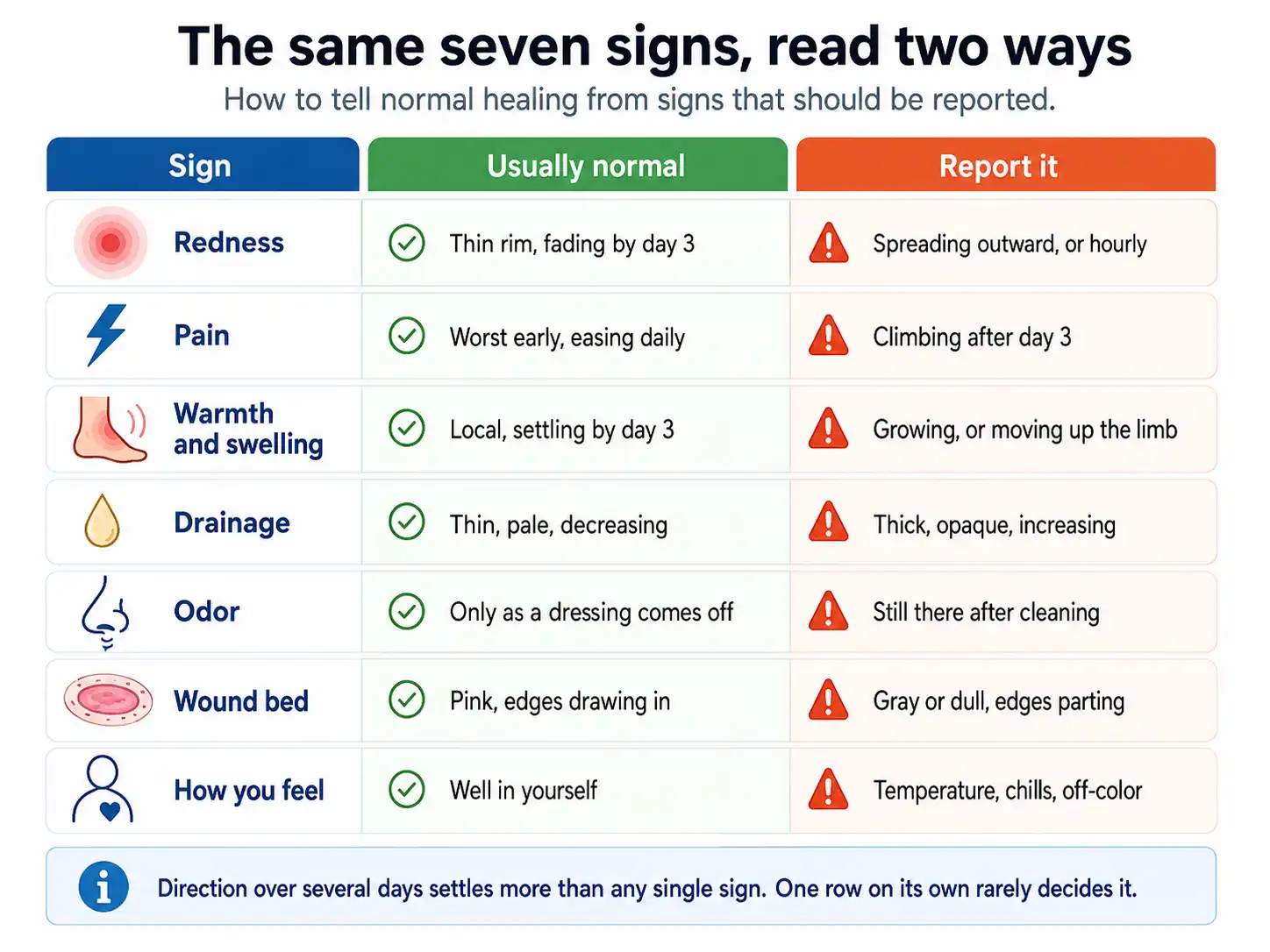
Redness, warmth and swelling behave as a group, since they share one cause. Judge them on reach and on trend. Redness creeping up a limb, or thin red lines running from the wound toward the groin or the armpit, suggests infection traveling along the lymph channels and needs assessment the same day.
Pain deserves one addition to what was said above. Discomfort far out of keeping with how a wound looks is taken seriously by clinicians even when nothing else has changed, because several of the more serious infections announce themselves through pain long before anything appears on the surface.
Drainage and odor are the two most commonly misread. Pus is thick and opaque, cream, yellow, green or brown, and it wipes away. Slough is a soft yellow or tan layer stuck to the wound base that does not wipe away; it is dead tissue, extremely common in wounds that have been open a while, and it is not pus. Mistaking one for the other sends a great many people to an appointment convinced that a stable wound is full of infection.
Odor is judged after cleaning, never at the moment a dressing comes off. Dressings that turn to gel as they absorb fluid produce a sour smell of their own, and fluid held at skin temperature for a day or two will smell whatever the wound underneath is doing. Clean the wound, give it a moment, then check again. A smell that survives that is coming from the wound.
The wound bed is the slowest of the seven and among the most reliable. A healing wound gets smaller, its edges draw inward, and its base stays pink or red and slightly bumpy. A wound whose edges have begun to separate, whose base has turned gray or dull, or that has simply stopped changing for weeks, is telling you something even while the skin around it stays calm.
The signs that outrank the wound itself
How you feel in yourself carries more weight than how the wound looks.
A raised temperature, shivering or teeth-chattering shakes, a racing pulse, appetite gone, aching all over, or simply feeling unwell in a way you cannot place. Any of these alongside a wound suggests the response has stopped being local. Mentioned together with the wound, they change the urgency completely.
Two versions of this get missed regularly. In older adults, infection often shows up as sudden confusion, unsteadiness or a fall, with no temperature at all, and a temperature below normal can be as meaningful as one above it. In someone with diabetes, blood glucose that becomes unexpectedly hard to control, without any change in food or medication, is a recognized early clue that an infection is developing somewhere, and it sometimes appears before the wound looks any different.
When an infection reaches the bloodstream and the body’s reaction begins to injure its own organs, that is sepsis. It is uncommon from a small wound, and it is a medical emergency whenever it does happen. MedlinePlus, the patient service run by the National Library of Medicine, describes the warning signs of sepsis in ordinary language.
A temperature or shivering alongside a wound, redness expanding by the hour, red lines tracking away from it, or sudden confusion in an older person all need medical attention the same day.
When the usual signs never show up
The classic signs depend on a working blood supply, working nerves and a working immune response. Remove any one of those and an infection can advance while the wound stays quiet.
Poor arterial circulation takes away the most visible signs first. Redness, heat and swelling all require blood to be delivered to the area, and a leg or foot fed by badly narrowed arteries cannot deliver much of it. A wound on that limb can be seriously infected and still look pale, dry and undramatic. Wounds caused by inadequate arterial flow have their own appearance and their own rules, described on our page about arterial ulcers.
Nerve damage takes away pain, which is the earliest and most sensitive warning most people get. Someone with neuropathy, nerve damage that dulls sensation, can walk around on an infected foot wound and feel nothing at all. Where the infection has reached the bone underneath, the surface often stays deceptively ordinary, a pattern examined closely in osteomyelitis in a foot ulcer.
Medication and illness can blunt the response too. Corticosteroids, chemotherapy, the drugs taken after a transplant, and poorly controlled diabetes all reduce how loudly the body reacts to invasion. The infection is no less real; the alarm is simply quieter.
Anyone in those groups should hold a lower threshold for asking, and the quieter signals carry more weight for them: a wound that has stopped progressing, drainage that has increased, a new smell after cleaning, glucose drifting upward, or a general sense of being off-color with no obvious cause.
Bacteria on a wound is not an infection
Every open wound has bacteria on it within hours. Skin is not sterile, air is not sterile, and no dressing changes that.
A wound that has been open for weeks carries a settled population of organisms, sometimes organized into a biofilm, a thin, slippery community that anchors itself to the wound surface and resists both the immune system and topical treatments. That state is called colonization, and on its own it neither stops a wound healing nor makes anyone unwell.
Infection differs in two specific ways: the bacteria are multiplying into living tissue, and the body is mounting a reaction that is causing damage. Presence is not the test. Invasion and harm are.
The practical consequence catches people out. A swab that grows bacteria is not by itself a diagnosis, because a swab taken from almost any chronic wound will grow something. Clinicians read a culture alongside the examination, which is why swabs are not taken at every visit and why a positive result does not automatically produce a prescription. Antibiotics given for colonization do nothing useful for the wound and add to the wider problem of resistance.
Between the two sits a state clinicians watch for closely: a wound with no obvious redness and no temperature that has nonetheless stalled, bleeds at the slightest touch, produces more fluid than it used to and has turned newly painful. That combination in a long-standing ulcer is often treated as local infection without any of the classic picture. It shows up frequently in venous leg ulcers, where the wound bed is never sterile and the question is always one of degree.
What you can do
Keep a record instead of a running commentary in your head.
Mark the redness and date the mark. Take one photograph a day in the same light. Use a thermometer instead of estimating a temperature from how warm you feel. Note when each change started and which day of the wound it was. Five minutes of that gives a clinician far more to work with than a description assembled from memory, and it gives you something concrete to check against tomorrow.
Clean the wound and change the dressing exactly as you were shown, on the schedule you were given. A dressing left an extra two days because the wound seemed fine is one of the more common routes from a manageable problem to a visible one.
Support the things the body needs for the job. Blood glucose held in the range your diabetes team advises makes a measurable difference to how well immune cells work. Enough protein in the diet matters for tissue repair. Stopping smoking improves the blood supply reaching the wound, and blood supply is the delivery route for everything else.
Where the wound sits on a leg or a foot, follow whatever elevation or pressure-relief advice you were given. Fluid pooling in a limb and unrelieved pressure on a wound both slow healing, and a wound that is not closing gives bacteria more time and more room.
Report changes as they happen. A wound that has moved the wrong way does not become easier to treat by waiting for the appointment already on the calendar.
What to avoid
Do not pour hydrogen peroxide, rubbing alcohol or undiluted antiseptic into a wound to kill an infection. These damage the new cells doing the repair, they do not reach bacteria that have already moved into tissue, and a wound left with fewer working cells heals more slowly for the trouble.
Do not start antibiotics left over from an earlier course. The dose is wrong, the drug may not cover what is actually growing, a partial course encourages resistance, and a half-treated infection is considerably harder for a clinician to interpret a few days later.
Do not squeeze, press or open a wound to force pus out of it. Pressure applied to infected tissue can drive bacteria along the planes between tissues and into areas that were not involved before.
Do not answer a worsening wound by covering it more heavily and looking at it less often. The impulse makes sense and it removes the only monitoring available.
Do not judge by a photograph taken in different light from the last one, and do not assess redness straight after a hot shower, when ordinary skin is flushed anyway.
Do not stay quiet because you suspect you are overreacting. Reporting a change that turns out to be nothing is a normal and expected part of managing a wound.
Living with the not knowing
The uncertainty is a problem in its own right, and it rarely gets mentioned.
People check a wound eight or ten times a day, take their temperature repeatedly, lose sleep, and search the same questions at two in the morning against photographs that never quite match their own. Others go the opposite way and stop looking at the wound altogether, because looking makes it real. Both patterns are common, and neither produces a better outcome.
A daily routine helps more than constant vigilance. One look, one photograph, the pen mark checked once, and then the wound is left alone until tomorrow. That turns an open question into a record, and a record is what makes a change obvious the moment it happens.
There is a social cost as well. People with a wound that might be infected cancel plans, avoid pools and gyms, and worry about being around grandchildren. A wound infection is generally not passed on through everyday contact, and washing hands before and after handling a dressing is the precaution that counts.
Anyone managing a long-term wound also runs into fatigue from false alarms. Several reports that came to nothing can make a person stop mentioning things, which is precisely the moment a real change slips past. Care teams would far sooner assess ten wounds that turn out fine than meet the eleventh a week late.
When to get it seen
Seek medical attention the same day for a temperature or shivering alongside a wound, redness expanding while you watch it, thin red lines running from the wound up a limb, pain climbing quickly, or new confusion or unsteadiness in an older person.
Go to an emergency department for pain that is severe and far out of keeping with how the wound looks, particularly with skin turning dusky, gray or blistered, or with swelling advancing rapidly. That combination is uncommon, and it does not wait.
Anyone with diabetes should treat a foot wound differently from a wound anywhere else. New redness, swelling, drainage or any other change in a foot wound warrants prompt assessment, because the usual warning signs are so often muted.
Arrange an appointment within a day or two for drainage that has thickened or increased, a smell that persists after cleaning, a wound bed that has changed color, edges that are separating, or any of the seven signs moving the wrong way across consecutive days.
Book a review for any wound open more than four weeks without clear progress, whether or not infection is suspected. A wound that will not close has a reason behind it, and finding that reason is the purpose of a specialist assessment.
Common questions
How soon would a wound show signs of infection?
Most often between two and five days after the injury, though it varies with the wound and with the organism involved. Changes appearing in the first 24 to 48 hours are more likely to be ordinary inflammation. Changes that begin after the third day, or that arrive once a wound had started to improve, are the ones that raise the question.
What does an infected wound look like?
There is no single appearance, which is why the question is so hard to answer from a photograph. Common features include redness spreading outward past the wound edge, swelling and warmth that keep increasing, thick opaque drainage, a wound bed that has gone from pink to gray or dull, and edges that are separating. Each of these carries more meaning when it is new or growing.
Can a wound be infected without any pus?
Yes, and it happens often. Deep infections, infections in a limb with a poor blood supply, and bone infection beneath an ulcer can all occur with little or no visible discharge. The absence of pus does not rule infection out.
Is a yellow layer in the wound a sign of infection?
Usually not. A soft yellow or tan layer stuck to the wound base is most often slough, which is dead tissue and not pus. Slough does not wipe away and is normal in wounds that have been open a while. Pus is thicker, sits on the surface and can be wiped off.
Should I put antibiotic ointment on it?
For a small, clean household wound, an over-the-counter antibiotic ointment used according to its directions is a reasonable option. It has no useful role on a chronic wound or a surgical incision unless a clinician has specifically advised it, and it will not treat an infection that has already moved into tissue. Follow whatever dressing plan you were given for the wound you actually have.
Is an infected wound contagious?
Generally not through everyday contact. Some wound bacteria can pass to another person through direct contact with the wound or with a used dressing, so washing hands around dressing changes and disposing of old dressings properly makes sense. Living alongside someone who has an infected wound is not a risk in itself.
The takeaway
How to tell if a wound is infected has less to do with spotting a particular sign than with reading the direction of travel. Redness, warmth, swelling and pain all belong to normal healing in the first few days. The versions that matter start later, reach further, or keep building at the point where they should be fading.
Two habits do most of the work: mark the edge of the redness with a pen and a time, and take one photograph a day in the same light. Everything else becomes easier once there is something to compare against.
How you feel in yourself outranks how the wound looks. A temperature, shivering, sudden confusion in an older person, or glucose that has become hard to control all belong in the same phone call. And where circulation is poor, nerves are damaged or the immune response is suppressed, the familiar signs may never arrive at all, which makes a stalled wound, a new smell or heavier drainage than last week the signals to act on.
Not sure whether a wound has become infected?
An assessment can separate inflammation from infection, work out what is keeping the wound open, and establish whether antibiotics are the right answer or the wrong one.
Assessing a wound that may be infected sits within our chronic wound treatment service, along with identifying whatever has kept the wound from closing.
This article is general education and does not replace a clinical assessment. No description can confirm or exclude infection in a specific wound; that takes an examination. Contact a healthcare professional about any wound that is changing for the worse, and seek same-day care if a temperature, expanding redness or fast-climbing pain appears alongside it.