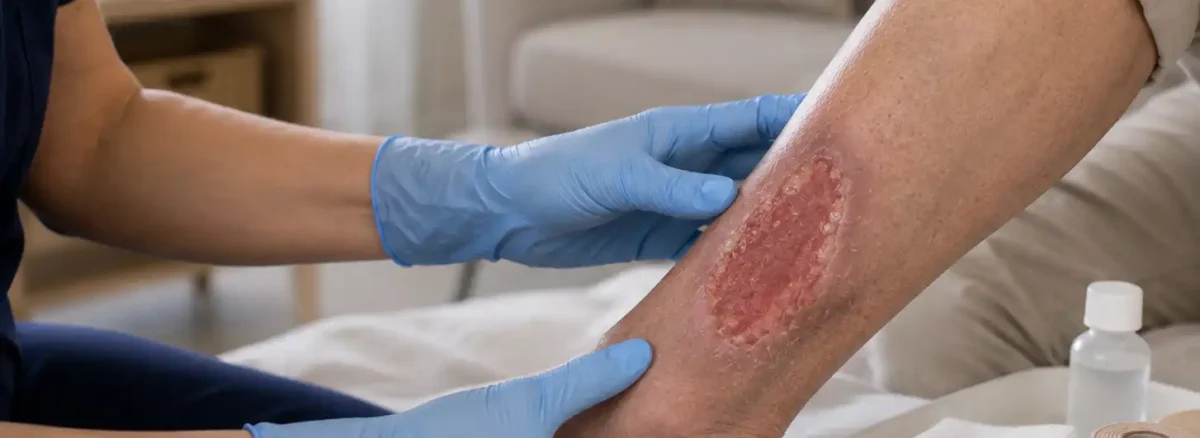
Why won’t my wound heal? Because something is holding it back, and that something is usually not in the wound itself. A wound not healing on schedule is rarely a wound that needs more patience. It is a wound with a barrier sitting behind it, and the whole job of treatment is working out which barrier.
That reframing matters at home, because it changes what you should be asking for. This guide covers the difference between slow and stalled, the measurement that tells the two apart, the six barriers responsible for most cases, the one that almost nobody has explained to you, and the point at which a stalled wound stops being a nuisance and starts being a warning.
On this page
- Why won’t my wound heal?
- Slow and stalled are different problems
- The four-week clock, and what beats it
- Six barriers that keep a wound open
- The film on the wound bed nobody mentions
- When a stalled wound points to something serious
- What actually moves a stalled wound
- Habits that keep a wound open
- Living with a wound that will not close
- When to have a stalled wound assessed
- Questions about wounds that will not heal
- The takeaway
Why won’t my wound heal?
Because repair has been interrupted by something specific. Healing is not a passive process that runs on its own given enough time. It is an active build that needs oxygen delivered to the site, a wound bed clear enough to build on, freedom from repeated damage, and a body with the raw materials to do the work. Take away any one of those and the build stops, however good the dressing on top of it is.
The barriers responsible fall into two groups, and the distinction is more useful than any list. Local barriers sit in or immediately around the wound: dead tissue, bacterial load, pressure, swelling, moisture. Systemic barriers sit in the person: circulation, blood glucose, nutrition, certain medicines, smoking. A wound not healing after weeks of careful dressing changes almost always has a barrier in the second group, which is exactly why more careful dressing changes do not fix it.
Most wounds carry more than one. A foot ulcer can be under pressure, short of blood supply and loaded with dead tissue at the same time, and clearing two of the three still leaves it open. Assessment exists to find all of them, not the first one that presents itself.
Slow and stalled are different problems
These get treated as the same complaint and they are not remotely the same. A wound that is getting smaller every week, just less quickly than you hoped, is healing. That is a timeline question, and the answer is usually to keep going. A wound that is the same size it was three weeks ago is stalled. That is a barrier question, and waiting will not answer it.
The reason the difference is invisible at home is that repair happens in overlapping stages, and the stalled wound gets stuck in one of them. Bleeding stops first. Then comes an inflammatory stage, where the body floods the site to clear debris and bacteria, which is why a fresh wound is red, warm and sore for a few days. Then new tissue fills the gap from the base upward. Then months of quiet strengthening.
A chronic wound is typically one that never leaves the inflammatory stage. The cleanup phase keeps running because there is always something new to clean up, and it never hands over to the building phase. The wound stays wet, stays inflamed, and sits there looking active without producing anything.
You can sometimes see this at the wound edge. In a healing wound, the rim of new skin creeps inward as a thin pale border. In a stalled one, that edge stops advancing and can thicken, harden or curl under itself, leaving a raised lip around a bed that goes nowhere. A wound whose edges look rolled and callused instead of flat and pale has usually been stuck for a while.
The four-week clock, and what beats it
Four to six weeks is the ordinary span for a wound to close, and one that runs past it without closing is what clinicians mean by a chronic wound. That range, along with the list of factors known to interfere with repair, is set out by the National Library of Medicine in its clinical reference on how wounds repair.
The calendar is a blunt instrument though, and on its own it will let a wound drift. A large surgical wound at six weeks may be entirely on track. A small graze at three weeks that has not budged is already in trouble. Age tells you when to start worrying. It does not tell you whether this particular wound is moving.
Measurement does. Record the wound’s length and width at its widest points, the same way each time, and write the numbers down with the date. Once a week is enough. A photograph taken from the same distance and angle, with a ruler or a coin lying flat beside the wound for scale, is worth as much as the numbers and takes ten seconds.
A wound that has not measurably shrunk across two to three weeks of appropriate care is stalled, whatever its age. That is the sentence to act on. It converts a vague worry into something you can put in front of a clinician, and it is far harder to wave away than a feeling that things are not progressing.
The measurement also protects you against the opposite error. Wounds that are healing properly often look worse for a week or two while dead tissue lifts away, and the numbers will show the area shrinking even while the wound bed looks messier than before.
Six barriers that keep a wound open
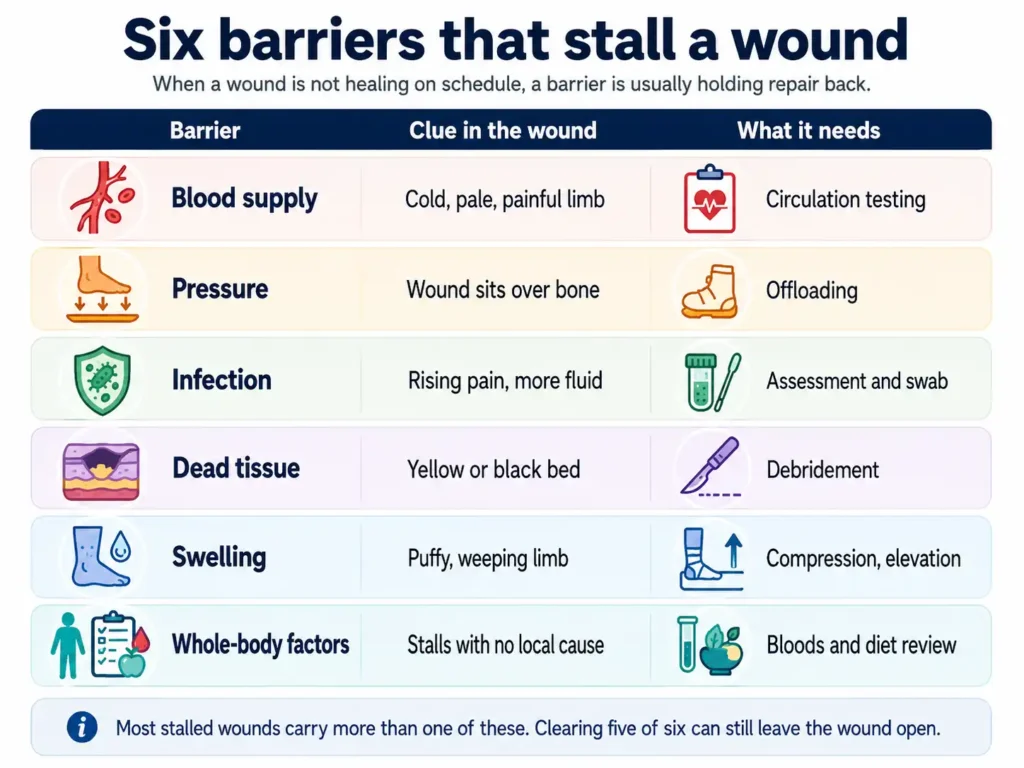
Six barriers account for the large majority of stalled wounds. Each one has a characteristic clue and a specific fix, and none of the fixes is a better dressing.
Blood supply
This is the barrier that overrides all the others, because tissue that cannot get oxygen cannot build anything. Suspect it when a leg or foot feels cool, the skin looks thin and shiny with little hair, pain settles at night and eases when the leg hangs over the edge of the bed, or a wound on the toes or outer ankle is unusually painful for its size. It is measured, not guessed, and the first test is normally an ankle-brachial index reading. A leg being redressed month after month with nobody having checked the pressures is a reasonable thing to query.
Pressure and repeated damage
New tissue is fragile, and a wound that gets loaded every day has its week’s progress undone every day. That accounts for most ulcers under the ball of the foot or the heel, and for pressure injuries over the tailbone or hip. Taking the load off the site does more than any product applied to it, which is the argument set out in our guide to pressure relief for diabetic foot ulcers. Friction and shear count too, so a heel dragging on a sheet or a shoe rubbing an edge belongs in the same category.
Infection and bacterial load
Every open wound has bacteria living on it and most cause no trouble at all. The problem starts when the number or the aggression of those bacteria outpaces what the body can hold down, at which point resources go into fighting instead of building. Classic infection announces itself with climbing pain, spreading redness, heat and heavier drainage, and the full set is laid out in the seven signs of an infected wound. A quieter version simply stalls the wound with none of that on display, which is the subject of the next section.
Dead tissue in the wound bed
New tissue cannot grow across dead tissue, so a bed covered in soft yellow slough or hard black eschar is physically blocked. Dead tissue also feeds bacteria and holds inflammation open. Clearing that layer away is called debridement, and the slowest form of it works quietly under a dressing across a week or more, which is the subject of our piece on debridement using the body’s own enzymes. Reading the bed correctly matters here, since not everything that looks alarming is dead, and our guide to the colors of a healing wound covers how to tell.
Swelling
A limb that stays swollen holds fluid under pressure in the tissue, and that pressure squeezes the small vessels feeding the wound edge. It also keeps the surrounding skin permanently damp, which breaks it down and enlarges the wound from the outside in. Compression is the usual answer for leg swelling and does most of the work in venous leg ulcers. It is not automatically right for every leg wound though, and applying firm compression to a leg with a poor arterial supply can cause real harm, which is why the circulation gets measured first.
Whole-body factors
Blood glucose running high impairs the immune cells that clear a wound and the vessels that supply it. Too little protein leaves the body without the material for new tissue, and our article on what a wound needs from food sets out which nutrients do what. Smoking narrows vessels and lowers the oxygen the blood can carry. Steroids taken long term suppress the inflammatory step that healing depends on, and several other medicines can slow repair, though none of them should be stopped without speaking to whoever prescribed them.
The film on the wound bed nobody mentions
Here is the barrier that explains most of the wounds that make no sense. Bacteria in a long-standing wound can stop behaving as individual organisms and build a shared slime layer over the surface, which shields them from the immune system and from antibiotics. This is called a biofilm, and it is a recognized reason wounds fail to progress.
What makes it so frustrating is that it does not look like infection. There may be no fever, no spreading redness and no pus. The wound simply refuses to move, and every test that gets ordered comes back unremarkable. Underneath, the film keeps the wound locked in the inflammatory stage and creates a low-oxygen pocket over the bed, which is precisely the environment healing cannot happen in.
The clues are indirect. A thin shiny or slippery layer that reforms across the wound within a day of cleaning, granulation tissue that looks dull and boggy instead of firm and beefy, more fluid than the wound’s size would explain, and a stall that has resisted an otherwise sensible plan. None of those confirms anything by itself, and a clinician weighs them together.
It also explains why a course of antibiotics so often changes nothing. The film is largely what antibiotics cannot reach. Management leans on physically disrupting it instead, through cleaning the wound more vigorously than a gentle rinse and through repeated debridement, sometimes paired with a dressing chosen to discourage it from reforming. If your wound has stalled and nobody has raised this, it is a fair thing to ask about by name.
When a stalled wound points to something serious
Most wounds that will not heal are stuck, not dangerous. A few are signaling something that needs finding.
A wound sitting directly over bone that keeps reopening in the same spot, or one deep enough that a probe reaches something hard at the base, raises the question of infection having reached the bone itself. Signs that a wound has reached the bone covers what raises that suspicion and how it gets confirmed, and the answer redirects the whole plan. A wound that has been treated for months as one type when it was always another is a second possibility, and telling the three main kinds of leg ulcer apart changes what gets prescribed.
Uncommonly, an ulcer open for years can change character, developing heaped or rolled edges, tissue that bulges above the skin surface, or a surface that bleeds at the lightest touch. Any long-standing wound that starts behaving differently from how it behaved for the previous year should be looked at instead of being absorbed into the routine.
Fever, uncontrollable shivering, redness pushing out past the wound margin, pain that escalates hour by hour, or feeling ill out of all proportion to the wound calls for same-day medical attention. Those point at infection that has moved past the wound, and they do not wait for a scheduled appointment.
What actually moves a stalled wound
Reassessment, first and above everything else. If the plan has not changed in a month and neither has the wound, the plan is the thing that needs attention. Repeating a treatment that has already demonstrated it does not work is the most common way months disappear.
A proper reassessment works through the barriers in order. Circulation gets measured. The wound bed gets cleared of dead tissue. Pressure gets taken off, or compression gets applied where the arterial supply allows it. Swelling gets addressed at its cause, which is often not the leg. Blood glucose, protein intake and current medicines all get reviewed. A swab may be taken where infection is genuinely suspected, though a swab from a wound with no signs of infection mostly returns bacteria that were never the problem.
Your own contribution is larger than it looks. The weekly numbers give everyone something objective to argue from. Changing dressings on the schedule you were given, using the technique you were shown, removes a variable that otherwise clouds everything, and our guide to a safe dressing change at home covers the routine. Eating enough protein, keeping glucose in the range you have agreed, and stopping smoking all act on real barriers, not imagined ones.
Where the basics have been properly optimized and a wound still will not close, there are further options a specialist service may consider, including therapies that apply controlled suction to the wound and skin substitute products. These are not first steps and they are not right for everyone, but their existence is a reason to ask for a specialist opinion instead of settling for a wound that has become permanent.
Habits that keep a wound open
Do not accept an unchanged plan for month after month because the appointments feel like progress. Attendance is not treatment. A wound that has not moved across two or three visits should trigger a review of the plan, and asking for one is entirely reasonable.
Keep hydrogen peroxide, rubbing alcohol, undiluted antiseptics and household disinfectants away from the wound bed. Those products damage the fragile cells doing the rebuilding at least as readily as they damage bacteria, and a wound left with a smaller workforce does not close any quicker. Do not cut, scrape or pull at dead tissue yourself either. The line between dead and living tissue is not obvious from above, and the bleeding and damage that follow set things back further.
Do not walk on a foot ulcer without the offloading you were given, and do not take a boot or cast off for a short trip across the house. The tissue does not know the walk was short. Avoid buying compression stockings on your own for a leg wound before anyone has measured the arterial supply, since firm compression on a leg that is already short of blood can do real damage.
Do not stop a prescribed medicine because you have read it slows healing. Steroids and several other drugs do interfere, and that is a conversation with the prescriber about balancing two problems, not a decision to make alone. And do not go quiet about a wound that has stopped improving. Wounds that are not reported as stalled tend to be assumed to be progressing.
Living with a wound that will not close
The clinical account leaves out most of what makes this hard, which is the open-endedness. A wound with a date attached is tolerable. A wound with no date reorganizes the calendar around dressing changes, makes booking anything feel presumptuous, and turns a shower into a planning exercise.
What people describe most often is the erosion of confidence in the plan. Being told a wound is healing while it looks the same as it did in the spring produces a particular kind of doubt, and some patients stop mentioning their concerns because raising them has not changed anything so far. Sleep goes, usually to pain or to the fear of the dressing shifting overnight. Work and money come under pressure. Family members doing the dressing changes carry a load nobody asks about.
The most useful thing you can do with that frustration is convert it into one direct question at the next appointment: what is stopping this wound from healing, and what are we doing about that specific thing? It is a fair question, it has an answer, and asking it tends to move a conversation from dressing choice to cause. If nobody has yet examined the circulation, the pressure on the site or the systemic picture, that question is how it starts.
When to have a stalled wound assessed
Arrange a specialist assessment for any wound still open at four weeks, any wound that has not measurably shrunk over two to three weeks, any wound that closed and then broke down again, and any wound on the foot of someone with diabetes regardless of how small or how new it is.
Report sooner than your next appointment if pain increases, if drainage becomes heavier or changes character, if the skin around the wound reddens or hardens, or if a smell appears that survives cleaning. Any shift in the type of fluid a wound is producing is worth flagging even when everything else looks the same.
Seek care the same day for a fever, shaking you cannot control, redness creeping beyond the wound edge, pain that worsens sharply, or a sudden sense of being unwell. Those signs sit outside the category of a stalled wound and need attention immediately.
Questions about wounds that will not heal
How long before a wound is considered chronic?
Around four to six weeks. Most wounds close inside that window, and one that has not is generally described as chronic. The label is less important than the measurement, since a wound making no progress at two weeks already deserves a look and does not need to wait for the calendar to catch up.
Can a wound that has been open for a year still heal?
Often, yes. Duration by itself does not make a wound unhealable. Many long-standing wounds close once a barrier that had been missed gets identified and dealt with, and poor circulation, unrelieved pressure and dead tissue are all treatable. What determines the outcome is whether the underlying cause can be corrected, not how long the wound has been there.
Does a wound not healing always mean infection?
No, and infection is not even the most common cause. Blood supply, pressure and dead tissue stall more wounds than infection does. Bacteria can certainly be involved without any of the familiar signs, particularly where a biofilm has formed, but plenty of stalled wounds have no bacterial problem at all.
Why does my wound heal and then break down again?
Because newly closed skin is weak for a long time, and because whatever caused the wound is often still present. Freshly healed tissue reaches only a fraction of normal strength for months. If pressure, swelling or poor circulation has not been dealt with, the same site gives way again. Recurrence at the same spot is a strong hint that the original cause was never addressed.
Will antibiotics restart a stalled wound?
Only where infection is genuinely the barrier. Antibiotics do nothing for a wound stalled by pressure, poor blood flow or dead tissue, and they penetrate a biofilm poorly. Taking them without a reason also carries its own costs. A clinician assesses the wound before prescribing for exactly this reason.
Does age on its own stop a wound healing?
Healing does slow with age, but age alone rarely explains a wound that has completely stopped. Older patients more often carry the conditions that create real barriers, including reduced circulation, diabetes, thinner skin and lower protein intake. Those are the things to investigate, and treating age itself as the explanation is how genuine causes get missed.
The takeaway
So why won’t my wound heal? Because a barrier is holding it open, and barriers are found rather than waited out. Six account for most cases: blood supply, pressure, infection, dead tissue, swelling, and the state of the body doing the healing. A seventh, the bacterial film that forms over a long-standing wound bed, explains a good share of the wounds that defeat a sensible plan.
Measure the wound weekly and photograph it, because a wound not healing over two to three weeks of proper care is a fact a clinician can act on. Four weeks open is the point to ask for a specialist opinion. And if the plan has not changed while the wound has not changed, ask what is stopping it, because that question is where the answer usually starts.
Has your wound stopped making progress?
A wound that has stalled has a reason, and most of those reasons can be treated once they are identified. An assessment looks at circulation, pressure, the wound bed and the factors behind the wound, not just the dressing on top of it.
Working out why a wound has stopped healing is the core of our chronic wound treatment service, and the reasoning behind each step is explained further through our wound care management education resources.
This article is general education and does not replace a clinical assessment. A wound that has not improved over several weeks, or one that changes suddenly, should be evaluated by a healthcare professional who can examine it and the factors behind it.