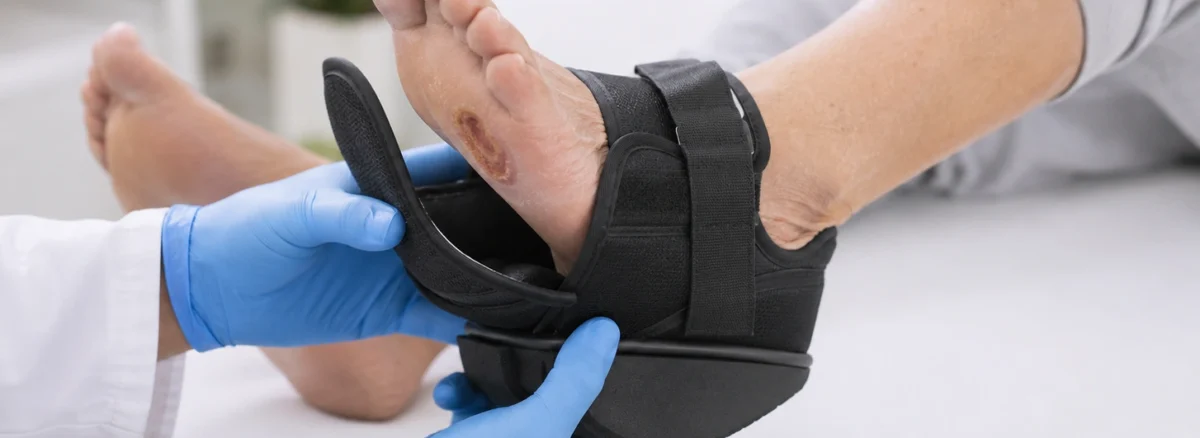
Offloading a diabetic foot ulcer means taking body weight off the wound so it can close. For an ulcer on the sole of the foot it is the single most important part of treatment, and it outranks every dressing, cream and antibiotic available.
That claim sounds overstated until you see what happens without it. A wound on the bottom of a foot is crushed under full body weight several thousand times a day. No dressing survives that, and no wound closes through it. This guide covers why pressure keeps these ulcers open, the offloading diabetic foot ulcer devices available and how they compare, the uncomfortable reason the best one is the one you cannot take off, and what happens after the wound finally closes.
On this page
- What offloading actually means
- Why pressure keeps the ulcer open
- Offloading diabetic foot ulcer devices, compared
- Why the best device is the one you cannot remove
- The total contact cast
- When a cast is not the answer
- What living with it is like
- How long it takes
- What to avoid
- After the ulcer closes
- When to call the clinic straight away
- Common questions
- The takeaway
What offloading actually means
Offloading is the general term for redirecting weight away from a wound. In practice it means a cast, a boot, a modified shoe or a padding arrangement that carries load somewhere the ulcer is not.
The word covers a wide range, from a fiberglass cast molded to the whole lower leg down to a piece of shaped felt stuck to the sole of a shoe. What they share is a single aim: reduce the force landing on one specific patch of skin often enough, and for long enough, that the tissue underneath can rebuild.
It applies mainly to ulcers on the plantar surface, meaning the underside of the foot, because those are the ones taking body weight. A wound on the top of the foot or the side of a toe has a pressure problem too, but the pressure usually comes from footwear, and the solution is a change of shoe over a cast.
Why pressure keeps the ulcer open
Two problems combine here, and neither one alone would do much damage.
The first is mechanical. Body weight does not spread evenly across the sole. It concentrates under the ball of the foot and the heel, and in a foot whose shape has changed over years of diabetes it can concentrate very sharply indeed on one small area. That is where these ulcers form, and it is where they keep being crushed with every step.
The second is neuropathy, meaning nerve damage that reduces sensation in the feet. It removes the warning system. A person without it who develops a sore spot limps, shifts their weight and changes their shoes without ever deciding to, because pain forces the issue. Someone whose feet cannot feel properly walks normally on an open wound, all day, without discomfort.
Put those together and you have a wound under repeated heavy load, with nothing telling the person to stop. That is why an ulcer on the sole can stay open for a year while receiving perfectly good dressings. The dressings were never the problem.
Offloading diabetic foot ulcer devices, compared
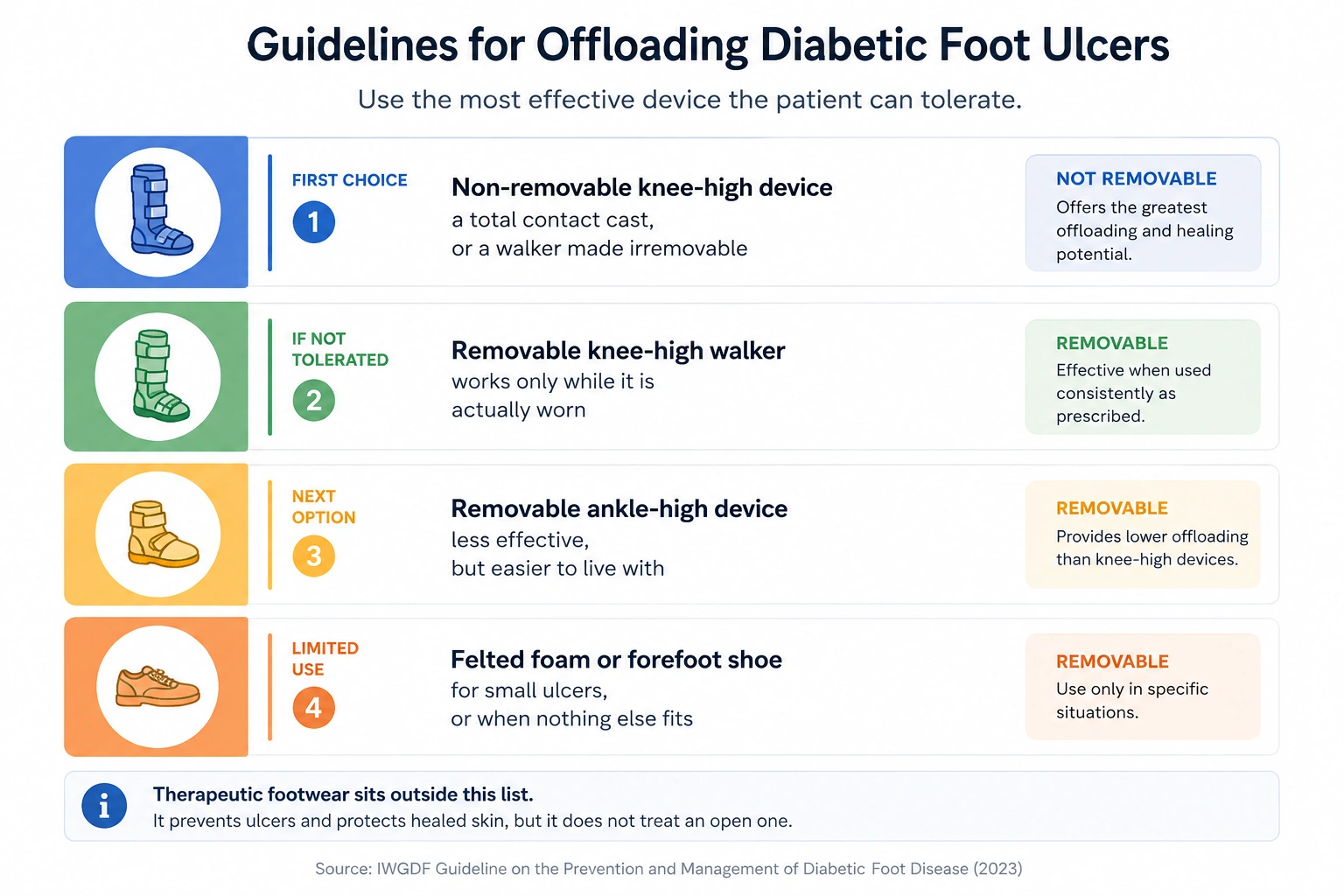
There is a recognized hierarchy here, and the ordering is consistent across international guidance.
Offloading options, strongest first
| Device | Where it stands |
|---|---|
| Total contact cast | The reference standard |
| Irremovable walker | Close second |
| Removable walker | Works only when worn |
| Half shoe or sandal | Limited relief |
| Felted foam padding | Short-term addition |
| Crutches or wheelchair | Rarely sustained |
The right choice also depends on infection, circulation and whether the foot can be safely enclosed.
The gap between the top two and the rest is larger than the list suggests. A cast or an irremovable boot changes the mechanics of every step. A soft sandal or a pad reduces pressure somewhat and permits a great deal of it through.
It helps to know what the lower options actually do. A half shoe removes load from the front of the foot by shortening the sole, which works while someone walks carefully and fails the moment they hurry or take a step backward. A healing sandal offers a cushioned base with no control over how the foot moves inside it. Felted foam, a shaped pad stuck around the wound so surrounding tissue carries the load, is genuinely useful as a temporary addition and wears flat within days. None of these controls the ankle, and ankle movement generates much of the force that lands on the front of the foot.
Recommendations from the International Working Group on the Diabetic Foot, published at iwgdfguidelines.org, place a non-removable knee-high device first for a plantar neuropathic ulcer, with the alternatives ranked below it. Those recommendations sit behind most offloading decisions made in wound clinics.
Why the best device is the one you cannot remove
This is the part that surprises people, and it explains most of the hierarchy above.
A removable boot, worn properly, relieves pressure about as well as a cast. Tested in a laboratory the two perform similarly. The difference appears in real life, where studies fitting activity monitors to people in removable walkers have consistently found the device is worn for only a fraction of the steps they actually take. The boot goes on for appointments and comes off at home, and the wound spends most of its day being walked on unprotected.
This is not a character flaw. A boot is hot, awkward on stairs and impossible to sleep in, and the foot inside it does not hurt. The device is asking for constant discipline in exchange for a benefit the person cannot feel.
The practical answer is to remove the decision. A removable walker wrapped in a layer of cohesive bandage or casting tape becomes an irremovable one, and outcomes rise close to those of a full cast. Nothing about the mechanics changed. Only the option to take it off did.
Understanding this changes how the conversation should go. If a clinician suggests making a device non-removable, the reasoning is about how healing actually works, not about a lack of trust.
The total contact cast
A total contact cast is a lightweight cast molded closely to the foot and lower leg, with minimal padding so it contacts the limb along its whole length.
Close contact is what makes it work. Load that would have concentrated on one patch of the sole is redistributed across the entire plantar surface and, importantly, up the walls of the cast into the lower leg. It also limits ankle movement, which cuts the forces generated as the foot pushes off, and it prevents the person adjusting their gait to favor the sore spot.
Applying one is a skilled job. A cast with a wrinkle in the lining or a pressure point at the ankle can create a fresh ulcer in a foot that cannot feel it happening, which is why they are applied by people who do it regularly and why the foot is inspected at each change.
Casts are changed at intervals, commonly weekly at first, both to check the wound and because a cast on a swollen limb becomes loose as the swelling settles.
When a cast is not the answer
Enclosing a foot in a cast only makes sense when the foot can safely be left alone between changes, and several situations rule that out.
Active deep infection is the main one. A wound that needs looking at daily cannot be sealed inside a cast for a week, and infection that is spreading needs to be visible. Significant shortage of blood supply is another, since a poorly perfused foot tolerates a cast badly and the priority becomes restoring circulation. Heavy drainage causes problems too, because a cast that becomes saturated damages the skin around the wound.
Practical considerations count as well. Someone unsteady on their feet may be at more risk from falling in a cast than from the ulcer, and a person who cannot get a cast into their car or up their stairs will not manage with one.
In those situations the plan moves down the hierarchy to a removable device, footwear modification or padding, with the honest acknowledgment that healing may take longer. Getting the second-best offloading used consistently beats the best one abandoned in a hallway.
What living with it is like
Worth knowing in advance, because the surprises are what make people give up.
A cast cannot get wet, so showering means a waterproof cover or a bath with the leg out. Sleeping takes adjusting to, and most people find a pillow under the calf helps. The cast raises one leg relative to the other, which throws off balance and hip alignment, and a shoe with a matching sole height on the other foot fixes a great deal of that discomfort.
Driving is usually out with a cast on the right leg, and you should check with your insurer before assuming otherwise. Stairs need care. Fatigue is normal, since walking in a cast takes more effort than walking without one.
The other foot needs watching throughout. It is now taking more load than usual, in a person whose feet are already vulnerable, and a new ulcer on the good side is a real and avoidable outcome. Check it daily.
How long it takes
Many uncomplicated plantar ulcers close within about six to eight weeks in a cast, though the range is wide and depends on the size and depth of the wound, the blood supply to the foot, and whether infection is present.
Progress should be visible from week to week. An ulcer that has not measurably shrunk after four weeks of genuine offloading is telling you something: either the offloading is not working as intended, or a second problem such as poor circulation or bone infection is holding it back. That is the point to reassess, not to press on unchanged.
The wound closing is not the end of the process. Newly healed skin over a pressure point is fragile for weeks afterward, and returning to ordinary shoes immediately is one of the more common ways people find themselves back at the start.
What to avoid
Do not take a removable device off for short trips around the house. Those trips are most of the walking most people do, and the wound cannot distinguish between a journey to the kitchen and a journey to the shops.
Do not cut, trim or pad a cast yourself to make it more comfortable. Altering the shape moves pressure somewhere unplanned, and the foot inside will not report the consequence.
Do not push anything down inside a cast to scratch an itch, and do not ignore a cast that has become loose, cracked, wet or is rubbing anywhere. Each of those is a reason to call the clinic and have it changed.
Do not go back to normal shoes the week the ulcer closes, and do not rely on padding alone as a long-term plan for a wound on the sole. Felt and foam have a place as a temporary addition, and neither substitutes for a proper device.
After the ulcer closes
Clinicians increasingly describe a healed diabetic foot ulcer as being in remission instead of cured, and the wording is chosen deliberately.
Roughly four in ten people who heal a foot ulcer develop another within a year, and the proportion climbs further over three years. The reason is straightforward: the wound closed, and nothing about the foot changed. The same bones, the same shape, the same pressure points and the same lack of sensation are all still there.
What lowers that risk is prescribed footwear with custom insoles built to redistribute load away from the site that broke down, daily foot inspection including the soles and between the toes, and regular professional review of calluses, since a thick callus concentrates pressure beneath itself and is a frequent site for the next ulcer to form unseen.
Treating footwear as part of the medical treatment, and not as an afterthought once the dressing stops, is the difference between one ulcer and a repeating cycle of them.
When to call the clinic straight away
Fever or chills, redness climbing the foot or leg, a jump in pain or swelling, a foul smell, or fresh drainage soaking through a cast all need looking at that day. The same goes for any abrupt change in the color or temperature of the foot or toes.
Call the clinic promptly, though less urgently, if a cast feels loose or tight, has cracked or become wet, or if you notice rubbing anywhere along its edges. A cast causing a problem needs changing, not enduring.
Common questions
Can I just stay off my feet instead?
Complete rest offloads the wound, and almost nobody sustains it. Bed rest and wheelchair use also bring their own problems, including loss of muscle strength, pressure injuries elsewhere and blood clots. A device that lets you keep moving while protecting the wound is generally the better trade.
Does a cast hurt?
It should not. In a foot with reduced sensation, the more important point is the opposite one: a cast can cause damage without hurting at all. That is why any rubbing, looseness, dampness or new discomfort is reported and not tolerated, and why the foot is checked at every change.
Why can I not have a removable boot?
You often can, and for some people it is the right choice. The preference for non-removable devices exists because wear time is the single biggest predictor of whether offloading works, and removable devices are worn far less than people intend. If a removable boot suits your circumstances better, wearing it for every step is what makes the difference.
Will insurance cover offloading devices?
Coverage varies by plan and by device, and asking directly before an item is ordered avoids an unwelcome surprise. Your clinic can usually tell you what documentation is typically required.
What about an ulcer on top of my foot?
Wounds on the top of the foot or the sides of the toes are usually caused by footwear instead of body weight, so the answer is a change of shoe, a stretched or modified shoe, or temporary avoidance of the pair responsible. A cast is generally unnecessary.
Can I work while wearing one?
Many people do, particularly in seated roles. Work involving long periods standing, ladders, or driving needs a conversation with both your clinician and your employer, since the aim is fewer loaded steps rather than simply wearing the device while taking the same number.
The takeaway
Offloading diabetic foot ulcer wounds on the sole of the foot decides whether they heal. A total contact cast sits at the top of the hierarchy, an irremovable walker close behind, and everything below those relies on the person choosing to use it every single time.
The insight to carry away is that wear time, not device design, is usually what separates success from a wound that stays open. And once it closes, the foot that produced one ulcer will produce another unless the footwear changes, which is why the shoes are part of the treatment and not the end of it.
Foot ulcer that will not close?
An ulcer on the sole of the foot rarely heals on dressings alone. An assessment identifies where the pressure is falling, checks circulation and infection, and matches an offloading device to the wound and to your daily life.
Our chronic wound treatment service manages diabetic foot ulcers, including offloading, debridement and the footwear planning that follows healing.
This article is general education and does not replace a clinical assessment. Which offloading device suits a particular wound depends on its depth, the blood supply to the foot and your wider health, and that choice is made in person. Seek care the same day for fever, spreading redness, or a sudden change in how the foot looks or feels.