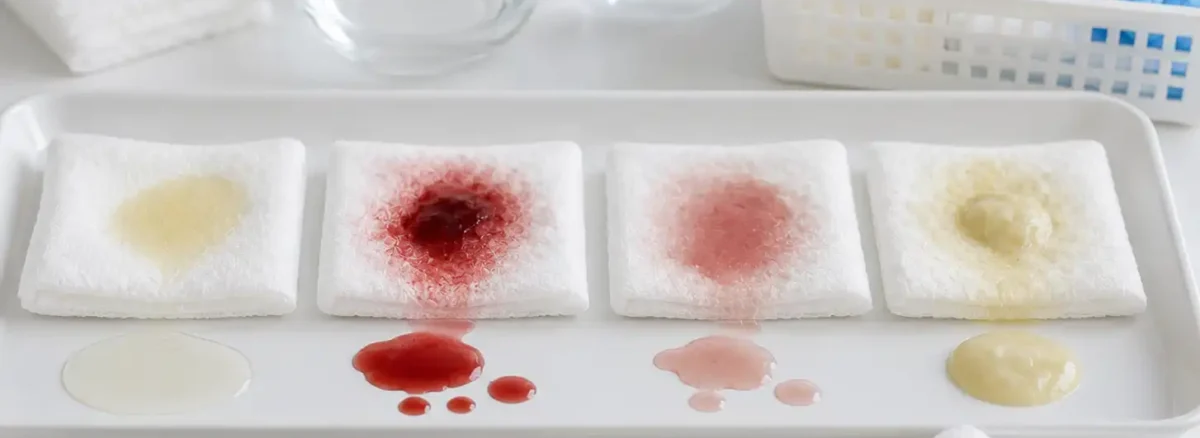
The four types of wound drainage are serous, sanguineous, serosanguineous and purulent: thin and clear, bloody, watery pink, and thick and opaque. Three of those four turn up routinely in wounds that are healing exactly as they should.
Which means the names, on their own, settle less than people expect. What a clinician reads from a dressing is mostly how much fluid is on it and whether that quantity is rising or falling, both of which can be tracked at home more accurately than any color can be judged. This guide covers what each of the four terms describes, the measurement that outranks all of them, how much drainage is normal and how long it lasts, the way a dressing manufactures appearances of its own, and the point at which fluid from a wound becomes a reason to call.
On this page
- What are the four types of wound drainage?
- The four names describe fluid, not severity
- The check that beats reading the color
- The four types, one at a time
- How much drainage is normal?
- How long does wound drainage last?
- The dressing produces fluid of its own
- When drainage points to something serious
- What you can do about it
- What to avoid
- Living with a wound that leaks
- When to get it seen
- Questions about wound drainage
- The takeaway
What are the four types of wound drainage?
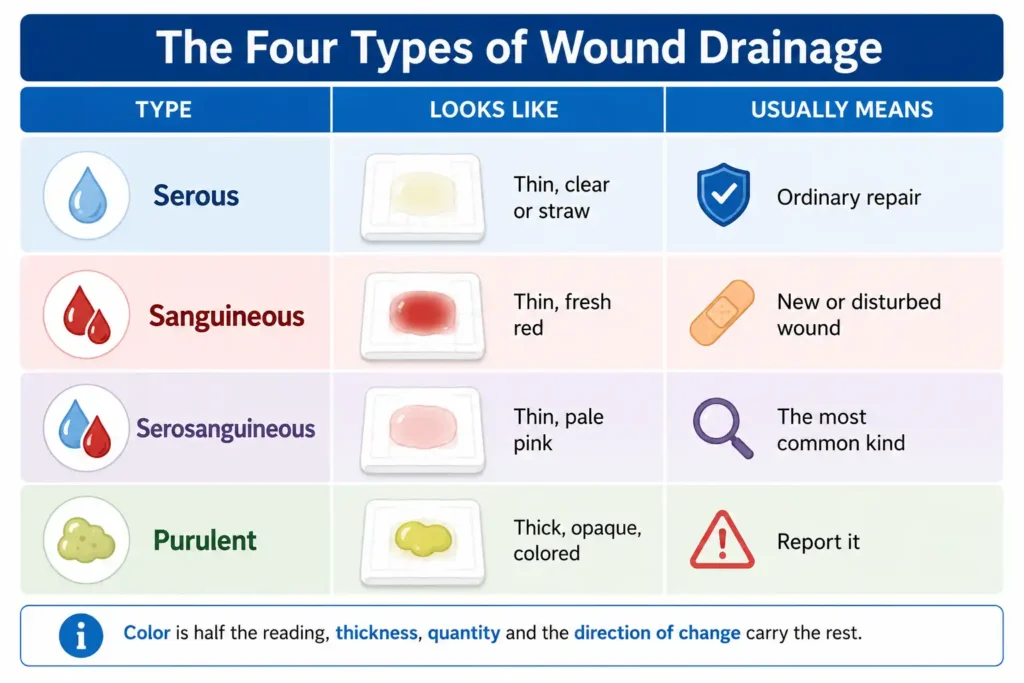
Serous drainage is thin and clear to pale straw. Sanguineous drainage is fresh red and equally thin, because it is blood. Serosanguineous drainage is the two combined, watery and pale pink. Purulent drainage is thick, opaque and cream, yellow, tan, green or brown, and it is the one most people mean when they say pus.
Every one of those names is built from two observations and nothing else: what color the fluid is, and how thick it runs. That is the whole system. The clinical word for the fluid itself is exudate, and a wound producing it is doing something deliberate. When skin breaks, small blood vessels around the injury widen and turn leaky, and plasma moves out into the tissue carrying white cells, growth factors, oxygen and nutrients to the surface that needs rebuilding. Drainage is the delivery mechanism for repair. A wound with none at all is either finished or dried out, and a dried-out wound bed heals slowly.
So the four terms are a shared vocabulary for describing what came off a dressing, in a way that another clinician can picture over the phone. They were never designed to grade a wound, and using them that way is where most of the worry starts.
The four names describe fluid, not severity
Written out in that order, the list looks like a ladder running from harmless to alarming. It is not a ladder, and reading it as one produces two opposite mistakes.
The first is treating a step along the list as deterioration. Sanguineous drainage from a wound that was debrided yesterday is the expected result of removing dead tissue from a bed with a live blood supply underneath. It says the procedure reached tissue that is alive. Meanwhile serous fluid, the type sitting innocently at the top of the list, can pour out of a swollen lower leg in volumes that soak through everything and hold the wound open for months. Serous is not automatically better news than sanguineous. It depends entirely on how much, from what, and for how long.
The second mistake is reading the stain instead of the fluid. A dressing pad spreads and dilutes whatever lands on it, and blood stains dramatically out of all proportion to its quantity. Perhaps half a teaspoon of blood will tint an entire pad a convincing pink, and the person looking at it in the bathroom counts the area, not the volume. Sizing drainage by how far the mark spreads reliably exaggerates it.
Worth separating too: the color of the fluid and the color of the wound underneath are two different readings that get merged into one. Yellow film stuck to the base of the wound is tissue, not drainage, and it does not lift when the wound is rinsed. The bed itself is a separate reading, worked through under what color a healing wound should be; this page is about the fluid coming off it.
The check that beats reading the color
Count instead of squinting. Two numbers, written down with the date, tell you more across a week than any amount of staring at a pad tells you in a moment.
The first number is how many dressing changes the wound needs in a day. The second is how wet the dressing is when it comes off, described in quarters: dry, a quarter wet, half wet, soaked, or through to the outside.
That last state has a name. Strikethrough is fluid reaching the outer face of the dressing, and it is the threshold to act on, because a dressing wet all the way through has stopped being a barrier. Bacteria can travel in either direction along a continuous film of fluid. Strikethrough means the dressing needs changing now, whatever the schedule says, and repeated strikethrough means the dressing is not matched to the wound.
Those two numbers are exactly what the words minimal, moderate and heavy stand for in a clinical note. Nobody is measuring milliliters. They are estimating changes per day and saturation per change, which is what you can record yourself with a phone and thirty seconds.
Compare across a week, never across a day. Falling numbers mean the wound is heading the right way, and that holds even while the fluid still looks unpleasant. Rising numbers mean something has changed, and that holds even while the fluid looks perfectly ordinary. Direction is the finding. A single snapshot is not.
The four types, one at a time
Each type has a normal home and a version of itself that deserves attention. Knowing both halves is more useful than memorizing the names.
Serous
Thin, clear, faintly yellow, about the consistency of water. This is plasma with the blood cells left behind, and it is the ordinary output of a wound getting on with things.
Quantity is the variable that matters here, since large volumes of clear fluid are still a problem even though the fluid itself is unremarkable. A leg that is swollen from poor venous return pushes fluid out through any opening in the skin, sometimes at a rate that defeats several dressings a day. The wound is not the cause in that situation and treating the wound harder will not slow it. Managing the swelling is what reduces the output, which is the reasoning behind compression in the pattern described under venous leg ulcers.
Sanguineous
Fresh red and thin, meaning frank blood. Expect it after debridement, after a dressing that had dried onto the bed was pulled away, or after the wound was knocked.
A little at a dressing change is unremarkable and usually stops within a few minutes of gentle pressure. Bleeding that keeps arriving between changes, or that soaks a pad within minutes, has stopped being a drainage question and become a bleeding one. That distinction matters for anyone taking a blood thinner, where a wound that oozes steadily can lose more over a day than the appearance suggests.
Serosanguineous
Watery and pale pink, the two previous types mixed. This is the most common finding in an open wound that is repairing, and new granulation tissue bleeds readily enough to keep tinting the fluid for weeks.
One situation turns this ordinary type into a signal. A surgical incision that had closed and gone quiet, then suddenly produces a run of pink watery fluid, can be warning that the layers beneath the skin have started to come apart before anything is visible on the surface. Report a sudden gush from a closed incision the same day. The mechanics of that separation, and of the hidden depth that goes with it, are set out under tunneling, undermining and dehiscence.
Purulent
Thick, opaque and colored, often with an odor that survives cleaning. Unlike the other three, this one is a finding to report instead of a description to note.
Thickness is the giveaway, more than the shade. Serous fluid can carry a yellow cast and stay perfectly thin; purulent fluid is creamy and holds its shape, and it pools in the wound instead of spreading across the pad. Even so, it is one input among several. Bacteria live on the surface of every open wound without causing harm, and a clinician weighs the fluid alongside pain, warmth, the wound’s edges and how the person feels in themselves before concluding anything, as the signs of a wound infection works through in detail.
How much drainage is normal?
Enough to keep the wound bed moist, and no more than that. A dressing that comes off damp but not saturated, at the interval it was designed for, is sitting where it should be.
Both extremes cause trouble, which is the part that gets left out. Too little and the surface dries; the cells crossing a wound to close it cannot travel over a dry bed, so healing stalls at the edges. Too much and the fluid overwhelms the dressing and sits against the skin around the wound. That skin turns white, soft and wrinkled, as if it has been in the bath too long, and it breaks down easily. Maceration of that kind quietly enlarges a wound from the outside in while everyone is watching the middle. The difference between damage caused by moisture and damage caused by pressure is covered under moisture associated skin damage.
Size sets a fair share of the expectation. A large wound has more surface producing fluid and legitimately drains more than a small one, so a big ulcer soaking a dressing is not necessarily behaving worse than a small one staying dry. Judge each wound against its own last week.
How long does wound drainage last?
For an ordinary acute wound, drainage is heaviest in the first two or three days, tapers over the following week or two, and should be down to very little by the time the wound has closed over.
That curve follows the inflammatory phase of healing. The leaky-vessel response that floods the area with immune cells peaks early and settles, and output falls with it. A surgical incision typically stops draining within a few days once the edges have sealed, and continued fluid from a closed incision after the first week is a reason to have it looked at.
Long-standing wounds keep no such timetable. A venous ulcer or a pressure injury can drain steadily for months, and the calendar tells you almost nothing about whether that is acceptable. The trend does. Output that is slowly falling week on week belongs to a wound that is working, however long it has been open. Output that is level or climbing after weeks of care is the signal, and a wound still soaking through a dressing every day at the four-week mark has earned a specialist opinion whichever of the four types is coming out of it.
Drainage restarting from a wound that had gone dry counts as a change in its own right. Report it even when the fluid looks harmless.
The dressing produces fluid of its own
Here is the part almost nobody is told, and it accounts for a large share of the alarming photographs that arrive at clinics. Several common dressings change what the drainage looks like without the wound having changed at all.
Alginate is the clearest example. Made from seaweed fibers and used where output is heavy, it turns to gel as it absorbs, and that gel can dry to a yellow or brown that is convincingly mistaken for pus. It also carries an unpleasant smell of its own. The StatPearls chapter on wound dressings, hosted by the National Library of Medicine, names that trap directly, noting the color change can be misread as purulence. Hydrocolloid dressings do something comparable, gelling into a soft yellowish residue with a sour smell that has nothing to do with infection.
Absorbency cuts both ways. Film dressings hold no fluid and let none escape, so on a leaking wound the fluid simply pools underneath and macerates the edges. Plain gauze absorbs little and reaches strikethrough quickly. Foam, alginate and hydrocolloid are the group that same reference points to where output is heavy; hydrogel, film and hydrocolloid suit wounds that are drier. Swap one group for the other and the amount of visible fluid changes overnight while the wound carries on exactly as before.
Which gives a useful first question whenever drainage looks wrong: what is on the wound, and did it change recently? A dressing chosen to hold moisture against the bed on purpose, as in autolytic debridement, is supposed to produce a wet, gelatinous, faintly unpleasant result. That is the treatment working, not the wound failing.
When drainage points to something serious
Fluid on its own rarely decides anything. Fluid arriving alongside other changes is what moves a wound up the queue.
Thick opaque drainage together with a raised temperature, shaking chills, a racing pulse or simply feeling unwell in yourself needs attention the same day. Those combinations suggest the problem has moved past the wound itself. The same urgency applies to a sudden surge in volume from a wound that had been steady for weeks, to pink watery fluid appearing from a surgical incision that had closed, and to bleeding that does not settle after ten minutes of firm pressure.
A smell that is still there after the wound has been cleaned belongs in the same group, since odor judged at the moment a dressing comes off tells you about the dressing and odor judged after cleaning tells you about the wound.
One group has to watch differently. Nerve damage from diabetes can remove the pain that would otherwise announce a deteriorating foot wound, so drainage may be the earliest thing anyone notices. A damp patch on a sock, a stain in a shoe or a dressing needing changing twice as often is worth acting on immediately in a foot that has lost sensation, and the pressure that drives those wounds is dealt with under offloading a diabetic foot ulcer.
What you can do about it
More than it might seem, and the useful things are unglamorous.
Keep the two numbers. Changes per day and saturation per change, noted with the date, turn a vague sense that things are worse into something a nurse can act on in one sentence. Change the dressing on the schedule you were given, and change it early whenever strikethrough appears, since leaving a soaked dressing in place damages the skin around the wound and does nothing for the wound itself.
Protect the surrounding skin deliberately. A barrier film or ointment on the intact rim, where one has been recommended, is what stands between a leaking wound and a wound twice the size. Keeping that skin clean and dry does more for the outcome than most people expect.
For a leaking lower leg, elevation and prescribed compression reduce output at the source by taking pressure out of the veins. The leg often weeps more for the first day or two of compression as fluid is squeezed out of the tissues, then considerably less. Stopping at that point is the common error and it undoes the benefit.
Ask about absorbency instead of changing dressings yourself. A wound needing three changes a day usually needs a different product, not more of the same one, and that is a straightforward conversation to have. The routine side of getting a change done cleanly is set out in our guidance on wound care at home.
What to avoid
Do not pile extra pads on top of a dressing that has soaked through. The fluid stays against the skin, the padding traps it there, and the only thing that improves is what you can see from the outside. Take the dressing off and replace it.
Do not press on to the scheduled change day when a dressing is already saturated, and do not reach for household absorbents to bridge the gap. Cotton wool, tissue and kitchen roll shed fibers into the wound bed, and those fibers are difficult to remove and provoke their own inflammation.
Do not try to dry the wound out to stop the leaking. Leaving it open to the air, aiming a hairdryer at it or letting it scab hard all attack the moisture the surface needs to close, and the fluid returns as soon as the wound is covered again. Household antiseptics aimed at the drainage cause the same kind of harm, damaging the new cells doing the repair while the underlying reason for the volume goes unaddressed.
Do not abandon compression because the leg leaked more at first, and do not decide privately that the amount is normal for you. Volume is the single most useful thing you can report, and a clinician can only weigh what they are told.
Living with a wound that leaks
Fluid is the part of wound care that reshapes an ordinary day, and it is rarely what gets discussed at an appointment.
A wound that leaks means towels on the bed and on the chair, laundry every day, and clothes chosen for what they hide. People stop wearing light colors. They sit on hard chairs at other people’s houses, work out where the bathroom is before they take their coat off, and shorten outings to fit between changes. A visible wet patch in public is the specific fear, and planning around it takes up more of the week than the dressing changes do.
There is a real cost attached as well. Extra pads bought privately, extra laundry, sometimes a chair or mattress protector. Families end up rationing dressings between visits, which pushes people toward exactly the habit that damages skin: leaving a saturated dressing on because there is nothing to replace it with.
That is not a peripheral complaint, and it is not something to shoulder in silence. Leakage that is organizing your life is a legitimate reason to ask for the dressing plan to be reviewed, and saying so plainly tends to change what gets offered, because there is nearly always a more absorbent option or a different way of holding it in place. Carrying a small kit with a spare dressing, tape and a bag is the practical stopgap while that gets sorted out.
When to get it seen
Book an appointment if the amount has been climbing across a week, if the fluid has thickened or turned opaque, if the skin around the wound is going white and soggy, if you need more changes than you used to, or if a smell is still present after cleaning.
Seek same-day care for thick colored drainage alongside a raised temperature or shaking chills, for redness spreading out from the wound, for a sudden surge of fluid from a wound that had been settled, for any fluid from a surgical incision that had closed, or for bleeding that will not stop with firm pressure.
And a wound that is still draining freely after a month of care justifies a specialist opinion on its own, whatever the fluid looks like. Persistent output usually means something is holding the wound in the inflammatory phase, and finding that something is a different job from changing the dressing again.
Questions about wound drainage
What is the most common type of wound drainage?
Serosanguineous, the thin pale pink fluid that mixes plasma with a small amount of blood. New tissue in a healing wound bleeds very easily, so a faint pink tint persists for weeks in wounds that are doing well.
Does yellow drainage mean my wound is infected?
Not by itself. Thin fluid with a yellow cast is ordinary serous drainage, and several dressings gel into a yellowish residue that resembles pus without being it. Thickness carries more information than shade, and thick opaque fluid alongside climbing pain, spreading redness or a raised temperature is the combination that warrants a call.
How much drainage is too much?
Enough that fluid reaches the outside of the dressing, or enough that you are changing it more often than you were last week. Both are practical thresholds you can judge at home, and both are worth reporting even when the fluid itself looks unremarkable.
How long should a surgical wound drain?
Usually a few days, easing as the edges seal. Fluid continuing beyond the first week, or restarting after the incision had gone dry, should be assessed. A sudden run of pink watery fluid from a closed incision needs looking at the same day.
Does more drainage mean the wound is getting worse?
Often, though not always. A rise can also follow debridement, a change of dressing type, an increase in swelling, or simply a wound opening up as dead tissue is cleared. A clinician reads the increase against what was done recently, which is why the date of the change matters as much as the change itself.
Can I just use a thicker dressing to stop the leaking?
Extra absorbency helps only when it is the right kind, and swapping products without advice can make things worse. Ask for the dressing to be reviewed instead. Heavy output is usually treated by handling its cause, whether that is swelling, dead tissue or infection, with absorbency managing what remains.
The takeaway
The four types of wound drainage are a vocabulary, not a verdict. Serous, sanguineous and serosanguineous all belong to wounds that are healing; purulent is the one that asks for a phone call, and thickness identifies it more reliably than color does.
What carries the real information is quantity and its direction. Track changes per day and how wet the dressing is when it comes off, compare across a week, and treat strikethrough as a reason to change immediately. Before reading anything sinister into an unfamiliar appearance, check what dressing is on the wound, since alginate and hydrocolloid both produce a yellowish gel that looks a great deal worse than it is.
Is your dressing soaking through faster than it used to?
Rising output has a cause behind it, and the cause is usually treatable once it has been identified. An assessment looks at what is driving the fluid and whether the dressing is matched to it.
Finding out why a wound is producing the fluid it is, then matching the dressing to that answer, is core to how our chronic wound treatment service approaches a leaking wound.
This article is general education and does not replace a clinical assessment. Dressing choice and change frequency should be set by the clinician managing your wound, and a sudden rise in drainage, thick colored fluid or bleeding that will not stop needs prompt medical attention.