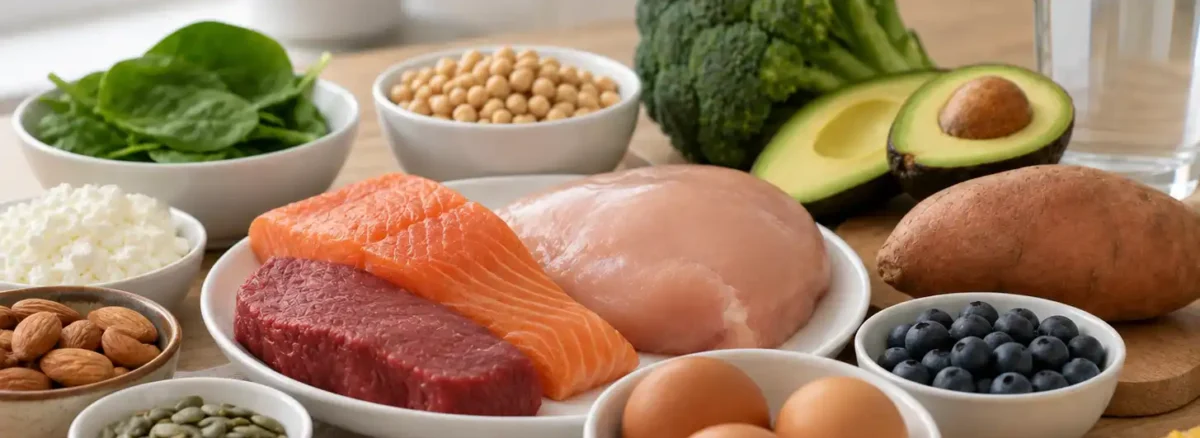
A healing wound asks for three things from food: enough protein to build the new tissue, enough calories to pay for the work, and a short list of vitamins and minerals without which collagen cannot form properly at all. Nutrition for wound healing is really about those three jobs, and the one that goes wrong most often is the plainest of them: simply not eating enough.
Most advice on this subject stops at “eat a balanced diet,” which is accurate and close to useless when you are staring at a wound that has been open for two months. This guide sets out what each nutrient does inside a wound, the single question that tells you whether food is part of your problem, why the wound itself quietly increases the bill, what to steer clear of, and the point at which a dietitian belongs in the conversation.
On this page
- What does a wound need from food?
- The myth that a supplement does the work
- The question that tells you where you stand
- What each nutrient actually does
- The drain nobody mentions
- When intake becomes a clinical problem
- Steps you can take at home
- What to avoid
- Living with a healing diet
- When to ask for a dietitian
- Questions people ask
- The takeaway
What does a wound need from food?
Material, fuel and a handful of tools. Those three categories cover almost everything that counts, and separating them makes the whole subject easier to hold in your head.
The material is protein. New skin, new blood vessels, the red tissue that fills a wound from the base upward and the immune cells patrolling it are all built from amino acids, which come from protein in the diet. There is no other source. A body short of protein will still attempt the repair, but it does so with whatever it can strip out of muscle.
The fuel is calories, and this part surprises people. Tissue repair is metabolically expensive, and if total calorie intake is too low, the body burns protein for energy instead of building with it. Eating more protein while eating too little overall is a common and frustrating combination, because the extra protein largely goes into the furnace.
The tools are micronutrients. Vitamin C, zinc, iron and vitamin A each sit at a specific step in the repair process, and a shortage of any of them slows that step regardless of how much protein arrives. The National Library of Medicine’s review of the factors behind impaired wound healing works through these one at a time, and its summary is blunt: the nutritional needs of a healing wound are complex, and they involve macronutrients and micronutrients together.
Add fluid to move all of it around, and that is the entire shopping list. What changes with a wound is not the type of food required but the quantity, because the requirement climbs while the wound is open and drops back once it closes.
The myth that a supplement does the work
The single most common error is treating this as a supplement question when it is nearly always an intake question.
Supplements sit on top of a diet. They do not stand in for one. A zinc tablet taken by someone managing a slice of toast and two cups of tea a day changes very little, because the limiting factor in that situation is not zinc. It is protein and calories, and no capsule contains a meaningful amount of either.
The second half of the myth is subtler. Correcting a shortage of something helps. Adding more of something you already have enough of generally does nothing measurable, and occasionally does harm. Someone with adequate zinc levels who starts taking zinc does not heal faster; they simply excrete most of it and run the risks described further down this page.
None of which makes supplements pointless. Products combining protein, arginine, vitamin C and zinc exist for a reason, and there are situations where a clinician recommends one deliberately: a large pressure injury, an appetite that has not recovered, a wound that has stalled with no mechanical explanation. The distinction is that a supplement is a targeted decision made after an assessment, not a default first move.
The question that tells you where you stand
Ask yourself one thing: am I eating more now than I was before this wound opened?
For most people the honest answer is no, and often considerably less. The requirement went up. Intake went down. Pain, reduced mobility, low mood, hospital food, medication side effects and the sheer tedium of being unwell all push in the same direction, and they arrive precisely when the body needs more than usual. That mismatch does more damage than any missing vitamin.
Four signs make the answer concrete. Clothes, rings or a belt getting looser without any effort on your part. Protein appearing at only one meal a day, usually the evening one, with breakfast and lunch reduced to tea, toast or a cookie. Meals routinely left half finished. And weight falling on the scales when nobody asked it to.
Unintentional weight loss while a wound is open should be raised at your next appointment even if you feel fine otherwise. It is one of the more useful pieces of information a wound care team can be given, and it is rarely volunteered, because few people connect the bathroom scale with the dressing on their leg.
What each nutrient actually does
Knowing the specific job each one performs makes the advice stick better than a list of foods ever will.
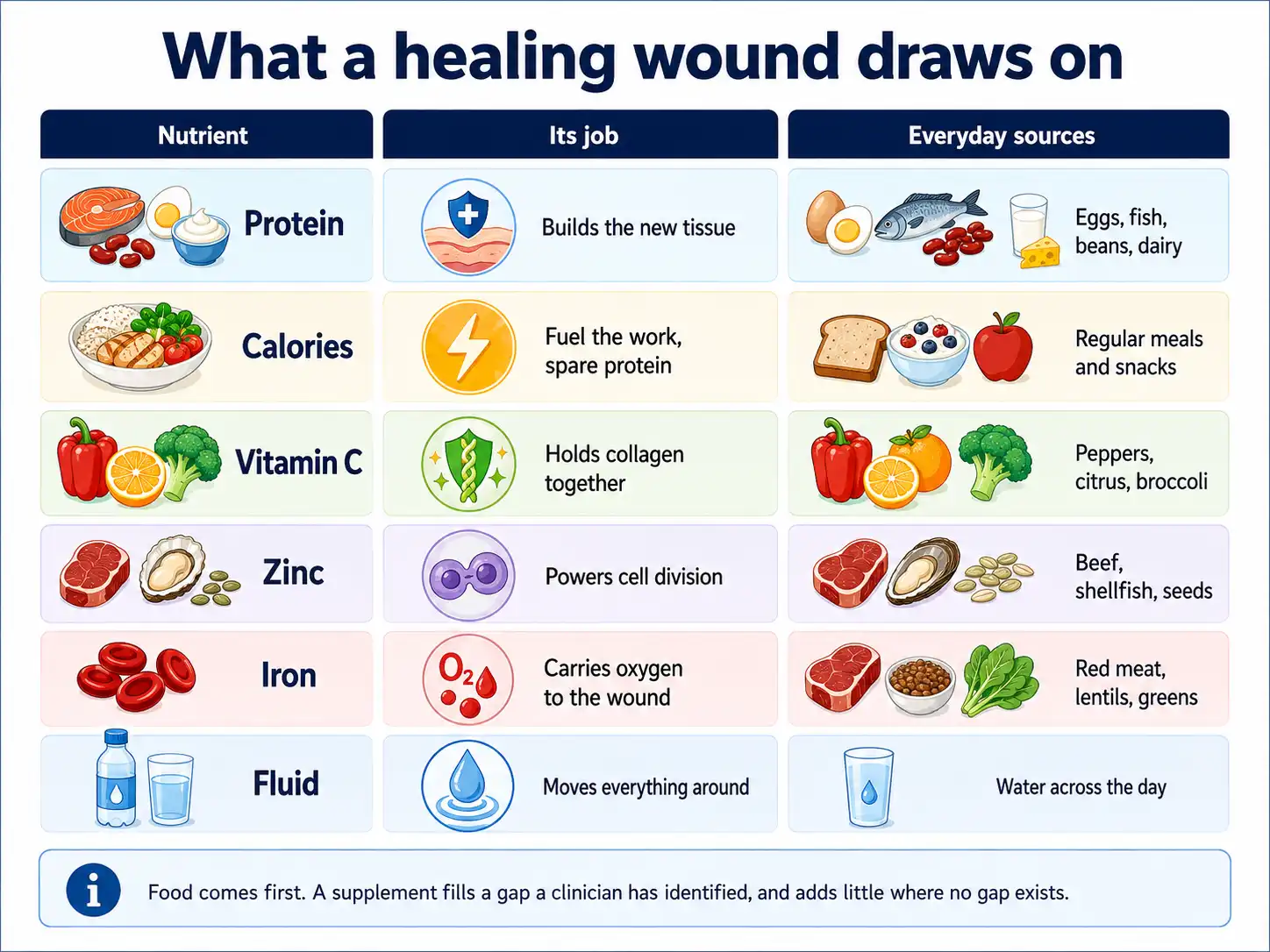
Protein
Collagen is a protein, and collagen is most of what a wound builds. So is the granulation tissue that fills a cavity from the bottom up, and so are the white cells doing the cleaning. Everything structural in a repair traces back to amino acids arriving from the plate. The beefy red appearance of a wound that is filling in comes largely from new collagen and new blood vessels, and what that color signals is covered in our guide to what color a healing wound should be.
Two amino acids get singled out in the wound literature. Arginine feeds into proline, a direct building block of collagen, and it also supports the growth of the small new blood vessels a wound depends on. Glutamine acts as an energy source for cells that are dividing quickly, which describes almost every cell in a wound bed.
One practical point does more good than any brand of shake. The body does not store spare amino acids well, so protein concentrated into a single evening meal is used less efficiently than the same total spread across three. Getting some protein into breakfast is usually the largest single improvement available, and it costs nothing.
Vitamin C
Its role is unusually specific. Vitamin C enables the chemical step that converts proline into hydroxyproline, and hydroxyproline is what allows collagen fibers to lock into a stable structure. Without it the body still produces collagen, but the result is weak and comes apart.
The historical illustration is scurvy, where long-healed scars from years earlier could open again. That is an extreme case and uncommon in the United States today, though it still appears in people living on a very restricted diet. The everyday version is milder and harder to spot: enough vitamin C to avoid outright deficiency, not necessarily enough to support an unusually large repair job.
Peppers, citrus fruit, kiwi, strawberries, broccoli and potatoes all supply it. Because the vitamin dissolves in water and is not stored in any quantity, a steady daily intake beats an occasional large one, and long boiling destroys a fair amount of what was in the vegetable to begin with.
Zinc
Zinc works as a cofactor for the enzymes that copy DNA and RNA, which means it is required anywhere cells are dividing rapidly. A wound bed is one of the fastest-dividing tissues in the body at that moment, so demand concentrates there.
Low zinc carries an unpleasant feedback loop. Two of its early effects are a dulled sense of taste and a reduced appetite, so the deficiency makes eating less appealing, and eating less deepens the deficiency. Anyone who says food has gone bland and they have stopped bothering with it is describing something a clinician should hear about.
Beef, shellfish, poultry, beans, nuts and seeds all carry it. Zinc is also the nutrient most often taken to excess by people trying to help their own wound along, and that has real consequences, which the section on what to avoid returns to.
The drain nobody mentions
An open wound does not only consume nutrients. It exports them.
Wound fluid contains protein, so a wound producing enough fluid to soak a dressing every day is carrying protein out of the body every day. Over a few weeks that accumulates into a genuine ongoing loss, on top of the raised demand from building tissue. It rarely comes up in conversation, and it explains something that otherwise looks unfair: the diet that kept you perfectly well for years can be quietly inadequate now, without a single thing about it having changed.
The size of the effect tracks the size of the wound and how wet it is. A small dry graze costs almost nothing. A large, heavily draining leg ulcer, an extensive pressure injury or a burn sits at the other end, and those are the situations where a dietitian is most likely to become involved early. Prevention advice for people at risk of skin breakdown, including the nutritional side, appears in our article on how to prevent bedsores.
There is a useful consequence for anyone tracking their own progress. When drainage settles, the nutritional pressure eases with it. Getting a wound under control and getting nutrition under control are not separate projects competing for attention; each one makes the other easier.
When intake becomes a clinical problem
Nutrition moves from background detail to active problem at the point where a wound stops improving and nothing else explains it.
Wound teams assess this routinely, and it is built into the tools they use. The Braden Scale, the risk score completed on hospital and nursing home admissions, devotes one of its six categories to nutrition for exactly this reason; how that scoring works is set out in our explanation of the Braden Scale. A poor score in that category is a prompt to act, not a label.
One widely held belief deserves correcting here, because patients meet it constantly. Blood albumin was used for decades as a nutrition marker, and a low result is still sometimes read that way. Albumin falls during inflammation and infection whatever a person has been eating, and an open wound produces inflammation by definition. A low albumin in someone with a chronic wound therefore says more about the inflammation than about the meals. Weight history, an honest account of what is actually being eaten and a physical assessment tell a clinician far more.
A registered dietitian is the person who turns all this into numbers. They calculate protein and calorie targets from body weight, wound size and medical history, adjust for kidney or liver disease where those set limits, and decide whether supplements have a role. That calculation is genuinely individual, which is why no article can responsibly hand you a figure.
Steps you can take at home
Small, repeatable changes beat ambitious plans that collapse within a week.
Put some protein into every meal, breakfast included. Eggs, Greek yogurt, milk, cheese, peanut butter, beans, canned fish, leftover chicken. None of it demands cooking skill or a special trip. If appetite is the barrier, fortify instead of adding volume: stir milk powder into soup, oatmeal or mashed potato, add grated cheese to whatever will take it, use whole milk in place of skim while the wound is open. The plate looks the same and delivers considerably more.
When appetite has gone, eat by the clock instead of by hunger. Six small things across the day are easier to face than three proper meals, and they add up to more. Keep something to drink within reach and use it steadily, since thirst is an unreliable prompt in older adults in particular.
Two extras apply to specific situations. If you have diabetes, glucose control belongs in the same conversation as food, since high blood sugar impairs the immune cells a wound relies on. The wider picture for foot wounds is in our guide to offloading a diabetic foot ulcer. The everyday routine around dressings sits alongside all of this and is covered in wound care at home. And if a clinician has suggested an oral nutrition supplement, treat it as part of the treatment instead of an optional extra, at the times you were told.
What to avoid
Do not take high-dose zinc for weeks on end on your own initiative. Sustained high intake interferes with the absorption of copper, and copper deficiency causes problems of its own, including effects on blood counts and nerves. Very high doses can also blunt parts of the immune response, which is the opposite of the intended effect. Short courses under clinical direction are a different matter entirely.
Do not start a weight-loss diet while a wound is open, however good the reasons for wanting to. A calorie deficit is paid for partly out of muscle, and the repair loses out alongside it. If weight loss is medically important, it can be planned properly once the wound has closed, or supervised in a way that protects protein intake.
Do not lean on a multivitamin to compensate for meals not eaten, and do not take very large doses of vitamin C hoping to speed things up. The excess is mostly excreted, high doses cause stomach upset and diarrhea, and in people prone to kidney stones they can raise the risk.
Alcohol deserves a mention, since it suppresses appetite, displaces nourishing food and interferes with the absorption of several of the nutrients discussed here. And avoid staying quiet about a poor appetite because it feels too minor to bring up next to the wound. It is not minor, and it is one of the few parts of a treatment plan the team cannot observe for themselves.
Living with a healing diet
Being told to eat more is easy advice to give and a heavy thing to receive when eating has stopped being enjoyable.
Food turns into a task. Long illness dulls appetite, pain removes it, several common medications alter taste, and someone who has spent months mostly indoors is not building much of an appetite through activity either. Meals then become another item on a list that already includes dressings, appointments and pills, and the enthusiasm for them drains away.
Cost is the part rarely acknowledged out loud. Protein foods are among the more expensive things in a grocery cart, and “increase your protein” can land as an instruction with no obvious way to follow it. Eggs, canned fish, dried beans, lentils, milk powder and peanut butter carry a great deal of protein for very little money, and a dietitian can work within a budget once told there is one.
Eating alone matters more than people expect; appetite has always been partly social, and portions shrink when nobody else is at the table. Meanwhile a worried family member counting mouthfuls turns every meal into an inspection, and the usual result is that the person eats less while insisting they are fine. Chewing problems, ill-fitting dentures, a dry mouth and difficulty swallowing sit underneath all of this and often go unmentioned for months.
Saying any of that plainly tends to change the plan. Nourishing drinks, smaller and more frequent meals, a dental referral, a swallowing assessment or help at mealtimes are all ordinary responses. What they need first is somebody knowing the situation exists.
When to ask for a dietitian
Ask for a nutritional review if weight is dropping without any intention behind it, if most meals have gone half eaten for more than a week or two, if a wound has stalled or grown with no mechanical explanation, or if appetite and taste have changed since treatment began. Heavy drainage continuing over several weeks is another reasonable trigger.
Any of those is a routine request, not a fuss. Nutritional input tends to arrive late in wound care precisely because patients assume it is too small a thing to raise.
Separately, a raised temperature, shaking chills, redness traveling outward from the wound edge, pain climbing quickly or a sudden sense of being generally unwell call for same-day medical attention. Those signs point at infection that has moved past the wound itself, and no amount of protein addresses them. Signs that point toward infection are listed in how to tell if a wound is infected.
Questions people ask
Does eating more protein make a wound heal faster?
It removes a brake, which is not the same as an accelerator. Where protein intake was too low, correcting it can make a visible difference to how a wound progresses. Where intake was already adequate, eating more does not push healing beyond its normal pace, and the surplus is used for energy or excreted.
Should I take a zinc supplement for my wound?
Ask before you start. Zinc helps people who are short of it and does little for people who are not, and taking it at high doses over a long period can cause a copper deficiency. A clinician can weigh your diet, your medications and your wound before deciding whether a short course makes sense.
How much protein do I actually need?
More than usual while a wound is open, and the exact figure depends on your body weight, the size of the wound, how much it is draining and whether you have kidney disease. A dietitian calculates it individually, which is why a single number quoted online can be wrong for you in either direction.
Do wound healing drinks and shakes work?
They can, in the right person. Oral nutrition supplements are a practical way to deliver protein and calories to someone who cannot manage enough food, and some formulations add arginine, vitamin C and zinc together. For a person eating well already, they mostly replace food that would have been eaten anyway.
Does sugar slow wound healing?
Persistently high blood glucose does, because it impairs the immune cells a wound depends on and affects the small blood vessels supplying it. That is a reason for people with diabetes to keep glucose in a reasonable range while a wound heals. A dessert on its own is not the villain the phrasing implies, and calories are useful when appetite is poor.
Can I lose weight while a wound is healing?
It is usually better to wait. Deliberate calorie restriction competes directly with tissue repair, and some of the loss comes out of muscle. If excess weight is contributing to the wound, discuss the timing with your care team, since the answer differs depending on the wound and your general health.
The takeaway
Nutrition for wound healing rests on three jobs: protein supplies the material, calories pay for the labor, and a handful of micronutrients (vitamin C and zinc chief among them) make the assembly possible. Iron and fluid support the whole operation.
The myth is that the answer lives in a bottle. In practice the limiting factor is usually total intake, at the one point in life when appetite is at its lowest, while the wound quietly drains protein away alongside. So the useful question is not which supplement to buy but whether you are eating more than you were before this started. If the answer is no, and particularly if weight is falling, that belongs on the table at your next appointment.
Has your wound stopped making progress?
A stalled wound usually has a reason behind it, and appetite and weight are among the ones most often missed. An assessment looks at the wound and at the factors feeding into it.
Practical guidance for patients and caregivers, including the everyday side of eating well while a wound heals, forms part of our wound care management education service.
This article is general education and does not replace a clinical assessment. Nutritional targets, supplements and any change to your diet should be agreed with a healthcare professional, particularly if you have diabetes, kidney disease or liver disease, since those conditions place limits on protein, fluid and certain minerals.