
A Braden Scale score is a number between 6 and 23 that estimates how likely a person is to develop a pressure injury over the coming days. Lower means higher risk, and a score of 18 or below is generally treated as the point at which a written prevention plan is expected.
The number usually arrives with no explanation attached. It appears on a chart, a discharge summary or a care home care plan, and whoever reads it is left to work out on their own whether 14 is alarming or routine. This guide sets out what the score measures, what each risk band is generally taken to mean, why the total by itself is the least informative part of the result, the six areas that produce it, and what a weak result in any one of those areas should change.
On this page
- What does a Braden Scale score mean?
- What each risk level means
- Why the total on its own can mislead
- The six areas the scale actually scores
- Friction and shear, the one scored out of three
- What the Braden Scale does not measure
- What a weak subscale should change
- Where the score gets misused
- Living with a risk score
- When to raise it with the team
- Common questions
- The takeaway
What does a Braden Scale score mean?
It is a prediction, not a finding. The score estimates the chance that pressure will damage someone’s skin in the near future. It says nothing about whether damage has already occurred.
Six areas are scored separately. Five of them run from 1 to 4, one runs from 1 to 3, and the six numbers are added together. The floor is 6, describing a person impaired in every area at once. The ceiling is 23, describing a person with no impairment anywhere. Lower totals point to higher risk, which reverses how most medical numbers behave and is the first thing people read backwards.
The tool’s full name is the Braden Scale for Predicting Pressure Sore Risk. Pressure sore and bedsore are the everyday words, pressure ulcer is what most people search for, and pressure injury is the term clinicians now use. Scoring and staging get confused constantly, so keep them apart: this scale is completed before anything has happened, while the four-stage system explained in pressure ulcer stages describes damage that already exists.
A score is normally recorded when someone is admitted to a hospital, a rehabilitation unit or a nursing facility, then repeated at intervals the facility sets. It sits alongside a separate head-to-toe skin check, and the two answer different questions. The skin check asks what the skin looks like today. The Braden Scale asks what is likely to happen to it if nothing changes.
What each risk level means
Totals are grouped into bands, and the band is what usually determines how much prevention gets written into the care plan.
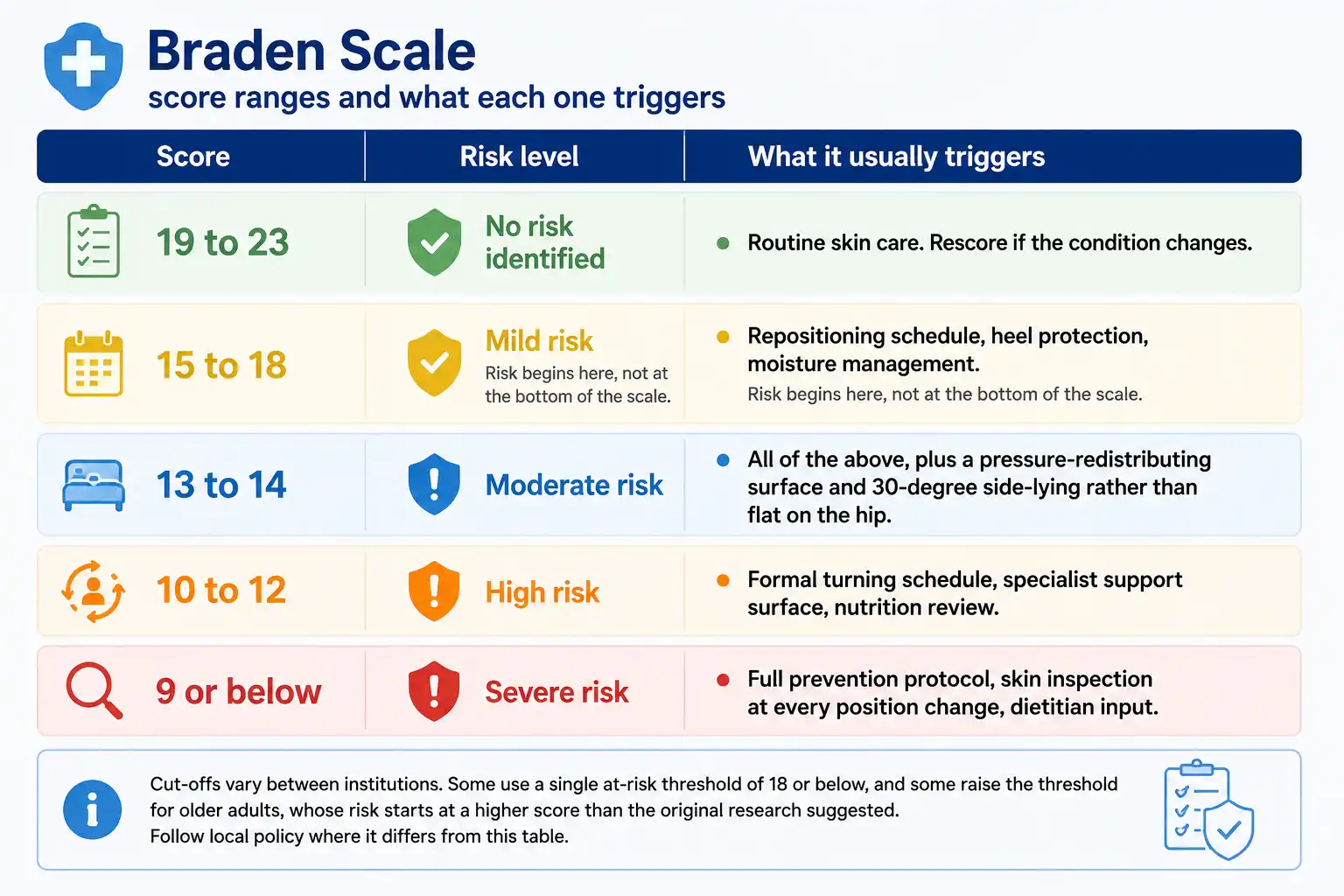
Treat those cut-offs as widely used instead of fixed. The Agency for Healthcare Research and Quality notes in its hospital pressure ulcer prevention toolkit that a total of 18 or less generally indicates at-risk status, and that the threshold may need adjusting for a particular patient group or according to a facility’s own guidelines. A surgical unit, an intensive care unit and a long-stay residential home reasonably draw the line in different places.
What the band produces is a level of effort. At the top of the range the expectation is that skin keeps being looked at and the score gets repeated when circumstances change. Further down, prevention stops being general and becomes specific: a named repositioning interval, a decision about the mattress or cushion, heels lifted off the bed, attention to how the person is moved. Nothing about the band tells anyone that a pressure injury is coming. It tells them how much has to be in place for it not to.
Why the total on its own can mislead
Because two people can reach the same total by completely different routes, and the routes carry more useful information than the arithmetic.
Picture two people who both score 16. The first has four threes and two fours: mildly limited across the board, nothing dramatic anywhere. The second scores well in five areas and holds a 1 in moisture, because their skin is damp almost constantly. Both land in the same band, and the second person has a concentrated, urgent, entirely fixable problem that the total quietly averages away.
A single 1 in any subscale deserves its own response, whatever the total says. That is the practical reading of a Braden Scale result, and it is the reading most likely to be missing when a number is handed to a family with no commentary attached.
A second limitation is less obvious. Research summarized by AHRQ suggests these tools earn their keep mainly in the middle of the range, since experienced nurses can usually identify the clearly high-risk and the clearly low-risk person without a scale at all. The real contribution of scoring is catching people whose risk is genuine but not conspicuous, which happens to be the group most easily missed on a busy unit.
The six areas the scale actually scores
Each one describes a different way pressure gets its chance to do harm.
Sensory perception covers whether someone can feel pressure discomfort and act on it. Healthy people shift position constantly without noticing, including dozens of times during sleep, because staying still becomes uncomfortable long before it becomes damaging. Sedation, reduced consciousness, spinal cord injury and neuropathy, meaning nerve damage that dulls sensation, all interrupt that signal. When the warning never arrives, the shift never happens.
Moisture covers how often the skin is damp, from perspiration, urine, stool or wound drainage. Wet skin softens, loses its barrier and tears under loads it would otherwise tolerate. Damage caused by wetness alone looks different from pressure damage and is managed differently, a distinction laid out in moisture associated skin damage.
Activity and mobility sound alike and measure separate things. Activity is how far a person gets during the day: walking freely, walking rarely, confined to a chair, confined to bed. Mobility is what they can do once they are there, meaning how much they can change and control their own position. Somebody who spends all day in a wheelchair but repositions themselves easily is in a very different situation from somebody who cannot lift their own weight off the seat.
Nutrition covers the usual pattern of eating, not one skipped lunch. Skin under load needs protein and calories to keep repairing itself, and a person eating half of most meals is running a slow deficit that shows up in the score before it shows up anywhere else.
Friction and shear is the sixth, and it behaves differently enough to deserve its own section.
Friction and shear, the one scored out of three
This subscale tops out at 3 instead of 4, and the shorter range has a logic to it: there is no level meaning no apparent problem at all. Its best available score describes someone who moves well enough to avoid sliding. Most people who need scoring are not in that position.
The two forces are related and not identical. Friction is skin dragging across a surface, the graze that comes from being pulled up a bed on a sheet. Shear happens underneath: the skeleton slides one way while the skin stays gripped to the mattress, and the tissue sandwiched between them stretches, kinks its own blood vessels and loses its supply. Raising the head of the bed is the everyday cause, because the body gradually slips toward the foot of it while the skin over the tailbone stays put.
Shear damage tends to begin deep, next to bone, and can be well established before the skin surface gives anything away. That pattern is described in deep tissue pressure injury, and it explains why this subscale carries weight out of proportion to its three-point range.
It is also the area most responsive to a change in technique. Sensory perception and nutrition shift slowly. How a person is moved up the bed, whether a slide sheet is used, and how far the backrest is raised can all change this afternoon.
What the Braden Scale does not measure
A good deal, and the omissions are why the score is meant to sit beside clinical judgment instead of replacing it.
Age is not in it. Neither is a pressure injury the person already has, nor a healed one, even though previously damaged tissue stays more vulnerable. Blood supply is absent, so poor circulation and low oxygen levels carry no weight in the total. Diabetes is not scored directly. Fever is not scored. Medical devices are not scored at all, which counts for a lot, because oxygen tubing behind the ears, a cervical collar or a catheter line pressed under a thigh can produce a wound in a person whose total looks comfortable.
Skin tone changes what an early sign looks like, and that sits outside the scale too. The classic first warning is redness that stays put when pressed, which is straightforward to spot on pale skin and considerably harder on brown or black skin, where the area may instead look purple, deeper in color than the skin around it, or simply feel warmer, firmer or unusually soft. A total in the safe range is no reason to skip that check on any patient.
The scale was built and validated for the general adult population as well. Children are assessed with a separate version, the Braden Q. AHRQ notes that risk tools tend to separate levels of risk less reliably in spinal cord injury, in palliative care and during surgery, where dedicated tools exist but have been studied less. None of that makes the score useless. It makes it one input among several.
What a weak subscale should change
Here is where a score stops being paperwork. Each area points at a different response, and the useful question to ask a nurse is not what the total was but which area scored lowest.
A low sensory perception score means nobody can rely on the person to report discomfort, so inspection has to be scheduled instead of prompted. A low moisture score points at the source: continence care, prompt changes, a barrier product on skin that keeps getting wet, and a dressing better matched to a wound that leaks. Low activity and mobility scores drive the two decisions people most associate with prevention, a repositioning interval and a surface that spreads weight, both covered in how to prevent bedsores and in the buying checks set out for a pressure relief mattress.
A low nutrition score is a referral, not a suggestion to eat more. Assessment by a dietitian can establish whether protein, calories or fluid are short and whether supplements have a role, and that conversation tends to happen sooner when somebody asks for it. A low friction and shear score changes handling: lifting instead of dragging, slide sheets, heels supported clear of the mattress, and keeping the backrest as low as the person’s breathing and swallowing safely allow.
One more thing follows from all of this. A score is a snapshot with a short shelf life. Surgery, a chest infection, a new sedating medication, a few days of diarrhea or a fall in appetite can move several subscales within a day, and a plan built on last week’s number will be the wrong size. Ask for a rescore whenever the situation changes instead of waiting for the next scheduled one.
Where the score gets misused
Do not read a comfortable total as permission to stop looking at the skin. The two are separate checks, and a high score has never prevented anything by itself. Pressure injuries develop in people who scored well, usually because something changed after the scoring and nobody went back to it.
Do not copy forward yesterday’s numbers. A scale filled in from memory records what somebody assumed instead of what they observed, and it produces a plan aimed at a person who is no longer in that state.
Do not wait for a threshold before doing the obvious. Someone who cannot feel their heels needs those heels lifted off the bed today, at any total. Scoring exists to catch risk that is easy to overlook, not to authorize care that is already clearly needed.
Do not treat a falling score as a failure or a criticism of anyone. A drop from 17 to 12 usually means the person became less well, which is information, not blame. Reading it as an accusation is one of the more reliable ways to make a family stop asking about it.
And do not apply the adult scale to a young child and act on the band it produces. The Braden Q exists for exactly that reason.
Living with a risk score
Being labeled high risk lands badly, and almost nobody warns people about that part.
What the number produces is a set of restrictions that reshape an ordinary day. Sitting up in a chair, often the thing a person most wants, may be limited to short stretches. Nights get broken by repositioning. An air mattress hums, feels unstable to lie on, and makes some people feel less able to move than they were before it arrived. Visitors turn up and find the visit organized around a turning schedule.
Families carry a version of the same weight. A relative doing the repositioning overnight is doing genuinely hard physical work with no rota and no relief, and the score is often their first indication of how much is now expected of them. That deserves a proper conversation about equipment, community nursing support and respite, none of which arrives automatically.
Two requests make a real difference here. Ask for the plan in writing, and ask which subscale drove it. A number with a reason attached can be discussed, adjusted around a person’s own priorities and handed on to whoever takes over the care. A number by itself tends to sit in a file doing nothing for anybody.
When to raise it with the team
Ask for a review if a score has been recorded but no prevention plan came with it, if the score has not been repeated since a clear change in health, if equipment named in the plan has not actually appeared, or if the person cannot manage the repositioning the plan assumes.
Report skin over any bony point that stays discolored for more than about half an hour after the pressure has been taken off it. Heels, tailbone, hips, shoulder blades, elbows and the back of the head are where this shows up first. A purple or maroon patch, a blood-filled blister, or an area that feels boggy, firm or warmer than the skin around it needs assessment promptly, since damage can be under way beneath skin that has not broken.
Seek same-day medical care for a raised temperature alongside broken skin, redness traveling outward from a wound, pain climbing quickly, or a sudden general decline in someone’s condition. Those point past prevention and toward an infection that needs treating.
Common questions
What is a normal Braden Scale score?
A total of 19 to 23 is generally read as not at risk, and 23 is the highest result possible. Facilities set their own action threshold, though, and many treat anything at or below 18 as the point where a prevention plan becomes mandatory. A person who has never been scored is not the same as a person who scored well.
Is a Braden Scale score of 15 bad?
It sits at the top of the at-risk band, which means prevention should be documented and followed, not that damage is expected. How the 15 was reached counts for more than the 15 itself. Fifteen made of consistent threes calls for a different plan from a 15 containing a 1 in mobility or moisture.
How often should the Braden Scale be repeated?
On admission and then at intervals the setting decides, which tends to be daily in acute care and less frequent in stable long-term care. Frequency is meant to be individualized. Any real change in condition is a reason to rescore before the next scheduled assessment falls due.
Can a family member score the Braden Scale at home?
The tool is designed for trained staff, and a total produced at home will not carry weight in a care plan. Reading through the six areas is still useful for a different purpose: it shows a caregiver which part of the day is doing the damage, whether that is dampness, immobility, poor intake or the way someone is being moved.
Does a high score mean a pressure injury cannot happen?
No. The scale estimates likelihood, and likelihood is not a guarantee in either direction. Factors it never asks about, including circulation, medical devices and an existing scar, can produce a wound in someone whose total looked reassuring the day before.
How is the Braden Scale different from the Norton Scale?
Both predict pressure injury risk and both are established tools. The Norton Scale uses five areas and totals from 5 to 20, with 14 or below usually treated as at risk. The Braden Scale uses six areas and totals from 6 to 23. Which one a facility chooses counts for less than using a validated tool consistently and acting on what it shows.
The takeaway
A Braden Scale score runs from 6 to 23, lower means more risk, and 18 or below is the point most places treat as at risk. The bands set the level of prevention expected, and nothing in them says a pressure injury is coming.
The more useful number is the smallest one. Ask which of the six areas scored lowest, because that single answer tells you whether the priority is dampness, position changes, food, handling, or the fact that the person cannot feel the pressure at all. Then ask when the score will be repeated, since a plan is only as current as the assessment underneath it.
Given a risk score but not a plan?
A score only becomes useful once somebody turns it into specific actions. An assessment can identify which factors are driving the risk, check the skin over every pressure point, and set out what should be in place at home or in a facility.
Pressure risk is one of the things assessed by our chronic wound treatment service, alongside skin protection, pressure relief and the management of wounds that have already opened.
This article is general education and does not replace an individual assessment. A Braden Scale score should be interpreted by the clinical team who recorded it, alongside a skin examination and the person’s wider medical situation.