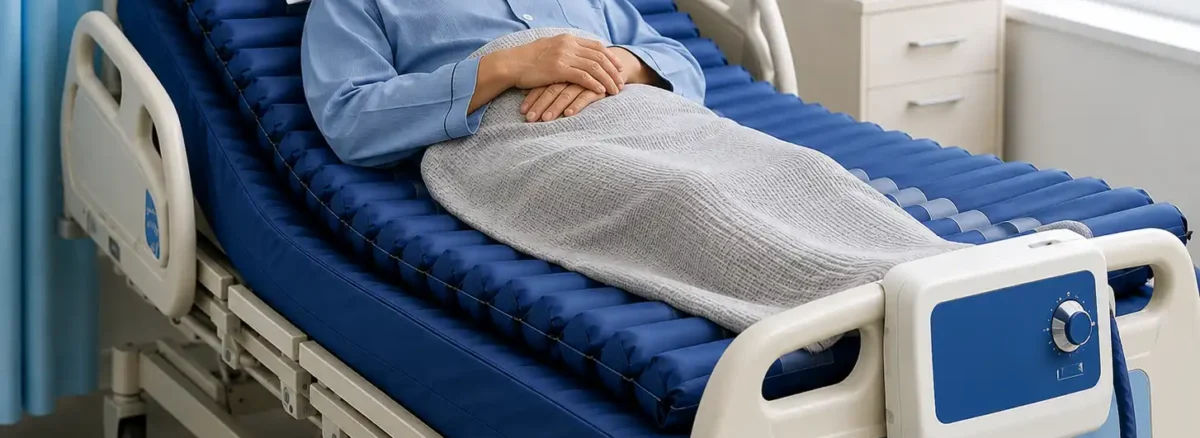
A pressure relief mattress is chosen by how much risk the person is under and how little they can move themselves, not by how soft it feels in the showroom or how much it costs. Almost every question that follows is settled by those two facts.
The labels on the boxes are little help. Foam, gel, static air, alternating pressure, hybrid, low air loss: the words describe genuinely different mechanisms, and the packaging seldom explains which mechanism suits which situation. This guide sets out how the choice is actually made, the one-minute check that tells you whether a surface is working, what each type does, why the cushion deserves as much attention as the bed, the trade-off that arrives with a very soft surface, and the setup errors that quietly cancel out an expensive piece of equipment.
On this page
- How do you choose a pressure relief mattress?
- Why comfort is the wrong test
- The hand check that settles it
- What each type of surface actually does
- The cushion is the half that gets forgotten
- The one spot no mattress covers
- The trade-off nobody mentions
- Setting it up so it does its job
- What to avoid
- Living with a powered surface
- When to ask for a reassessment
- Common questions
- The takeaway
How do you choose a pressure relief mattress?
By matching the surface to an assessed level of risk, to how much the person can shift their own weight, and to whether skin damage has already started. Those three inputs drive the decision, and a clinician who has looked at the skin is the one who weighs them.
Every surface in this category does the same underlying job. It lowers the pressure at any single point by spreading body weight over a wider area of contact. Immersion and envelopment are the terms for it. Immersion is how far the body sinks into the surface; envelopment is how closely the material wraps around the shape of the body once it has sunk in. A surface that allows both puts far less load on the sacrum or a hip than a firm one, because the same body weight is being carried by a much larger patch of skin.
Risk is the first input. Someone who can reposition freely in bed, has intact skin and is eating well sits at one end; someone unconscious, immobile after a stroke, or nearing the end of life sits at the other. Most people fall in between, and the assessment that places them there also considers circulation, body weight, moisture on the skin, nutrition and how ill they currently are.
Existing damage is the second. A person who already has an open pressure ulcer needs a surface capable of taking load off that specific site, which narrows the options considerably, and the depth of the wound changes what is appropriate. Our guide to pressure ulcer stages explains what those depths signify.
The third input is practical and gets underweighted. Where does the bed sit, is there a power outlet nearby, who will manage the pump, can the person still get out of bed unaided, and will the household actually keep the thing running. A surface that suits the biology and defeats the family is not the right surface.
Why comfort is the wrong test
The instinct when trying a mattress or a cushion is to sit on it and see whether it feels good. That instinct is why so much money gets spent on products that redistribute nothing.
Comfort is a surface sensation. It comes from the top inch or so of material yielding pleasantly under the skin, and it tells you almost nothing about what is happening deeper down, where soft tissue is being squeezed against bone. A plush topper can feel wonderful and still allow the sacrum to press through onto a firm base underneath. Meanwhile a properly specified foam mattress can feel unremarkable, even slightly firm, while spreading weight far more effectively.
Convoluted foam overlays, sold everywhere as egg crate toppers, are the clearest example. The peaks and troughs look purposeful and the material is soft to the hand. The layer is thin, it compresses flat under a bony prominence within minutes, and it is not regarded as a pressure redistribution surface for anyone at genuine risk. It adds comfort to a bed. That is the whole of its contribution.
The question that counts is whether bone is still reaching something hard once a whole body is lying on the surface, and there is a quick way to find out.
The hand check that settles it
Slide a flat hand, palm upward, under the surface directly beneath the bony point carrying the most weight, and feel how much material is left between your fingers and that bone.
For a wheelchair or armchair cushion, that means reaching under the cushion beneath the ischial tuberosities, the pair of bony points at the base of the pelvis you can feel through a wooden seat. For a mattress, it means reaching between the mattress and the bed base under the sacrum while the person is lying in their usual position. Keep the hand flat and do not press upward, which would give you a falsely generous answer.
Less than roughly an inch of material between your fingers and the bone means the surface has bottomed out: the person is effectively resting on whatever lies beneath it. A cushion or mattress in that state has stopped working, whatever it cost and however new it is.
Bottoming out has several causes, and each has a different fix. Foam that has been in daily use for a year or two loses its resilience and gives way permanently under the heaviest point, which is why an old foam cushion often carries a visible crater. An air cushion may simply need inflating, or may have a slow leak. A powered mattress may be set for the wrong weight, or the pump may be sitting in a static mode and no longer cycling. And sometimes the surface was never suitable for that person’s weight and build in the first place.
Repeating this check every few weeks costs a minute and catches the commonest way pressure relieving equipment fails, which is silently, while everyone assumes it is still doing what it did when it arrived.
What each type of surface actually does
Support surfaces split into two families. Reactive surfaces hold a constant low pressure: they conform to the body and stay there, and they need no power. Active surfaces change the loaded area over time, inflating and deflating cells in sequence so that no region carries weight continuously.
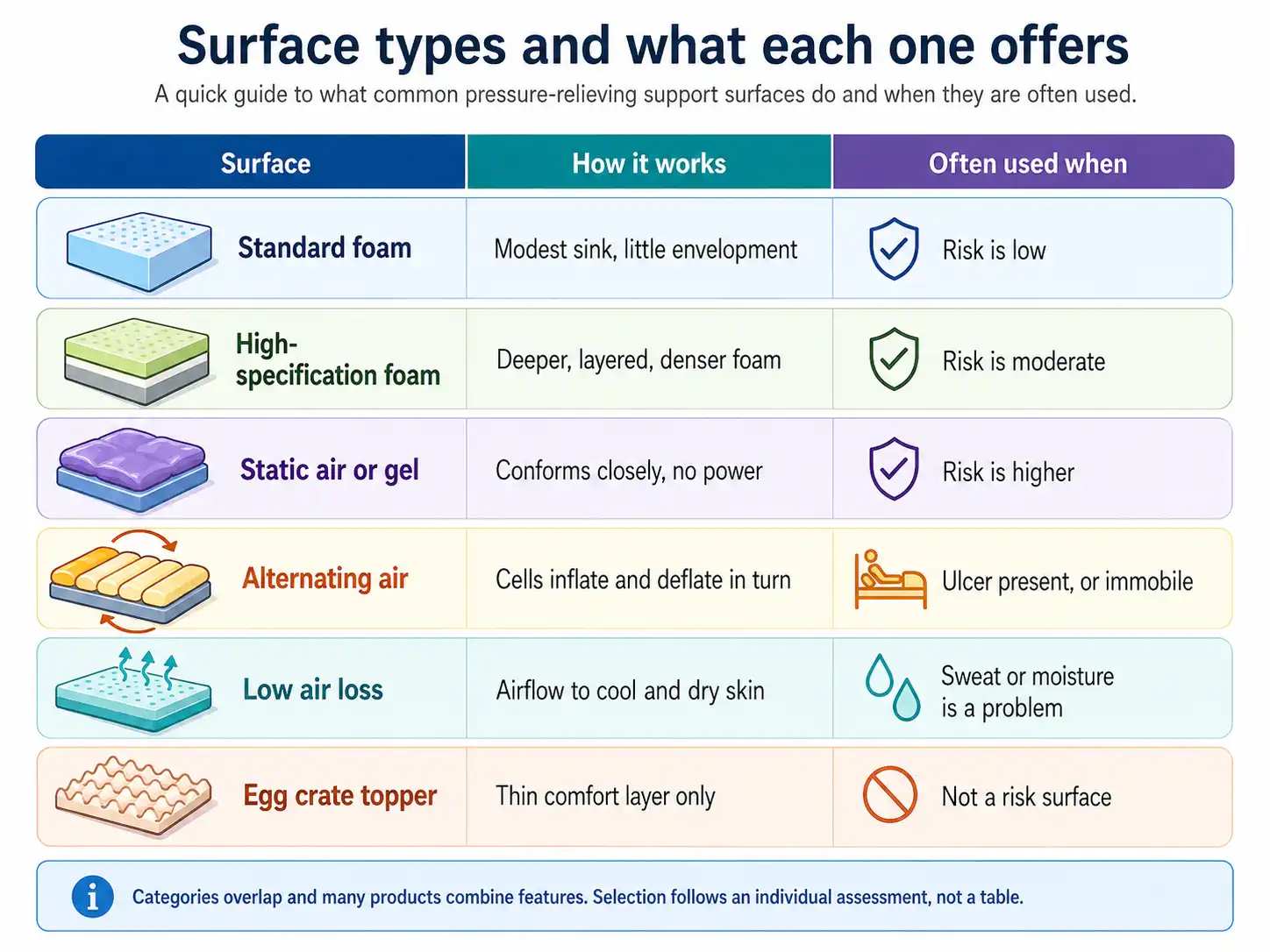
High-specification foam is the workhorse. It is thicker and denser than an ordinary mattress, often built in layers of differing firmness, and for people at risk it outperforms a standard hospital foam mattress by a clear margin. It is silent, needs no electricity, cannot fail mid-shift and asks nothing of the household.
Where risk climbs or a wound is already open, the choice usually moves to air. Static air surfaces hold a fixed volume and let the body sink deeply into it. Alternating systems take a different route, lifting the load off each strip of tissue in rotation. Both are widely used, and the honest position is that the research has not established one as reliably better than the other for every patient. The current international guideline from the pressure injury advisory panels, which devotes a full section to support surfaces for pressure injury prevention, treats the decision as one that turns on the individual instead of a ranking.
Low air loss adds a stream of air through the cover to carry away heat and sweat. That addresses microclimate, meaning the temperature and humidity right at the skin surface, and warm damp skin tears at loads it would otherwise tolerate. Where wetness dominates, the damage it leaves looks different and calls for different measures, a distinction separated out under moisture associated skin damage.
The cushion is the half that gets forgotten
A great deal of effort goes into the bed, and then the person spends nine hours a day sitting on whatever was already on the chair.
Sitting concentrates weight onto a much smaller area than lying does, so the pressure over the loaded tissue is higher and the time available before damage begins is shorter. Anyone who transfers to a wheelchair or a recliner for most of the day needs the seating solved with at least as much care as the mattress, and a pressure relief mattress on its own leaves that gap wide open.
Fit is the part that gets skipped. A cushion wider than the seat will curl at the edges and tip the person into a lean. One narrower than the seat lets the hips drop over the sides. Depth matters as well: the front edge should stop two or three finger widths short of the back of the knee, because a cushion that runs the whole length of the thigh presses into the soft tissue behind the knee and can restrict circulation to the lower leg. Measure the chair before ordering anything.
Air cushions bring one extra requirement. They work by letting the sitting bones sink in, so an over-inflated cushion is genuinely worse than a modest foam one: the person perches on a drum and the peak pressure goes up. Inflate it, sit on it, then release air until the hand check leaves an inch or so of cushion under the bony point. Check it weekly, since air escapes gradually and nobody notices the day it crosses the line.
The one spot no mattress covers
Heels remain at risk on every surface sold, including the most sophisticated ones, and it helps to know that before assuming the equipment has it covered.
The reason is anatomical. Almost nothing pads the heel bone, and it meets the bed over a patch the size of a coin, so load concentrates there in a way that spreading weight across a mattress cannot resolve. Heels need to be lifted clear of the bed entirely, using a pillow that supports the length of the calf or an offloading boot built for the job, and they need looking at daily.
The same logic governs a foot wound in someone with diabetes, where taking the weight off the site outperforms anything applied to it, a principle set out in our article on offloading a diabetic foot ulcer. A surface underneath reduces pressure. Only removing contact eliminates it.
The trade-off nobody mentions
Here is the consideration that rarely appears in a product description: the softer and more immersive a surface is, the harder it becomes to move on.
Someone who can still turn themselves in bed, sit on the edge and stand up needs something to push against. Sink them deeply into an air mattress and every one of those movements gets harder. People who were managing independently begin to need help; transfers become two-person jobs; and the small unconscious shifts that a person makes all night, which are themselves a form of pressure relief, become effortful enough that they happen less often.
The same applies in the chair. A very soft seat cushion reduces postural stability, and someone who has to fight to stay upright may end up sliding forward, which produces shear at the sacrum and undoes the point of the exercise.
None of this argues against powered surfaces where they are needed. It argues for matching the level of support to the person in front of you and reviewing it as they change. Somebody recovering mobility after an illness may be safer moving down to firm high-specification foam once they can move again, and it is reasonable to raise that step-down yourself instead of waiting for it to be offered.
Setting it up so it does its job
Delivery is not the end of the process, and several avoidable errors happen in the first week.
Set the weight dial correctly on any powered system. Most pumps have a control calibrated in kilograms or a soft-to-firm scale, and it exists because the same cell pressure that supports a large adult will leave a slight one floating on top of the cells with no immersion at all, while the reverse allows the pelvis to sink through to the base. Set it on arrival, and reset it if the person’s weight changes appreciably.
Learn what the pump’s modes mean. Alternating mattresses generally have a static setting, used for procedures and transfers, and a rapid deflate valve for emergencies. A mattress left in static mode is a plain air mattress that has stopped alternating, and this is a common finding when a wound appears on someone whose family believed the machine was working. Check the indicator light and listen for the cycle.
Keep the layers between skin and surface to a minimum. A fitted sheet is fine. Sheets pulled drum-tight are not, because a taut layer bridges the dips the surface is trying to create. Every additional incontinence pad, draw sheet and folded towel reduces the effect further, and a stack of them can cancel out most of what the mattress was bought to do.
Finally, keep the repositioning going. A surface bought to reduce pressure lowers how often a change of position is needed and does not remove the need for one, and any adjustment to the interval should come from the clinician who assessed the skin. Our guide on how to prevent bedsores covers building a routine a household can sustain.
What to avoid
Ring and doughnut cushions should not be used. Lifting the middle away from the seat sounds sensible, and the price is a narrow circle of tissue taking everything that was lifted, with the blood supply inside that ring squeezed off. They cause the injury they are sold to prevent.
Improvised supports carry the same flaw. Rolled towels, water-filled gloves, bags of saline and foam offcuts under a heel all create edges and loading points that nobody has measured, and they move out of position within the hour.
Do not buy a surface on a star rating and a marketing phrase. Terms such as orthopedic, memory foam or medical grade have no agreed technical meaning in this context, and a thick memory foam topper on a domestic bed is not equivalent to an assessed support surface. Where a wound already exists or risk is high, the specification needs to come from someone who has examined the skin.
Do not run a foam surface past its life. Foam softens with use and body heat, and a mattress or cushion that has flattened under the heaviest point is no longer redistributing anything, however clean the cover looks.
And do not let equipment become a reason to look less often. Skin inspection is what tells you the surface is right; the surface never tells you the skin is.
Living with a powered surface
This is the part that gets no mention at the point of supply, and it is often what the household ends up struggling with.
Pumps make noise. A low hum and a soft click as cells change over is normal, and it is also right beside somebody’s head all night. Some people stop noticing within a week. Others do not, and lie awake listening to it. Moving the pump to the foot end where the design allows, resting it on something that absorbs vibration instead of a hard floor, and checking the tubing is not rattling against the bed frame all help.
Then there is the motion. An alternating surface is gently moving underneath the person continuously, and a proportion of people find that unsettling or faintly seasick at first. It usually passes. Where it does not, say so, because a static air or foam surface may serve nearly as well for that individual and get used, which the disliked one may not.
Couples feel it too. A powered mattress on a single hospital bed frequently ends a shared bed after decades, and that loss deserves acknowledging instead of being treated as an administrative detail. Some households find a way to keep the beds side by side. Others cannot, and there is no reason to pretend that costs nothing.
Practical friction accumulates as well: the cable across the floor, the alarm that sounds at three in the morning because a connector has worked loose, the difficulty of making a bed whose surface keeps changing shape, the heat some people feel on an air surface in summer. None of it makes the equipment wrong. All of it belongs at a review, since most of it has a workaround and none of it improves by being endured quietly.
When to ask for a reassessment
Ask for the surface to be reviewed if a mark keeps appearing at the same spot, if the hand check shows the person bottoming out, if their weight or mobility has changed noticeably, if the equipment is more than a few years old, or if a wound has opened despite everything being followed.
A discolored patch over a bony point that is still there half an hour after the weight came off it is an early pressure ulcer, and it needs attention while it remains fully reversible. A purple or maroon area under intact skin, or a blister filled with dark fluid, warrants a same-day look, as damage of that kind starts deep and can open quickly. Skin that has already broken over the sacrum, a hip or a heel should be assessed, not dressed at home and watched.
Raised temperature, shaking chills, redness traveling outward from a broken area, heat and swelling, pain climbing without explanation, or thick or foul-smelling discharge all call for same-day medical attention. A fuller list of the signals worth acting on sits under how to tell if a wound is infected.
Common questions
Is an alternating mattress better than a static one?
Not automatically. Alternating and static air surfaces are both used for people at high risk, and the research has not shown one to be dependably superior across the board. The choice usually rests on the individual: how much they can move, whether a wound already exists and where it sits, their weight, and whether they tolerate the movement of an alternating surface.
Does a pressure relief mattress mean turning can stop?
No. A good surface lowers pressure at every point and can lengthen the interval between position changes, sometimes usefully at night. It does not address shear, it does nothing for a heel resting on it, and it does not replace repositioning. Any change to the schedule should be agreed with the clinician who assessed the person.
Are memory foam or egg crate toppers good enough?
For someone at real risk, generally not. Convoluted egg crate foam is a comfort layer that compresses flat under a bony prominence, and a domestic memory foam topper is not built or tested to the specification of a support surface. Either may be perfectly reasonable for a person who moves freely and has healthy skin.
How long does a pressure relief mattress last?
It depends on the type and how heavily it is used, and the honest answer is that the hand check tells you more than the age does. Foam typically softens gradually and loses effectiveness after a few years of daily use. Air systems can last longer, though pumps, cells and covers all eventually fail. Check for bottoming out periodically instead of waiting for a replacement date.
Do I need a cushion as well as a mattress?
If the person sits for any meaningful part of the day, yes. Sitting loads a smaller area at higher pressure than lying does, so a chair without a suitable cushion can undo overnight protection within a couple of hours. The cushion should be selected and sized for that specific chair.
Will insurance or Medicare pay for one?
Coverage for support surfaces depends on the plan, on documented clinical need, and often on evidence that other measures have been tried. Ask your clinician what documentation would support a request before ordering privately. Whether we can help arrange a surface for you is a question our team can answer on 888-391-4999.
The takeaway
Choosing a pressure relief mattress comes down to assessed risk, remaining mobility and whether skin is already broken, and comfort is close to irrelevant as a guide. Slide a flat hand underneath the surface beneath the bony point that carries the weight: less than an inch of material left means it has bottomed out and needs attention, whatever it cost.
Give the chair the same scrutiny as the bed, because sitting is where pressure concentrates hardest. Lift the heels clear, since no surface protects them. Set the pump correctly, keep the bedding layers thin, and remember that a very soft surface can quietly cost somebody the ability to move themselves. Above all, keep looking at the skin, because that is the only thing that ever confirms the choice was right.
Not sure the surface you have is the right one?
Marks that keep returning at the same site usually mean the surface, the seating or the interval needs adjusting. An assessment can work out which of the three is falling short.
Equipment, seating and the wound itself belong to the same conversation, and our chronic wound treatment service covers surface selection alongside the reasons a particular site keeps breaking down.
This article is general education and does not replace a clinical assessment. Mattress and cushion selection depends on an individual risk assessment, and any equipment that leaves marks on the skin, or that the person cannot safely move on, should be reviewed by a healthcare professional.