
How to prevent bedsores comes down to a single idea applied relentlessly: no patch of skin should carry the body’s weight for long enough to lose its blood supply. Mattresses, cushions, creams and charts all exist to serve that one purpose.
Most advice stops at “turn every two hours,” which sounds precise and quietly sets families up to fail. The interval that protects one person leaves the next with a mark on the sacrum by morning. Bedsores travel under other names too: pressure sores in everyday speech, pressure ulcers and pressure injuries in the notes, and each describes the same damage. This guide covers what a bedsore needs in order to form, where the two-hour figure came from, the six things that decide whether skin holds, why sitting in a chair is riskier than lying in bed, and how to build a repositioning schedule a real household can keep going for months.
On this page
- How do you prevent bedsores?
- Where the two-hour rule came from
- The six things that decide it
- The chair is the riskier seat
- Building a schedule someone can keep
- Mistakes that undo the plan
- The part of prevention nobody schedules
- When to have skin looked at promptly
- What families ask before starting
- The takeaway
How do you prevent bedsores?
By moving the load around often enough that no area of skin stays squeezed long enough to run short of blood, and by removing the other forces that damage tissue while the skin still looks intact.
A bedsore begins in a very ordinary way. Body weight presses soft tissue against a bone underneath, the tiny blood vessels running through that tissue are flattened, and the cells they supply stop receiving oxygen. Release the pressure early and the area floods with blood, flushes pink and recovers with nothing to show for it. Leave it, and the cells that were starved begin to die.
Pressure and time trade against each other. A heavy load briefly and a light load for hours can do comparable harm, which is why someone unable to shift position is at risk even on a soft surface, and why forty minutes on a hard edge is a risk for somebody mobile the rest of the day.
Then there is shear, the second force and the one people almost never hear about. When somebody slides down a bed that has been raised at the head, the skin grips the sheet while the skeleton keeps traveling. The layers in between get dragged in opposite directions, and the small vessels crossing them stretch and kink. Damage from shear starts deep, near the bone, and the surface can look perfectly normal for days while it develops. Sacral bedsores that appear on someone who has been repositioned faithfully are frequently shear injuries, not missed turns.
Preventing bedsores is therefore four jobs running at once: pressure relief, shear control, skin condition and nutrition. The sites at risk are wherever bone sits close to the surface, and the sacrum and the heels account for most pressure ulcers between them.
Where the two-hour rule came from
Two-hourly turning has been printed in nursing textbooks for decades, and it has been repeated to families for just as long. It is a reasonable starting point. It was never meant to be a law of biology, and current guidance no longer treats it as a number that suits everybody.
The reason is that the correct interval depends on three things the rule ignores. It depends on the surface the person is lying on, because a high-specification foam or air mattress spreads weight over a much larger area than an ordinary one and buys real time. It depends on the person: circulation, body weight, skin condition, how much sensation they have, how ill they are, whether they can make small adjustments themselves. And it depends on what the skin has been doing, which is the only feedback loop available.
The skin sets the interval, not the clock. If a discolored patch appears over a bony point and has not faded within about half an hour of the pressure coming off it, the interval is too long for that person on that surface. Shorten it. If skin stays clear for weeks at a given schedule, that schedule is working.
It cuts both ways. One family may be wearing themselves out on a two-hour cycle when a good mattress would support a longer night interval; another may find their relative marking up at ninety minutes and needs to know that two hours is not a safe default in their case. The National Library of Medicine’s patient guidance on preventing pressure injuries is a useful thing to have open when the plan is agreed.
The six things that decide it
Prevention routines vary in the details and rest on the same six components. Get all six roughly right and most people stay intact. Get five right and skip one, and the missing one tends to be where the bedsore appears.
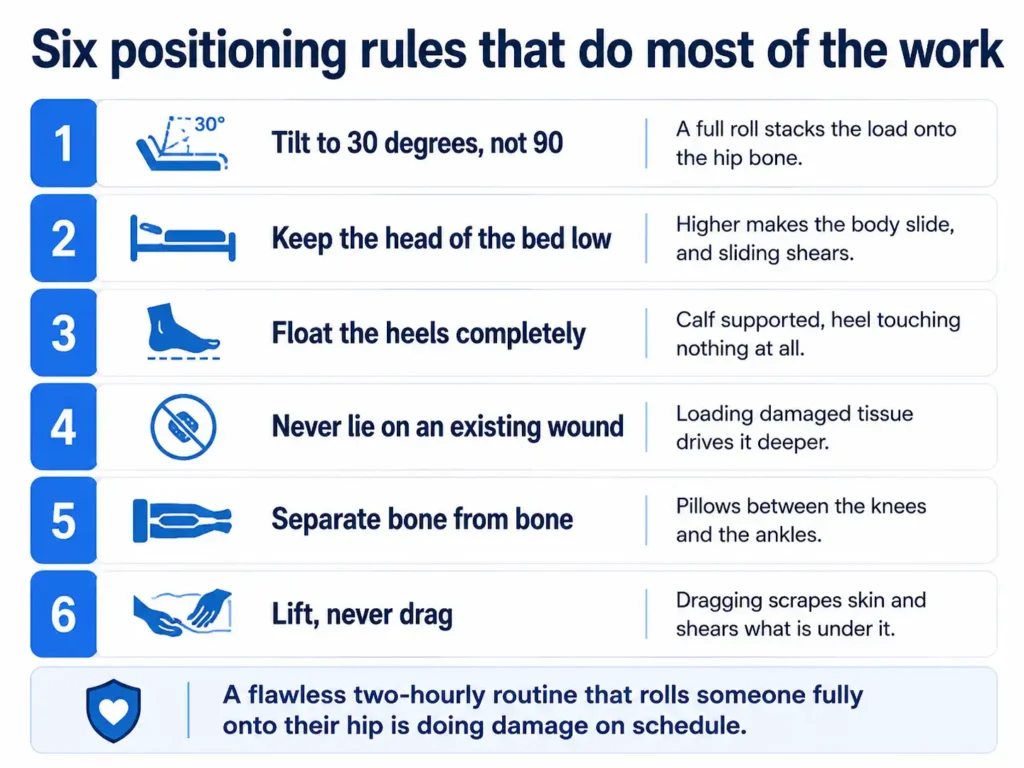
Reposition on an interval that fits the person
Repositioning is the core of it, and the goal is a real change of loaded site, not a nudge. Turning someone a few degrees leaves the same tissue bearing much the same weight.
Side-lying at roughly thirty degrees, propped with pillows behind the back so the person rests slightly tilted, is generally preferred to rolling fully onto the hip. A full ninety-degree turn parks body weight directly on the greater trochanter, the bony prominence at the side of the hip, which has very little padding over it. The gentler tilt keeps weight off the sacrum without transferring all of it to the next bony point along.
Rotate through positions instead of alternating between two. Back, tilted to the left, tilted to the right, and back again gives four loaded areas where two would otherwise share everything, and it doubles the recovery time each site gets. Medical conditions sometimes rule a position out, so agree the rotation with the nurse or clinician who knows the case.
The surface underneath does half the work
A support surface works by spreading body weight across a larger area, which lowers the pressure at every individual point. Foam mattresses designed for the purpose do this passively. Powered alternating-pressure mattresses inflate and deflate cells in sequence, so the loaded area changes continuously without anyone lifting a finger.
Which one suits depends on the level of pressure ulcer risk, the person’s weight and build, whether they can move at all independently, and practical questions such as where in the house the bed sits. Ask for that assessment explicitly: the gap between an ordinary household mattress and one selected for the job is substantial.
Two cautions. Layers of sheets, incontinence pads and folded towels piled on top of a pressure-relieving mattress reduce what it can do; keep the layers between skin and surface to the minimum. And a good mattress reduces how often repositioning is needed. It does not replace it.
Heels need lifting, not cushioning
The heel is the most common site for a bedsore after the sacrum, and the hardest to protect with a surface. There is almost no fat between the heel bone and the skin, and the contact area is small, so pressure concentrates there in a way that no mattress fully resolves.
The standard answer is to float the heels: place a pillow lengthwise under the calf so the whole lower leg is supported and the heel hangs clear of the bed entirely, with the knee left slightly bent instead of locked straight. Purpose-made offloading boots do the same job and stay in place better overnight. What does not work is a pillow shoved directly under the heel, which moves the pressure point a couple of inches and calls it a solution.
Heels also deserve a look every single day, the back and the sides included. A bedsore there can progress under skin that is still closed, and dry dark tissue on a heel is often left deliberately in place instead of being cleaned off. The reasoning behind that runs through our guide to the unstageable pressure ulcer.
Lower the head of the bed where you can
Raising the head of the bed above about thirty degrees starts the slow slide that produces shear at the sacrum, and sacral pressure ulcers follow from it. Where a person can lie flatter, they should; where they cannot, because of breathing, reflux or feeding, the head should come back down as soon as lowering it is safe.
Raising the knee section slightly before raising the head helps hold the body in place. So does checking every so often whether the person has drifted down the bed, since most of the sliding happens gradually and unnoticed.
Look at the skin every day, in good light
A daily inspection of every bony point takes a couple of minutes and is the step that catches a bedsore while it is still reversible. Check the sacrum, both heels, hips, elbows, shoulder blades, the back of the head, the ears, and anywhere a tube, catheter, oxygen strap or shoe presses.
Look for a change in color, then press it gently. Skin with a working blood supply goes white under a fingertip and refills a second or two after you lift it. Skin where a bedsore has started keeps its color throughout.
That test does less work on brown and Black skin, where the first sign is seldom anything a person would call red: a purple or bluish cast, or a patch that just looks different from what surrounds it. Your hands become the better instrument. Compare the spot with the area beside it for heat, coolness, hardness or a spongy give under the fingers, and treat any of those as the equal of a visible mark. Bedsores are caught late far more often on darker skin, and expecting that in advance is what closes the gap. Our explanation of pressure ulcer stages sets out what the earliest changes signify.
Keeping skin clean and dry belongs in the same two minutes. Sweat, urine and stool weaken the outer layer, and skin softened by moisture tears under forces it would otherwise survive. Where incontinence is a factor, a barrier product protects the area and lowers the pressure ulcer risk that comes with it. Damage caused by wetness looks different from pressure damage and calls for a different fix, a distinction drawn in detail in our comparison of moisture associated skin damage and pressure injury.
Protein, calories and fluid
Skin under load is tissue being asked to survive repeated injury, and it is rebuilt from what the person eats. Someone eating very little, losing weight, or living on tea and toast has thinner padding over every bony point and less material available for repair.
Protein and overall calorie intake carry most of this, and fluid matters because dehydrated skin is less elastic and less tolerant of pressure. None of it produces a visible result in a week, which is precisely why it slides down the list. Where appetite has dropped or weight is falling, ask for a dietitian referral: it is a routine request and it addresses something no mattress can compensate for.
The chair is the riskier seat
Advice on preventing bedsores concentrates almost entirely on the bed, and a great many pressure ulcers form in a chair.
Sitting upright funnels most of the body’s weight onto the ischial tuberosities, the two bones you can feel under the buttocks when you sit on a hard bench. The loaded area is far smaller than the area supporting a person lying down, so the pressure over it is far higher. Time works differently as a result: an interval that is generous in bed can be dangerous in a chair.
For someone at risk, position changes while sitting are usually needed every fifteen minutes to an hour, depending on the assessment and on what the cushion can do. A wheelchair user with arm strength may lift clear of the seat for around thirty seconds, lean well over to one side, or tilt the chair back where it has that function. Anyone who cannot manage that needs help to shift, or a cap on how long each spell of sitting runs. Hours in a chair, in the name of getting out of bed, can quietly cost more than they gain.
A cushion selected for pressure redistribution is not the same object as a comfortable seat pad, and the two are easily confused when buying one. The logic here is the same as the reasoning behind offloading a diabetic foot ulcer: no dressing, cream or cushion outperforms simply taking the weight off.
Building a schedule someone can keep
A schedule that exists on paper and collapses in week three has prevented no bedsores. Designing for what a household can sustain is a clinical decision, not a soft one.
Write it down somewhere visible, with the position and the time. Memory fails at four in the morning, and hardest of all when several people share the care. A sheet on the wall also gives a visiting nurse something to read and adjust, and settles the question of whether a turn actually happened.
Anchor turns to things that already happen. Meals, medication rounds, the end of a television program and bedtime are all easier to remember than an abstract clock time, and a routine attached to existing events survives a disrupted day. Where the interval is short, phone alarms carry the load better than good intentions.
Nights need their own answer, because waking someone every two hours wrecks sleep for the patient and the caregiver alike, and accumulated sleep debt is what usually breaks a schedule. That is the strongest argument for asking about a powered mattress: where one suits, the night interval can sometimes be safely extended, a decision belonging to the clinician who has assessed the skin. Splitting nights between two people, where two people exist, is the other half.
Then test it against the skin. Any repositioning schedule is a hypothesis about how long this person’s tissue tolerates load, and the daily check is the experiment. Marks appearing means shortening the interval or changing the surface; weeks of clear skin means the plan is holding.
Mistakes that undo the plan
Never rub a discolored patch that sits over bone. Generations of caregivers were taught this drew blood back into the area; it achieves the opposite, because those cells are already hurt and friction hurts them again. Wash the spot gently, dry it, and get the weight off it instead.
Ring and doughnut cushions belong in the bin. Whatever they lift off the middle, they load onto a narrow circle of tissue instead, and the blood supply inside that circle pays for it. Improvised props share the flaw: rolled towels, water-filled gloves and bags of fluid under a heel produce hard edges and pressure points nobody has measured.
Never haul or slide someone up the mattress. That motion is shear in undiluted form, and a slide sheet, a hoist or a second pair of hands heads off an injury no dressing afterward can reverse.
Do not treat equipment as permission to stop turning. A powered mattress reduces the frequency required and does not abolish it, and the sacral bedsore that develops on an expensive surface is almost always this mistake.
Skip the talcum powder, and avoid layering products on skin that is already protected. Powder cakes in skin folds and adds friction, and stacking a powder over a barrier cream produces a paste that does the job of neither. Keep the skin clean, dry and covered with one appropriate product.
Above all, do not write off a mark that will not fade because it looks trivial. That mark is the one point in the whole sequence where everything remains fully recoverable, and it is the point that passes unremarked most often.
The part of prevention nobody schedules
Preventing bedsores is invisible work that succeeds by producing nothing. Done well, it leaves no wound to point at, no improvement to photograph and no moment where anybody says well done. Months can pass without a scrap of feedback, and that wears on people in a way they rarely name.
The cost lands first on sleep. Broken nights, week after week, wear down judgment and patience before they wear down the body, and a caregiver running on four hours in fragments will eventually miss a repositioning or misread a mark. That is not a character failure; it is arithmetic, and it argues for asking someone else to take a night, not for trying harder.
It lands on the person being cared for too. Being moved on somebody else’s timetable, out of the position you find comfortable, several times a night, is genuinely unpleasant. People resist it, and the resistance gets read as poor cooperation when it sits closer to grief about lost control. Explaining what each turn is for, and leaving whatever choice remains (which side, what to hold, when within a window of a few minutes) restores something without costing the plan anything.
The inspections carry their own quiet cost, too, for the person examined and for whoever does the examining. None of that is grounds for stopping. It is grounds for saying so at appointments, because a plan built around an exhausted household gets followed, and a flawless one drawn up on the assumption that nobody needs sleep does not.
When to have skin looked at promptly
Report any discolored patch over a bony point still there half an hour after the pressure came off it, and report broken skin at any of those sites whatever its size. Both are early pressure ulcers until somebody says otherwise.
A purple or maroon area under skin that is still closed, or a blister containing dark blood, should be looked at the same day. That appearance suggests damage that began deep against the bone and worked upward, and it can open quickly.
Same-day attention is also the right response to a fever, shaking chills, a rim of redness creeping away from a broken area, skin gone hot and puffy, pain rising for no clear reason, or discharge that has turned thick or smells bad. The wider set of indications is gathered in our guide on how to tell if a wound is infected.
One signal is easy to blame on something else. An older person who turns suddenly muddled, becomes hard to rouse, or is simply not themselves may be showing the opening effect of an infection, and this can arrive before any fever does. Where a bedsore already exists, that shift warrants a call the same day.
What families ask before starting
How often should someone be turned to prevent bedsores?
There is no universal figure. Two hours is the traditional starting point in bed, and the right repositioning interval for a given person depends on the mattress they are on, their circulation and skin condition, how ill they are, and how the skin has responded so far. In a chair it is much shorter, often between fifteen minutes and an hour. A clinician sets it after assessing the person; the skin then confirms whether the setting was right.
Can bedsores always be prevented?
Many are preventable; some are not. A large share of bedsores are stopped by the ordinary measures: moving the load, a surface chosen for the job, skin kept clean and dry, and enough food and fluid. There are also people whose risk cannot be engineered away: very poor circulation, serious illness, and the last stage of life, where tissue can fail despite careful attention. Care then aims at catching a pressure ulcer while it remains reversible and keeping the person comfortable.
How quickly can a bedsore form?
Faster than most families expect. A pressure ulcer can begin within a few hours of unrelieved pressure, and in someone frail or with a poor blood supply it can begin sooner. A long spell on a hard surface (an emergency department gurney, an operating table, a chair nobody thought to move someone out of) is a well-recognized starting point for a pressure ulcer that surfaces days later.
Does a special mattress mean we can stop turning?
No. A pressure-redistributing or alternating-pressure mattress lowers the pressure at each point and can reduce how often repositioning is needed, sometimes noticeably at night. It does not remove the requirement for repositioning, and it does nothing about shear or about a heel resting on the surface. Any change to the schedule should come from the clinician who assessed the equipment.
What is the first sign of a bedsore?
A patch over a bony point that has changed color and stays changed after the weight comes off it. Press healthy skin and it blanches; this will not. It often feels different too (warm, cold, firm or slightly boggy), and it may be sore or itchy. Where skin is dark the change may not register as redness at all, so touch tells you more than sight.
Should reddened skin be massaged?
No. Massaging skin over a bony point that has changed color adds further injury to tissue that has already been damaged, and the practice has been dropped from guidance for that reason. Take the pressure off the area, keep it clean and dry, and have it assessed if it has not settled.
The takeaway
Knowing how to prevent bedsores is mostly a matter of keeping load moving and reading the skin honestly. Set the repositioning interval for the person and not from a textbook, put a surface underneath that spreads weight, lift the heels clear, keep the head of the bed low, inspect every bony point daily, and pay attention to what the person is eating and drinking.
Sitting deserves more suspicion than it gets, because a chair concentrates weight onto a small area and shortens the safe interval dramatically. And the schedule that protects skin over months is the one a tired household can genuinely follow, so design it around the people doing it. A discolored mark that will not fade is the moment to act, the last point at which a bedsore can still be called off entirely.
Worried about a mark that keeps coming back?
Skin that keeps marking at the same spot usually means the interval, the surface or the seating is not right yet. An assessment can work out which, and set a routine around what the household can sustain.
Skin at risk and skin already broken are handled together in our chronic wound treatment service, where the repositioning plan, the support surface and the reason a site keeps marking are looked at as one problem.
This article is general education and does not replace a clinical assessment. Repositioning frequency, mattress and cushion choice all depend on an individual assessment, and any discolored patch over a bony point that does not fade after pressure is removed should be reviewed by a healthcare professional.