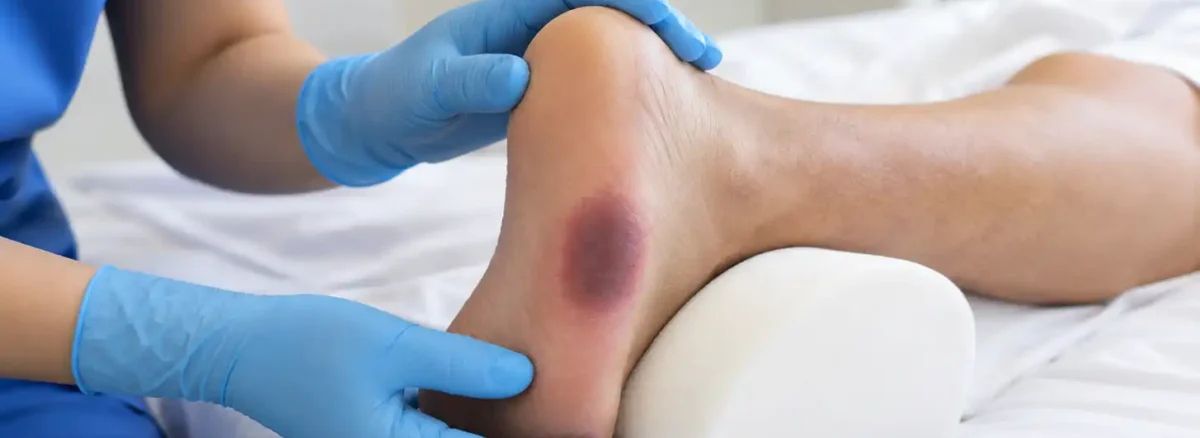
A deep tissue pressure injury is pressure damage that begins at the bone and works outward, which is why the skin above it can still be closed and unbroken while the muscle underneath has already died. The maroon or purple patch you can see is the last part of the injury to arrive, not the first sign of one starting.
That one fact changes how the mark should be read. It is not a bruise on its way out, and it is not an early warning that something might develop. It is the surface finally reporting damage that began hours or days earlier, somewhere it could not be seen. This guide covers what the discoloration means, the four things to check while the skin is still intact, why it is missed so often on darker skin, what usually caused it, and what tends to happen over the days that follow.
On this page
- What is a deep tissue pressure injury?
- Why the skin gives way last
- Four signs to check on closed skin
- Why darker skin makes this harder
- The single event behind most of them
- Why it carries no stage number
- The two ways it goes from here
- What helps in the first days
- What to avoid
- The week nobody can predict
- When to get it seen
- Questions families ask
- The takeaway
What is a deep tissue pressure injury?
It is a persistent patch of deep red, maroon or purple skin over a bony point, or a blister filled with dark blood, in someone whose movement has been limited. The color does not fade when you press on it, and it does not behave like a bruise, because the tissue below has been crushed against bone for long enough to die.
Non-blanchable is the word clinicians use, and it means exactly what it sounds like. Press a finger gently on ordinary red skin and the color drains away for a second, because you have squeezed blood out of vessels that are still working. Press on this and the color stays. The blood is no longer inside intact vessels, so there is nothing to push out of the way.
The label is reserved for damage caused by pressure and shear. It is not applied to bruising from a knock, to skin changes from poor circulation, or to a rash, even where the color looks similar. The National Library of Medicine hosts a clinical reference on pressure injury that carries the same definition a wound nurse works from, which is useful if you want to read the original wording.
Where it shows up is predictable. The tailbone and the sitting bones account for a large share, along with the heels, the outer hip and the shoulder blades. It also forms under equipment: oxygen tubing resting behind an ear, a neck collar, the rim of a cast, a catheter tube trapped beneath a thigh. Anywhere a hard surface meets a bone with thin tissue in between will do it.
Why the skin gives way last
Skin tolerates being squashed far better than muscle does. Muscle has a high demand for blood and very little tolerance for being deformed, so when body weight presses tissue between a mattress and a bone, muscle is the layer that fails first. Fat is next. Skin, the layer everybody watches, holds out the longest.
The result is an injury shaped like a cone standing on its point. It is widest down at the bone and narrows as it climbs toward the surface. That geometry explains something families find hard to accept later: the visible mark is the narrow tip of the damage, and whatever is happening underneath covers a bigger area than the patch you are looking at.
Shear makes it worse. Shear is what happens when the skin stays gripped to the sheet while the skeleton slides in the opposite direction, which is what a person does when they gradually slip down a bed with the head raised. The skin is anchored, the bone travels, and the soft tissue in the middle is dragged and stretched. Pressure alone damages tissue; pressure with shear does it faster and deeper.
There is one more mechanism worth naming, because it surprises people. When pressure lifts and blood floods back into starved tissue, that return can itself trigger a burst of inflammation that adds to the damage. This is a description of how the injury behaves, not an argument against repositioning. Relieving pressure is still the single most protective thing anyone can do.
Four signs to check on closed skin
Because the skin is intact, there is no wound to measure and no depth to describe. What is left is a short set of checks, and any one of them appearing over a bony point in someone with limited mobility deserves attention that day.
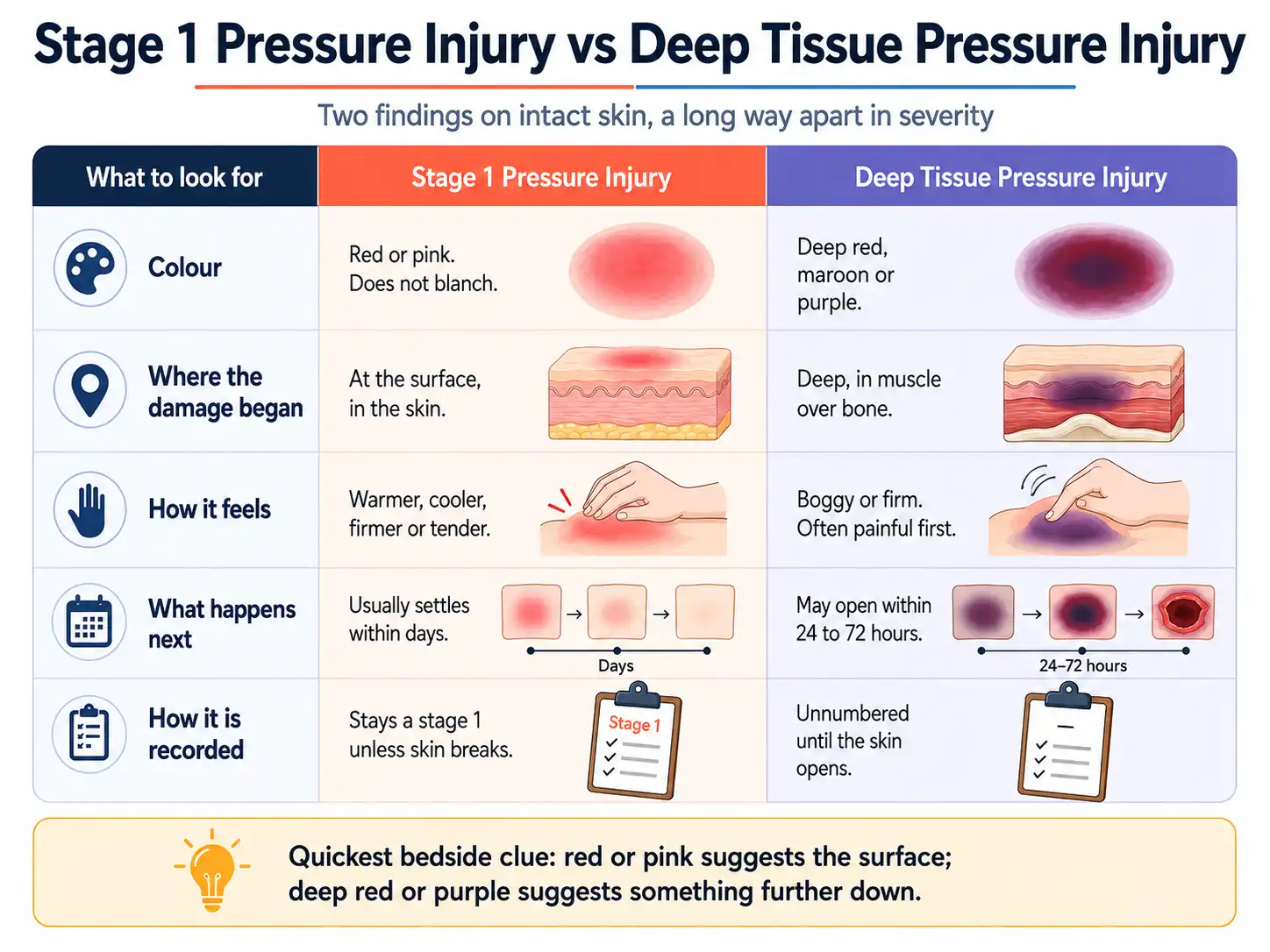
Texture is the one most people never think to test, and it is often the earliest thing available. Run the flat of your hand over the area and compare it to the tissue an inch or two away. Damaged deep tissue can feel swollen and squashy, like a sponge under the skin, or it can feel unusually hard and set. Either difference is meaningful.
Temperature follows a pattern that is easy to misread. Early on the area may feel warmer than the skin around it, because the body is mounting an inflammatory response. Later it may turn cooler, which is the more worrying finding, because it suggests blood is no longer reaching the tissue at all. The back of the hand reads small temperature differences better than the palm.
Pain deserves particular respect here. Someone who can speak will often complain about a spot days before anything shows on the surface, and being told there is nothing there is a common and damaging experience. If a person keeps returning to the same patch of skin, examine it properly. Wipe off any barrier cream first, use good light, and check what sits underneath every piece of equipment touching them.
Why darker skin makes this harder
Every description of this injury leads with color, and color is the least reliable sign on brown and black skin. Purple over deep pigment can read as a faint darkening, a dull gray cast, or a patch that simply looks slightly different from its surroundings in poor light. Under a dim bedside lamp it may not read at all.
The practical consequence is that the other three checks move up the list. Temperature difference, a boggy or hardened feel, and the person’s own report of soreness carry more weight when color cannot be trusted, and they should be sought deliberately instead of being treated as extras. Comparing the area against a matching spot on the opposite side of the body is more useful than trying to judge a shade in isolation.
Light matters more than most people realize. Natural daylight or a bright white lamp held close will reveal a change that overhead room lighting hides completely, and a small flashlight angled across the skin is a genuinely useful tool for this. Skin should also be dry and clean when it is inspected, since emollients and barrier creams both mask and mimic discoloration.
None of this is a minor detail. Pressure injuries are found later and at a more advanced stage in people with darker skin, and late detection is the difference between an area that recovers and one that opens. Anyone caring for a person with limited mobility should assume color will let them down and build the habit of touching the skin as well as looking at it.
The single event behind most of them
Here is the part that almost nobody is told, and it removes a great deal of unnecessary blame. This injury frequently traces back to one identifiable episode of prolonged pressure, not to weeks of drifting care.
Long surgery on a firm table is a classic setup. So is a fall at home where an older person lay on a hard floor for several hours before anyone found them. Hours spent waiting on an ambulance stretcher or an emergency department gurney will do it. So will a long journey in a wheelchair without a single shift of position, or a stretch of illness where someone stayed in one spot because moving hurt.
The damage is done during that episode. The color reaches the surface two or three days later, by which time the person may be somewhere else entirely, being looked after well. Families and care teams then hunt for what went wrong this week, and the answer is usually that nothing did. The mark appearing on a Thursday says very little about Thursday.
Equipment causes the rest. Tubing, straps, collars, splints, casts and monitoring leads all press a small hard object into skin that has no fat behind it, and they do it continuously because equipment does not shift when the person shifts. A patch appearing in an odd place, behind an ear or across the bridge of the nose, is almost always a device story.
Why it carries no stage number
Because the numbered stages describe how far down an open wound goes, and here nothing is open. A clinician cannot see fat, muscle or bone, so there is no depth to record, and guessing one would put a number in the notes that later turns out to be wrong.
It is also not a stage 1, although the two get mixed up constantly. A stage 1 is non-blanchable redness where the damage is confined to the skin itself. Deep red, maroon and purple say something different: that blood has pooled in tissue well below the surface. Same intact skin, different depth of injury, different outlook. How the numbered scale works is set out in pressure ulcer stages 1 to 4.
It is not unstageable either, which is the other category without a number. Unstageable means an open wound whose base is hidden under dead tissue, so the depth exists but cannot be seen. That distinction is explained in what an unstageable pressure ulcer means. Here the skin has not opened at all.
The paperwork has one lasting consequence. Should the area open and turn out to reach fat or muscle, a stage 3 or stage 4 is entered in the notes, and that label stays attached to the wound permanently, including through the months when it is closing over. The category is not a ranking of severity, and a wound described without a number is not a mild one.
The two ways it goes from here
There are only two outcomes, and which one arrives is usually decided within a week.
Some resolve. The discoloration lightens over several days to a few weeks, the tissue underneath softens back to normal, and the skin never breaks. This happens more often when the pressure came off early and the injured layer was thin. Nothing dramatic marks the recovery; the patch simply fades and stops being interesting.
Others declare themselves. The surface blisters, darkens further, or peels away, and an open wound appears where the patch was. This can move quickly, sometimes within a day or two, and the wound that emerges is often wider and deeper than the discoloration suggested. Dead tissue may cover the base, in which case a depth cannot be recorded until it is cleared.
A patch that opens up a few days after care improved is not evidence that the care failed. It is the injury that already existed becoming visible on its own schedule. Nothing available today can reverse tissue that died last week, and a team that repositioned diligently and still watched a wound appear did not cause it. Knowing this in advance spares a lot of families a fight they did not need to have.
What helps in the first days
The first job is to take every bit of pressure off that specific spot, which is stricter than it sounds. Less pressure is not the target. None is.
For a patch over the tailbone, that rules out lying flat on the back and rules out sitting upright in a chair for meals, however brief. Positioning on alternate sides, tilted instead of fully rolled, keeps weight off both the tailbone and the hip bone underneath. For heels, the answer is to lift them clear of the mattress entirely with a pillow supporting the calf and the heel hanging free, since a cushion under a heel still loads it.
The surface underneath does a share of the work that no schedule can replace, and this is the point at which many households discover their equipment is not up to the job. Choosing between the options is covered in the guide to pressure relief mattresses and cushions, and the repositioning side of it sits in how to prevent bedsores.
Beyond offloading, keep the area clean and dry, protect it from friction with a dressing a clinician has chosen, and inspect it at least twice a day in good light. A dated photograph taken from the same angle each time is far more useful than a memory of how it looked yesterday. Wet skin complicates the picture as well, and the damage that moisture alone causes is described in moisture associated skin damage.
Food and fluid belong in this list too. Tissue repair runs on protein and calories, and an older person eating poorly through an illness has less to work with. A dietitian or clinician can advise on what is realistic, which is a more honest answer than a supplement recommendation from a web page.
What to avoid
Do not rub or massage the area, however much it looks like a bruise that wants working on. The tissue there has already been crushed and stretched, and rubbing adds exactly the kind of shear force that produced the injury. This was taught as good practice decades ago and has been advised against for years.
Do not apply heat, and do not use a ring or donut cushion. A heat source raises the metabolic demand of tissue that already cannot get enough blood. A ring cushion transfers load onto the circle of skin around the hole and reduces blood flow in the middle, which is the opposite of what the shape appears to promise.
Do not wait for it to fade. A bruise fades, and treating this as one costs the days when removing pressure still changes the outcome. In the same spirit, do not open or drain a blood-filled blister at home; that blister is a roof over damaged tissue, and it stays where it is until a clinician decides otherwise.
Do not cover it with a thick opaque dressing that then goes unopened for days, and do not smother it in barrier cream before someone is due to assess it. Both hide the one thing everybody needs to watch. Finally, do not let anyone talk about it as a mark that appeared overnight because of something done that morning, which sends the conversation somewhere unproductive.
The week nobody can predict
The waiting is the hardest part of this particular injury, and it gets very little acknowledgment. For a week or more nobody can tell you whether the patch will fade quietly or open into a wound that takes months, and no test will settle it early. Families check it hourly, photograph it obsessively, and read the smallest change as a verdict.
Blame usually arrives with the uncertainty. Relatives suspect the facility, facilities point at the hospital stay, and adult children who were doing everything asked of them decide privately that they missed something. The origin story is often an ambulance, an operating table or a night on the floor, and saying that out loud early tends to defuse a great deal of it.
The person with the injury has their own version of this. Being sore in a place that looks almost normal, and having that doubted, is genuinely distressing. Add the loss of positions they are allowed to use, no sitting up to eat with everyone else, no favorite side to sleep on, and a routine that now involves being turned through the night, and the cost is more than skin deep.
Ask the team directly what they are watching for and what finding would change the plan, since a stated threshold is easier to live with than open-ended waiting. It also helps to treat the photographs as a job, taken once or twice a day at set times, so the rest of the day does not have to be spent inspecting a patch of skin.
When to get it seen
Any new patch of discolored skin over a bony point in someone with limited mobility should be assessed within a day or two. That is not a wait-and-see finding, because the window in which offloading changes the outcome is measured in days.
Seek care the same day for a raised temperature or shaking chills, redness or warmth traveling outward beyond the patch, pain climbing quickly, any drainage or smell, or new confusion in an older adult. Confusion in particular is easy to blame on a bad night and is one of the ways infection announces itself in older people. The wider set of signals is laid out in how to tell if a wound is infected.
Book a review sooner than planned if the skin blisters or breaks, if the area spreads, or if the position that keeps weight off it is one the person cannot hold at home. That last situation is an equipment and support problem, and it is fixable, but only once somebody knows about it.
Questions families ask
Is a deep tissue pressure injury just a bruise?
No. A bruise comes from a blow, sits wherever the impact landed, and fades through green and yellow over a week or two. This sits over a bone in someone who has been immobile, has no impact behind it, does not blanch when pressed, and can open into a wound instead of fading. The color is the only thing the two share.
Can it heal without the skin ever breaking?
Yes, and a fair number do. Where the pressure came off early and the injured layer was shallow, the discoloration can fade over days to weeks with no open wound at any point. That outcome is more likely the sooner the area is kept completely free of weight, which is why the first few days matter so much.
How quickly can this kind of damage happen?
Faster than most people expect. Deep tissue can be injured within a few hours of continuous pressure, and in someone frail or poorly perfused it can take less. The visible mark then lags behind, typically appearing one to three days later, which is why the timing of the discoloration is a poor guide to when the harm occurred.
Why did it get worse after we started turning him?
Almost always because the damage was already done and simply became visible on schedule. Tissue that died several days ago will break down whatever happens next, and repositioning cannot bring it back. Improved care during that week protects the surrounding skin and everywhere else on the body, even when it cannot rescue the area that is already lost.
What stage is a deep tissue pressure injury?
It has no number. The numbered stages describe visible depth in an open wound, and this one has intact skin, so nothing can be measured. It sits in its own category alongside unstageable wounds. Should it later open and expose fat or muscle, a number is assigned at that point and kept.
Can this happen to someone who is not bed-bound?
Yes. Wheelchair users develop it over the sitting bones, and it turns up after long surgery in people who walk in and walk out. It also forms under equipment on someone fully mobile, behind an ear from oxygen tubing or under the edge of a cast. Continuous pressure on one spot is the requirement, not being confined to bed.
The takeaway
A deep tissue pressure injury is damage that started at the bone, and the purple patch on the surface is the tip of it, not the whole of it. Because muscle fails long before skin does, unbroken skin proves nothing about what is underneath.
Check four things where color cannot be trusted: how the area feels, how warm it is, whether the color moves under a finger, and whether the person says it hurts. Take every bit of weight off the spot immediately, because that is the intervention with a time limit on it. And expect one of two endings, either a quiet fade or an opening within about a week, with the second outcome reflecting damage already done and not care recently given.
Found a purple patch that will not blanch?
Discolored skin over a bony point is assessed by examining the area, the surface the person lies on, and how long the pressure has been there. The first few days are the ones where taking weight off still counts.
An area at this stage is assessed by the chronic wound treatment service, which looks at the surface a person is nursed on, the positions available to them, and how to keep weight off the site while it declares itself.
This article is general education and does not replace a clinical assessment. Skin that is discolored, boggy or sore over a bony point in a person with limited mobility should be examined in person, and no blister or darkened area should be opened, drained or massaged on the strength of a web page. A raised temperature, new confusion or redness spreading beyond the patch needs attention the same day.