
An unstageable pressure ulcer is a wound whose base is buried under dead tissue, so nobody can see how far down the damage reaches. The word describes what can be observed on the day, not how serious the wound is.
Underneath that covering is a full-thickness wound, which means it has gone through the entire depth of the skin. Once the dead tissue is gone, it turns out to be a stage 3 or a stage 4. Which of the two cannot be established while the base is out of sight, and that is the whole reason the label exists.
Families hear this word and reasonably assume it means the wound is beyond classification, or beyond help. It means neither. This guide covers what is lying over the wound, why some of it is removed and some of it is deliberately left in place, what happens between now and a stage being recorded, and why a wound frequently looks bigger after it has been cleaned than it did before.
On this page
- What does an unstageable pressure ulcer mean?
- What is sitting on top of the wound
- Why a number cannot be recorded yet
- Unstageable is not a stage 5
- The black heel that is left alone on purpose
- What gets assessed before anything is removed
- How the covering comes off
- Why the wound can look worse afterward
- What helps while the depth is unknown
- Mistakes that make this harder
- Living with a wound nobody can measure yet
- When to call the same day
- Questions families ask most
- The takeaway
What does an unstageable pressure ulcer mean?
It means the depth is hidden. Staging a pressure wound works by looking at which tissue layer has been lost, and that requires a clear view of the wound bed. When dead tissue covers the bed, the layer underneath is anybody’s guess, so no number goes in the notes.
Two facts hold regardless. The wound is full thickness, because dead tissue of this kind does not form in a shallow one. And the eventual number will be either 3 or 4, since those are the two full-thickness categories in the system that pressure ulcer stages works through in full.
The label is temporary by design. Nearly every unstageable wound gets a number in the end, usually within days to a few weeks, once the covering has been dealt with. A small group keep the label for longer, and that is almost always a heel with a hard dry crust on it, for reasons covered further down.
What is sitting on top of the wound
Dead tissue in a wound takes two forms, and knowing which one you are looking at explains most of what happens next.
Slough is soft dead tissue. It is yellow, tan, gray or greenish, wet to look at, often stringy, and it clings to the wound bed like wet tissue paper. People frequently mistake it for pus. It is not: pus is fluid that can be wiped away, while slough is attached and stays put.
Eschar is dry dead tissue. It is brown or black, hard, and often has the texture of leather or an overcooked scab. Eschar forms when dead tissue dries out and shrinks, and on a heel it can be so firm and so flat that it looks more like a scab than a wound.
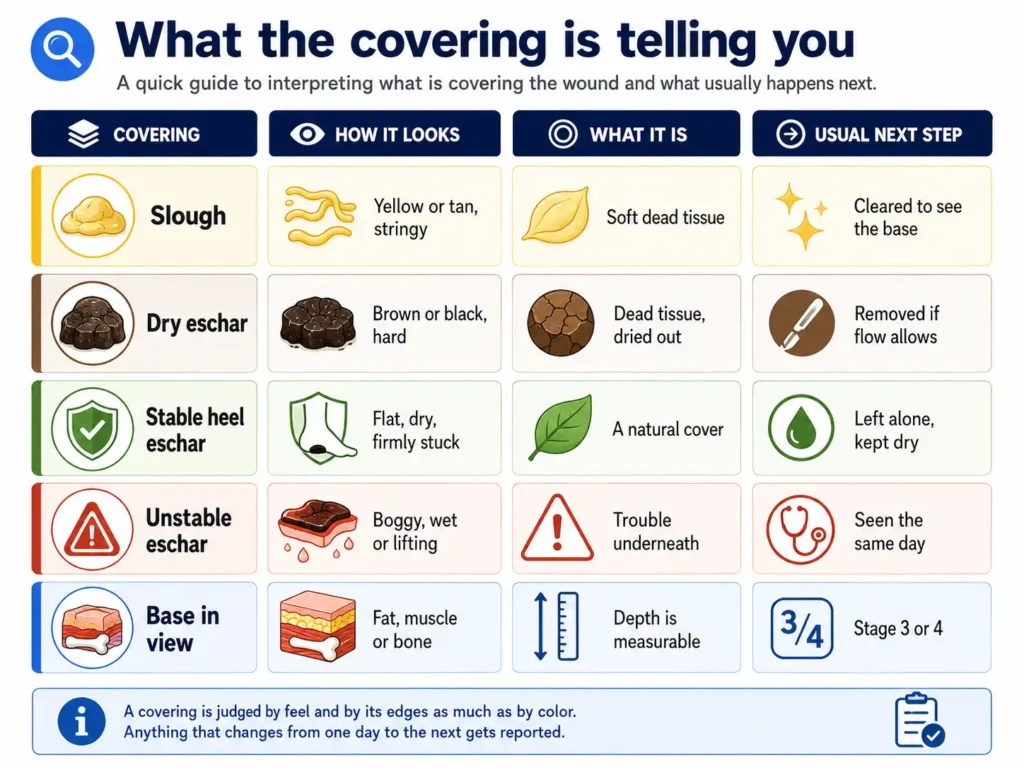
Both can appear in the same wound, with a dry center and softer material around the rim. And both are the body’s own tissue, not an infection and not dirt. That distinction spares a lot of unnecessary guilt in households where somebody has decided the wound looks this way because they missed something.
Why a number cannot be recorded yet
Because a stage is a measurement of depth, and depth is measured by what the eye can see at the bottom of the wound.
A clinician assigning a stage is answering one question: what is the deepest tissue that has been lost? Fat visible at the base puts the wound at stage 3. Muscle, tendon, ligament, cartilage or bone puts it at stage 4. With a lid of slough or eschar in the way, neither answer is available, and guessing at it would produce a record the next clinician cannot trust.
There is a practical reason this matters beyond the paperwork. The stage feeds into what gets planned. A wound down to bone raises the question of whether the bone itself has become infected, which changes the treatment considerably. What raises that suspicion in the first place is covered under osteomyelitis foot ulcer. Until the base is visible, that question sits open, which is one more argument for clearing the covering when it is safe to do so.
Depth is also the one thing on the wound chart nobody can estimate from above. Length and width can be measured through a covering. Drainage, odor and the state of the surrounding skin are all assessable. Depth is not, and it happens to be the measurement the classification depends on.
Unstageable is not a stage 5
No such stage exists. The scale stops at 4, and unstageable sits outside the numbers instead of above them.
The confusion is understandable. The word arrives sounding like a verdict, it usually arrives about a wound that looks alarming, and it often arrives in the same breath as the phrase “we cannot tell how deep it is”, which nobody finds reassuring. The term is a statement about visibility. Two wounds of identical depth can be described differently on the same afternoon, purely because one has a clear base and the other does not.
It also is not a stage a wound has deteriorated into. A stage 3 that develops a layer of slough over its base becomes unstageable without getting any deeper. It has not progressed; it has become harder to look at. When the slough clears, the same stage 3 is recorded again.
One further point catches people out. A wound that turns out to be a stage 4 keeps that number for the rest of its life, even as it improves. It is described as a healing stage 4 and never re-labeled downward, because the muscle and fat that were lost do not grow back and the scar filling the space is weaker than what it replaced.
The black heel that is left alone on purpose
This generates more complaints than any other part of the topic, and it is usually a correct decision being misread as neglect.
A heel carrying hard black eschar, where the crust is dry, flat, firmly attached and has no redness, swelling, softness or fluid around it, is described as stable. Stable eschar is generally left where it is. It is sealed, it keeps bacteria out, and the tissue beneath it is protected in a way no dressing manages as well. The organizations that publish the international pressure injury guideline treat intact dry eschar on a heel as a covering to preserve, not a problem to solve.
The reasoning is about blood supply. Feet and heels sit at the far end of the circulation, and they are where a shortfall in blood flow shows up first. Cutting that crust away creates an open wound which then has to heal, and healing takes an adequate blood supply arriving at the site. Where the supply is poor, opening the heel can turn a sealed, stable situation into an open one that will not close. What a shortfall of that kind does to a wound is the entire subject of the arterial ulcer.
Left alone does not mean ignored. A stable heel is inspected at every visit, kept dry, and floated clear of the mattress so nothing presses on it. The instruction to the household is usually to keep it dry and report any change, and the changes that count are specific: softening, wetness, a boggy feel, drainage, odor, new redness around the edge, or the crust starting to lift. Any of those turn a stable heel into an unstable one, and an unstable one needs looking at promptly.
What gets assessed before anything is removed
Debridement, the removal of dead tissue, is not automatic. Several things are established first, and they determine whether it goes ahead at all.
Can the blood supply support an open wound?
On a leg or foot, this is the first question asked. A clinician may check for a pulse in the foot, compare the color and temperature of the skin against the other leg, ask whether walking brings on calf pain, and arrange a simple blood pressure comparison between ankle and arm. How to read that figure, and what it predicts about healing, is covered under ankle-brachial index. Where the supply looks inadequate, a vascular opinion may come before any debridement instead of after it.
Is the covering stable or unstable?
A dry, adherent, quiet crust is treated very differently from one that is soft, wet, lifting at the edges, draining, or ringed by redness and swelling. The second suggests something active underneath, and that generally moves debridement up the list whatever the circulation looks like, because a sealed pocket of infection is a worse problem than an open wound.
Can the person heal what gets opened?
Nutrition, blood glucose control, medication, other illnesses and how much pressure the site is still taking all feed into the decision. Someone at the end of life may reasonably be offered comfort, odor control and protection in place of an aggressive clearance that would cause pain for a result they will not live to see. That is a legitimate plan, chosen deliberately and not by default.
How the covering comes off
Several methods exist for clearing dead tissue, and they differ mainly in speed and in how selective they are.
The quickest is sharp debridement, where a clinician cuts the dead tissue away with a scalpel, curette or scissors. Small amounts can often be done at the bedside or in clinic with local anesthetic; larger clearances may be done in an operating room. Because a trained eye chooses what to cut, healthy tissue is left in place, and this route reveals the base soonest.
Slower methods work over days. An enzyme ointment can be applied to break dead tissue down chemically. A moisture-retaining dressing can let the body’s own enzymes soften and lift it, which is gentle and painless but takes longer and needs the surrounding skin protected from the fluid that results. Specialized pads and cloths can wipe away loose surface material at a dressing change. In some settings sterile medical maggots are used to consume dead tissue very selectively, which sounds worse than it is and works well in wounds where cutting is difficult.
Which route is chosen depends on how urgent the situation is, how much tissue there is, whether infection is suspected, how much pain the person can tolerate and where the wound sits. More than one is often used in sequence, with an ointment or dressing softening a hard crust so it can be cut away comfortably a few days later. Those less common methods sit within our advanced wound care service.
Why the wound can look worse afterward
Expect it to. A wound that has been debrided is usually wider, deeper and more open-looking than the one you saw the week before, and families regularly conclude something went wrong.
Nothing did. The covering was hiding the true size of the wound as well as its depth, and it was frequently holding the edges together. Taking it away does not enlarge the damage; it exposes damage that was already present. The measurement recorded after debridement is the first honest one, which is why the numbers on the chart can appear to jump in the wrong direction on the very visit that improved things.
The other common surprise is what the base turns out to contain. A crust the size of a coin can sit over a cavity extending sideways under intact skin, and pockets or narrow tunnels are found at this point fairly often. Those get measured and packed, and they change the dressing plan more than they change the outlook.
What follows tends to be more encouraging. A clean wound bed is where healing actually starts, and progress from that point is visible in a way it never was while the base was covered.
What helps while the depth is unknown
Waiting for a stage does not mean waiting to do anything. Most of the treatment that decides the outcome starts before the number is known, because it addresses the cause and not the classification.
Getting the load off the site does the heaviest lifting. No wound closes while it is still being squeezed, and the site needs to be genuinely clear of pressure, not merely on a better mattress. Heels come off the bed with a pillow under the calf; a wound on the sacrum or buttock means changing position on a schedule set for that person, not a generic one. The same principle decides whether a foot wound closes, which is the case made in offloading a diabetic foot ulcer.
Food counts for more than most people are told. Rebuilding tissue takes protein, calories, fluid and, for some, extra vitamins or minerals, and a deep wound drains protein continuously. Appetite and weight get asked about at wound appointments for that reason, and a poor answer will slow healing more than any dressing choice can compensate for.
Keeping the skin around the wound clean and dry protects it from the fluid the wound produces, and managing incontinence promptly protects it from a second source of damage. The other useful contribution from home is observation. Photographs on a phone at each dressing change, taken from the same distance in the same light, give a clinician a far better sense of the direction of travel than a description from memory.
Mistakes that make this harder
Do not pick, cut, peel or scrape at slough or eschar yourself. This is the single most damaging thing a well-meaning household can do. Where the crust is sealing a poorly supplied heel, lifting it opens a wound that may not close. Where it is stuck to healthy tissue underneath, pulling at it tears the tissue that was going to do the healing.
Do not soak, cream, oil or otherwise soften dry eschar on a heel unless a clinician has specifically asked you to. Moisture is exactly what turns a stable crust into an unstable one, and it is easy to do by accident with a moisturizer applied to the whole foot.
Keep hydrogen peroxide, undiluted antiseptics, bleach solutions and alcohol away from the wound. They damage the new cells doing the repair and they will not shift dead tissue. Iodine preparations are sometimes used deliberately by a clinician to keep a heel crust dry, which is a different thing from household antiseptic poured on at home.
Do not assume the plan is on hold because no stage has been recorded. And do not treat the dressing as the treatment. A wound still taking weight has not started healing, however good the product on top of it looks.
Living with a wound nobody can measure yet
The uncertainty is its own burden, and it is rarely acknowledged in the appointment.
Being told a wound cannot be staged leaves a family without the one thing they were hoping to take away: a sense of scale. There is no number to look up, no timeline to plan around, and no way to answer the relatives who ask how bad it is. People fill that gap with the worst case, and they usually fill it alone, at night, on a search engine.
Caregivers carry a particular version of this. A black heel or a covered sacral wound looks dramatic, and the person changing the dressing is often a son, daughter or spouse who was doing none of this three months ago. Guilt attaches quickly, especially where somebody believes the wound formed on their watch. Pressure damage can develop within hours in a person who is unwell and immobile, and it can begin deep and surface later, meaning it was frequently underway before anything was visible to notice.
The practical side wears people down too. Dressing changes take time, drainage and odor keep visitors away, and repositioning through the night costs sleep on both sides of the bed. Odor in particular is treatable and badly under-reported, since charcoal dressings and clearing dead tissue both address it directly.
Say all of this out loud at the appointment. Asking directly what the plan is for reaching a stage, how long it is expected to take and what would change it turns an open-ended worry into a timeline. And describing honestly what is manageable at home, instead of what was recommended, usually produces a plan that actually gets followed.
When to call the same day
Contact the care team the same day if a dry crust turns soft, wet or boggy, if it starts lifting at the edges, if fluid appears from underneath it, if the skin around it becomes red, hot or swollen, or if a new odor develops. Those changes suggest something is happening under a covering that was previously sealed.
Seek urgent medical attention for a raised temperature or shaking chills alongside the wound, redness traveling outward from it, pain climbing quickly, or a wound that has begun to smell strongly and drain heavily over a short period. In an older adult, new confusion or unusual drowsiness can be the earliest sign of infection and can appear before any temperature does.
Book a review, without urgency, if weeks are passing with no plan for clearing the covering, if nobody has explained why a heel is being left alone, or if the wound is producing odor or drainage that is affecting daily life. Each of those is a reasonable thing to ask about, and none of them requires waiting for the next scheduled visit.
Questions families ask most
Is an unstageable pressure ulcer worse than stage 4?
No. It is a full-thickness wound that will be recorded as a stage 3 or a stage 4 once the base can be seen, so at worst it equals a stage 4. The term reflects what is visible, not the severity of the damage.
How long does a wound stay unstageable?
Usually days to a few weeks, depending on how the dead tissue is cleared. Sharp debridement can reveal the base in a single visit. Ointments and dressings work over one to three weeks. A stable heel crust being left in place on purpose may keep the label for months, which is an intended outcome and not a delay.
Why will nobody remove the black tissue from my mother’s heel?
Most likely because it is dry, firmly attached and showing no sign of infection, and because the blood supply to that foot may not support an open wound. In that situation the crust is doing a protective job. Ask directly whether the circulation has been checked and what would change the decision, and report it immediately if the crust softens or the skin around it reddens.
Does unstageable mean the wound is infected?
Not by itself. Dead tissue is the body’s own tissue that has died, and it can sit in a wound with no infection present. It does give bacteria somewhere to live, so infection is more likely than in a clean wound, and that is one of the reasons clearing it is usually preferred. Infection is judged on redness, warmth, swelling, pain, drainage, odor and how the person feels overall.
Is debridement painful?
Dead tissue has no feeling in it, so removing the tissue itself is often less uncomfortable than expected. Sensation returns at the border with living tissue, and pain relief or local anesthetic is used where that border is reached. Say if a dressing change hurts, since pain can be planned for and the gentler methods exist partly for this reason.
Can an unstageable pressure ulcer heal?
Many can, though full-thickness wounds take months and some need surgery to close. What decides it is largely whether the pressure comes off the site, whether the blood supply is adequate, whether infection is controlled and whether the person is getting enough nutrition. Depth is only one factor among those.
The takeaway
Unstageable describes a view, not a verdict. Dead tissue is covering the base of a full-thickness wound, so the depth cannot be seen, and the number that eventually goes in the notes will be a 3 or a 4.
Most of these wounds get their number within days or weeks of the covering being cleared. The heel is the exception worth understanding: a dry, flat, firmly attached crust with quiet skin around it is protecting the tissue underneath, and on a foot with a poor blood supply, removing it can cause the harm it appears to prevent. Watch for softening, wetness, lifting edges, redness or odor, and report any of those.
Meanwhile the treatment that decides the outcome is already running. Pressure off the site, enough protein and fluid, protected surrounding skin and an eye on the wound each day all count for more than the number does.
Waiting to find out how deep a wound goes?
Clearing a covered wound bed safely depends on the blood supply, the state of the covering and what the person can heal. An assessment can settle those questions and set out how the depth will be established.
Wounds whose base cannot yet be seen are dealt with in our chronic wound treatment service, together with the debridement that uncovers them and the pressure relief that decides whether they close.
This article is general education and does not replace a clinical assessment. The decision to take dead tissue off any particular wound is made in person, once the blood supply and the condition of the covering have been examined. Dry eschar on a heel should never be cut, soaked or softened on the strength of a web page.