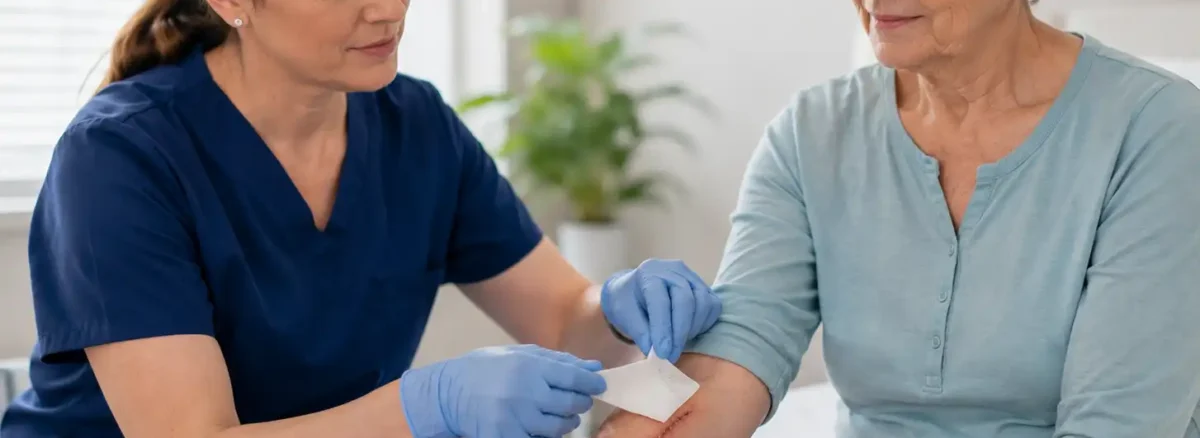
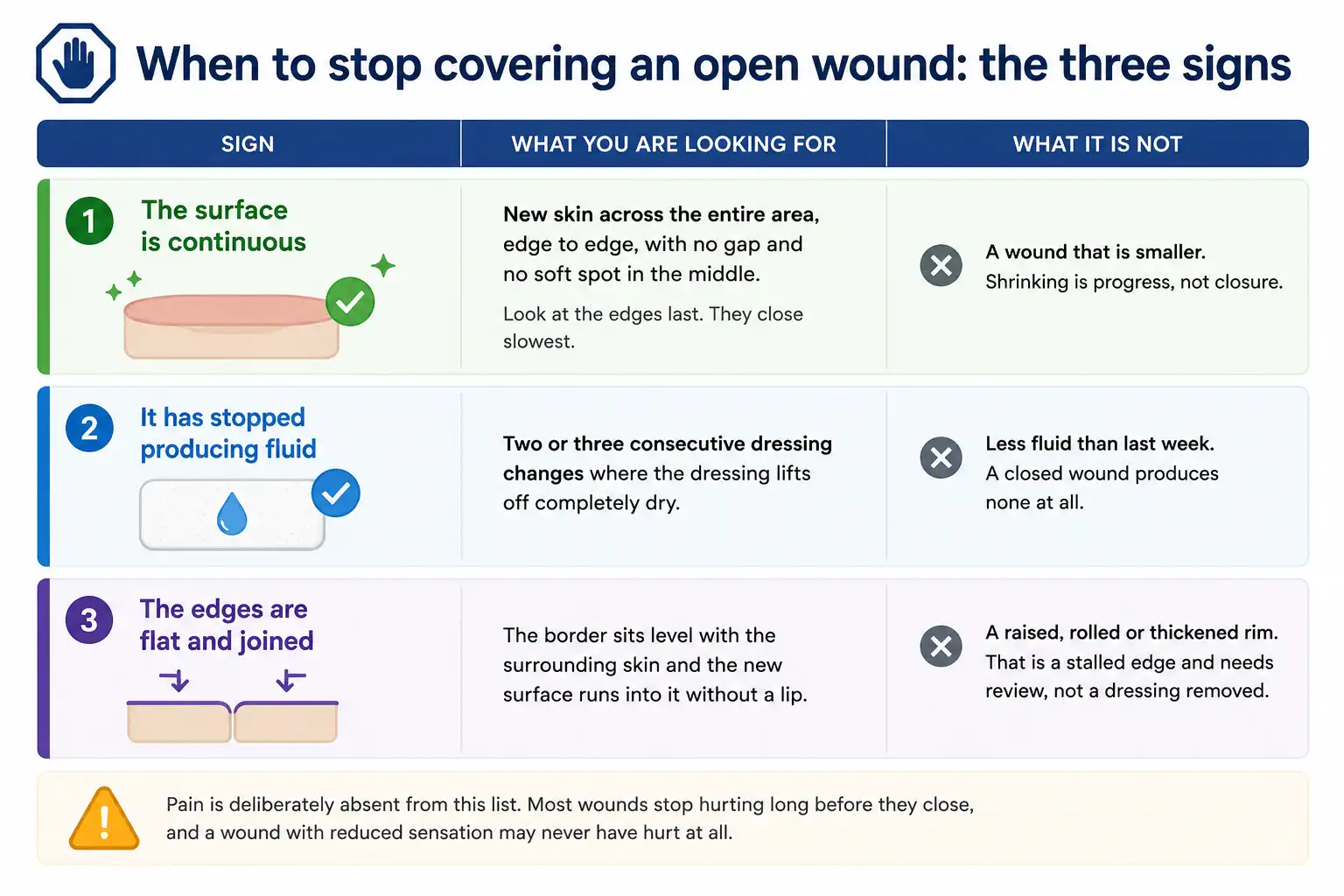
Knowing when to stop covering an open wound comes down to one question: has new skin closed the entire surface? Until it has, the dressing stays on. Once it has, the dressing has run out of work to do.
The difficulty is that a wound stops looking like a wound some time before it stops being one, and the last small opening is usually in the spot people are least likely to check. This guide sets out the six signs that a wound has genuinely closed, why closed skin is far weaker than it appears, the two opposite errors people make at this point, how to step down instead of stopping dead, and the wounds where this call belongs to a clinician.
On this page
- When should you stop covering an open wound?
- The six signs a wound has closed
- Closed and healed are not the same day
- Stopping too soon, and how it shows
- The opposite error: covering skin that has closed
- Step down, do not stop dead
- Wounds where the call is not yours
- What to avoid
- Living with skin that has only just closed
- When to get it seen
- Questions about stopping the dressing
- The takeaway
When should you stop covering an open wound?
Stop once new skin has covered the whole surface, no fluid is coming from it, and it has stayed that way across more than one dressing change. All three parts carry weight, and the third one is the part people skip.
A single dry pad proves very little. Drainage rises and falls with activity, swelling, the weather and how long you have been on your feet, so one quiet day can look like an ending and then be followed by a wet dressing the next morning. Two consecutive changes with a dry pad and an intact surface is a far more reliable place to make the decision.
Everything else people use as a cue is unreliable. A number of days is not a signal, because a graze and a leg ulcer sit on completely different timelines. A wound looking smaller is not a signal either. Smaller is progress, and progress is not the same as finished. The only thing that ends the need for a covering is an unbroken surface.
The six signs a wound has closed
Take these together at a dressing change, in good light, after the wound has been cleaned. Any one of them on its own can mislead you.
The first is new skin over the entire surface, edge to edge, with no gap left anywhere. Wounds close inward from their borders and upward from their base, so the middle of a wound often seals while a narrow slot remains at one end. Look along the rim instead of at the center.
The second is a surface that sits level with the skin around it, or close to level. A dip that still has a moist floor is an open wound with a small opening, not a closed one. The third is no drainage: the pad comes off dry, with no damp patch and no crust of dried fluid on the inside face of it.
The fourth is the absence of any scab or crust bridging a gap. A crust is a lid over an opening, and lifting it usually reveals that the opening is still there. Where that fits into the wider question of covering wounds at all is explained in should a wound be covered. The fifth is that the wound itself has stopped hurting. New skin can itch, prickle and feel tight, and none of that is pain from an open surface. The sixth is time: the first five have held true through at least two changes in a row.
New skin looks pink, red, purple or shiny, and often darker or lighter than the skin beside it. That color is normal and can persist for months. It is not a sign that something is wrong, and it is not a reason to keep covering.
Closed and healed are not the same day
Here is the piece almost nobody is told, and it changes how the following months should be handled. Closing the surface is not the end of the repair. It is roughly the halfway mark.
Once the surface seals, the body moves into a long rebuilding stage in which the collagen laid down in a hurry gets broken apart and replaced with a stronger, better organized version. That work is invisible from outside, and it takes far longer than the closing did.
Those figures come from the National Library of Medicine’s reference chapter on the phases of wound healing, which puts the start of the rebuilding stage at around week three, the point of maximum strength at roughly eleven to fourteen weeks, and the tail of the process at up to a year. It also records the ceiling: a healed site reaches about 80% of the strength of skin that was never injured, and never the full 100%.
The practical reading of that is straightforward. On the day you stop covering, the site is closed and fragile at the same time. It will not withstand what the surrounding skin withstands, and it will not do so for weeks. Protection from knocks, friction and pressure earns its place long after the dressing has been retired, and that is a different job from covering an open wound.
Stopping too soon, and how it shows
Uncovering a surface that has not finished closing undoes work that has already been paid for, and the damage tends to appear within a day or two.
The freshly closed layer is one cell deep in places and holds no moisture of its own. Left in the open it dries, splits and lifts, and the small gap that remained at one edge widens back into an opening. Clothing and bedding finish the job by catching the loose margin and peeling it. A wound that was days from being over can lose a week this way.
The signs that you moved too early are consistent: a spot of fresh moisture or a pinprick of blood on clothing, a patch that feels tacky, a small crust forming where the surface had been smooth, or the area starting to sting again in a way it had stopped doing. Any of those means the dressing goes back on and the count starts over.
Two situations push people into stopping early. One is running out of supplies and deciding the wound looked well enough anyway. The other is a wound that has dragged on for months, where the wish for it to be finished quietly starts editing what you see at each change. Both are understandable and both cost time. If supplies are the problem, that is a phone call to whoever is managing the wound.
The opposite error: covering skin that has closed
Carrying on out of caution feels like the safe choice. It is not free, and on new skin the costs arrive quickly.
Adhesive is the main one. Every removal takes a layer of surface cells with it, and skin that closed three weeks ago has few to spare. Repeated on the same patch, that produces redness, then shiny thinned areas, then a tear that opens a new wound beside the one that just finished. Clinicians call this a medical adhesive related skin injury, and older skin, thin skin and skin affected by long term steroid use are the most vulnerable to it.
Moisture is the second. A dressing designed to hold fluid against an open wound goes on holding it against skin that no longer produces any, and sweat has nowhere to go. The surface turns pale and soft, wrinkles and eventually breaks down. Sweat, urine or drainage sitting against skin produces the same effect, described under moisture associated skin damage.
There is a cost with no clinical name too. A dressing hides the area, and hidden skin does not get inspected. Anything starting underneath, a pressure mark, a blister, a split at the edge, goes unseen until the next change. On a heel or a foot in particular, that delay is the part that matters.
Step down, do not stop dead
Most of the difficulty at this stage disappears once you stop treating it as a switch. Coming off a dressing works better in stages.
The first move is off the treatment dressing and onto something simple. Whatever was doing a specific job, absorbing heavy fluid, holding moisture in, delivering an antimicrobial, is no longer needed once there is nothing to absorb and nothing to treat. A plain low adhesive pad or a thin film does the remaining work, which is protection.
The second move is off that and onto nothing, and it can be done gradually. Leave the area open in the evening at home, where the risk of catching it is low, and cover it for work, for sleep if you are restless, for anything involving shoes, tools or crowds. Stretch the open hours over a week or so. Nothing about this needs to happen on one particular day.
The third move is the one people forget: keep protecting the site without a dressing. Moisturizer on closed skin keeps it supple and reduces the splitting and itch. Sun protection matters more than it sounds, because new skin burns readily and can hold that darker or lighter mark permanently, so a covered limb or a high factor sunscreen is worth a year of attention. And where the wound sat over a pressure point, the padding or footwear that was protecting it stays in service.
Ask at your next appointment what the plan is for stopping, before you reach the point of needing it. It takes a minute, it is a question clinicians expect, and it saves the guesswork later.
Wounds where the call is not yours
For a scrape or a shallow cut, the judgment above is enough. Four kinds of wound sit outside it, and in each case stopping the dressing is not the same as stopping the treatment.
Surgical incisions. The team who made the incision sets the timeline, and it moves with the operation, the closure method and the person. Discharge instructions decide this one. Where stitches, staples or strips are still in place, the covering stays until they come out or lift on their own.
Diabetic foot ulcers. A closed foot ulcer is closed skin over the same foot, the same nerve damage and the same pressure that opened it, and reopening is common. The point at which the dressing stops is the point at which protective footwear, insoles and daily foot checks become the whole of the treatment. Practical guidance for that stage is published by the National Institute of Diabetes and Digestive and Kidney Diseases, whose page on diabetes and foot problems covers daily checks and footwear. Why pressure decides the outcome at all is worked through in offloading a diabetic foot ulcer.
Venous leg ulcers. This is the one that surprises people most. The ulcer closes, the dressing comes off, and compression carries on, often for years and sometimes indefinitely, because the vein problem that produced the ulcer has not gone anywhere. Stopping the stockings when the dressing stops is one of the more common routes back to an open ulcer, a pattern traced in venous leg ulcers.
Pressure injuries. Closed skin over a hip, a heel or the base of the spine is skin that broke down under load once already, and it is weaker there now than it was before. Repositioning, cushioning and daily inspection continue after the dressing ends. The routine that protects it is described in how to prevent bedsores.
What to avoid
Do not test whether a wound has closed by stretching or pulling at the new surface. It will separate under very little force at this stage, and the test itself creates the opening you were checking for. Look, in good light, and leave it alone.
Do not lift a crust to see what is underneath. If a crust is there, the answer is that the wound has not finished, and removing the crust exposes what it was covering to whatever the room contains.
Avoid strong adhesive tape and film dressings directly over skin that has just closed, and remove anything adhesive slowly, low and along the skin, supporting the surface with a finger as it lifts. Peeling upward at speed is what causes most tears.
Do not scrub, exfoliate or apply antiseptics to a closed site. There is nothing left for an antiseptic to do, and the cells doing the rebuilding are the ones it reaches. Plain moisturizer is the correct product on closed skin.
Above all, do not treat the closed surface as the end of the story where something caused the wound in the first place. Compression, offloading, repositioning and glucose control are what keep the site closed. Stopping those on the day the dressing stops is a common reason a healed wound is an open wound again a few months later.
Living with skin that has only just closed
Coming off a dressing is usually described as good news, and for a lot of people the weeks that follow are more unsettled than that suggests.
The routine ends abruptly. Months of changes, supplies and appointments gave the wound a structure and a form of proof that it was being handled, and losing all of it at once can feel less like relief than like being sent away without a safety net. People check the area many times a day. Some keep covering it for reassurance long past the point of need, and a few keep a box of dressings within reach for a year.
Then there is caution about the area itself. After a long healing process, patients often guard the limb, avoid kneeling, walking distances, gardening or picking up a grandchild, and hold that caution far longer than the tissue requires. Some of that is sensible while the site is fragile. Beyond a few weeks it becomes a habit that costs strength, balance and confidence, none of which return on their own.
Ask directly what you can do and when, in specific terms: standing for how long, lifting what weight, back to which activities in which week. Ask as well for a review appointment a few weeks after the dressings end, instead of being discharged into silence. A short check that confirms the site is holding is worth a great deal at this stage, and it is a reasonable thing to request.
When to get it seen
Get the area looked at if it opens again after you stop covering it, if fluid returns at any point, if a crack or split appears in the new surface, or if pain comes back after it had settled. A site that reopens is telling you something about the cause that has not been dealt with, and that is worth finding out early.
Book an appointment as well if the wound has stalled at nearly closed for several weeks, with a small opening that neither shrinks nor grows. A wound that gets to 90% and stops is a common pattern, and it usually has a specific cause: pressure at that exact spot, blood supply, swelling, or a low grade infection sitting in the tissue.
Seek same-day care for a raised temperature alongside the site, redness creeping outward from it, swelling and warmth that arrive together, sudden pain in an area that had been comfortable, or feeling generally unwell. Those can point to infection in the tissue underneath instead of a surface problem. The complete list of warning signals appears under how to tell if a wound is infected.
Anyone with diabetes, poor circulation or reduced sensation in the feet should have a reopened wound looked at promptly every time, without waiting to see how it goes. The margin for waiting is smaller in that group, and a small opening on a foot that cannot feel it can travel a long way before it announces itself.
Questions about stopping the dressing
How do I know a wound is fully closed?
New skin covers the surface from edge to edge with no gap, the area sits level with the skin around it, no fluid appears on the pad, there is no crust bridging an opening, and the wound itself no longer hurts. Confirm all of that across two dressing changes in a row before deciding.
Can I leave a wound uncovered once it scabs over?
A scab is not the same as a closed wound. It is dried fluid sitting over an opening that has not finished, and the surface beneath it is still repairing. Keep the area covered until new skin has replaced the crust, at which point the crust usually lifts on its own.
How long after a wound closes does it stay fragile?
Weeks at minimum. Strength climbs steadily from about the third week and reaches its highest point somewhere around eleven to fourteen weeks, with the rebuilding process running for up to a year in some wounds. Treat the site as breakable for at least the first month or two.
What if the wound opens up again after I stop?
Cover it again and have it assessed. A small reopening is not a disaster, though it does mean something is still acting on that spot, most often pressure, friction, swelling or the underlying condition that produced the wound. Working out which one is the useful next step.
Do I need to keep using compression or special shoes after it heals?
In many cases yes, and for considerably longer than the dressing. Compression for a venous ulcer and protective footwear after a diabetic foot ulcer are aimed at the cause, not the wound, and the cause is still present after the skin closes. Your clinician sets how long these continue.
Should I put anything on the new skin?
A plain, unscented moisturizer applied gently keeps new skin supple and eases the tightness and itching. Sun protection is worth maintaining for months, since the area burns easily and can keep a permanent mark. Antiseptics and exfoliating products have no role on skin that has already closed.
The takeaway
So, when to stop covering an open wound? Once new skin runs edge to edge with no gap, the pad comes off dry, nothing is bridging an opening, the pain has gone, and all of that has held through two changes in a row. Days on the calendar and a wound looking smaller are not evidence.
Then remember what closing does and does not mean. The surface is sealed and the tissue underneath is weak, and it stays weak for months while the rebuilding finishes. Come off the dressing in stages, keep protecting the site once it is uncovered, and keep going with whatever was addressing the cause. That last part is what decides whether the wound stays closed.
Not sure whether your wound is ready to be left open?
An assessment can confirm whether the surface has genuinely closed, set out how to step down from the dressing, and check that whatever caused the wound is still being managed.
Judging closure, planning the step down and protecting a site that has just healed all form part of an assessment through our advanced wound care service.
This article is general education and does not replace a clinical assessment. Anyone deciding when to stop covering an open wound that has been under professional care should confirm the timing with the team managing it, particularly after surgery or where diabetes, circulation problems or a previous ulcer are involved.