How long does a surgical wound take to heal? The skin usually closes within about two weeks, but the wound underneath is nowhere near finished. It keeps gaining strength for roughly three months and carries on quietly rebuilding for up to a year, and even then the repaired site settles at around 80 percent of the strength of skin that was never cut.
That gap between looking healed and being healed is the reason surgeons hand out restrictions measured in weeks, not a vague instruction to wait until the incision looks better. This guide walks through what happens in each phase, the short window when an incision is most likely to come apart, why some timelines run much longer than others, and how to tell an ordinary slow recovery from one that needs attention.
On this page
- How long does a surgical wound take to heal?
- Closed is not the same as healed
- The timeline, phase by phase
- The window when incisions come apart
- Why your timeline may look different
- What slows the clock down
- Slow healing versus a wound in trouble
- What actually helps it along
- What to avoid while it heals
- Living with the wait
- When to call someone
- Questions people ask
- The short version
How long does a surgical wound take to heal?
For most straightforward operations, the surface closes in one to two weeks. Stitches or staples usually come out somewhere between day 7 and day 14, and by that point the edges have knitted together well enough to hold themselves shut.
That is the answer most people are given, and it is only the first quarter of the story. Underneath the closed skin, the body is still laying down and reorganizing collagen, the structural protein that gives repaired tissue its hold. The National Library of Medicine’s clinical summary of the phases of wound healing puts the remodeling phase as starting around week 3 and running for as long as 12 months, with peak strength arriving at roughly 11 to 14 weeks.
So there are really two timelines running side by side. One is cosmetic and fast: the incision shuts, the dressing comes off, and you stop thinking about it. The other is structural and slow, with the tissue still gaining strength for about three months and still changing in appearance for the best part of a year. Almost every misunderstanding about surgical recovery comes from reading the first timeline and assuming it is the only one.
Closed is not the same as healed
A closed incision at two weeks holds only a small fraction of the strength of intact skin. It looks finished because the surface is sealed and the visible drama is over. What it actually has at that point is a temporary scaffold, and that scaffold has not yet been replaced with anything durable.
The first collagen the body lays down is disorganized, deposited fast in whatever direction happens to be convenient. Over the following months it gets broken down and relaid along the lines of tension the tissue actually experiences, which is what turns a soft repair into a strong one. That reorganization is the part nobody sees, and it decides whether the repair holds when you eventually go back to lifting, twisting and pushing.
It never reaches the original specification. The same clinical summary notes that a healed site ends up with about 80 percent of the tensile strength of uninjured skin. That figure is worth carrying around, because it explains something patients often find frustrating: the restrictions after abdominal or chest surgery are not lifted the moment the wound looks fine, and they are not arbitrary caution either.
The timeline, phase by phase
Recovery moves through phases that overlap at their edges, so the boundaries below are approximate. The rough shape holds for most planned operations that close without complications.
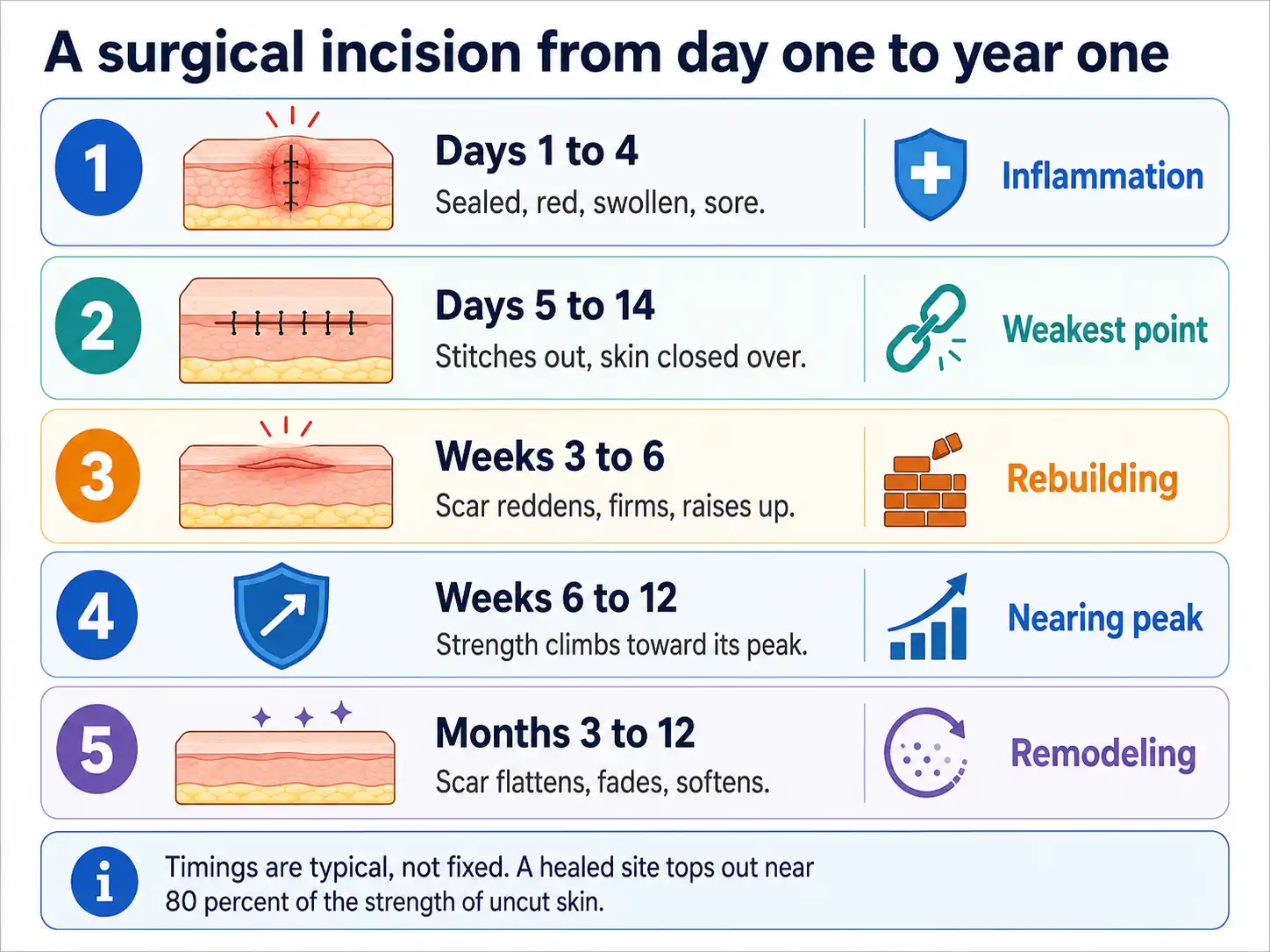
The first four days
The incision seals within hours as a clot forms and a thin surface layer bridges the gap. Around it, the tissue swells, reddens and warms up as immune cells arrive to clear debris and hold off bacteria. Some pinkness at the edge, some puffiness and a clear or lightly blood-tinged ooze on the dressing all belong to this phase.
Pain is usually at its worst in the first 48 hours and then begins to ease. A slight rise in temperature in the first day or two after an operation is common and does not automatically mean infection, though a fever that climbs or arrives later in the week is a different matter.
Days five to fourteen
New tissue fills the gap and the edges bond. Stitches, staples or adhesive strips come off somewhere in this window depending on the site, and the incision starts to look like a thin line instead of a wound.
This is also, awkwardly, the point at which the repair is weakest relative to the demands people start putting on it. The temporary scaffold is in place but the durable collagen is barely started, and the patient feels well enough to move around normally. That mismatch gets its own section below, because it is where most preventable setbacks happen.
Weeks three to six
Here the scar often looks worse than it did at week two, and this is the single most common reason people ring the clinic thinking something has gone wrong. The line thickens, turns pink or purple-red, sits slightly proud of the surrounding skin and may feel firm or ridged under a fingertip.
A scar that reddens, raises and firms up between weeks three and six is usually doing exactly what it should. The color comes from the dense network of new blood vessels feeding the repair, and the raised firmness is collagen being packed in. Both fade. Itching and a tight pulling sensation are normal in this stretch too, and numbness around the scar is common where small skin nerves were cut.
Weeks six to twelve
Strength climbs steeply through this period and reaches its maximum at roughly 11 to 14 weeks. Most lifting and activity restrictions after abdominal, chest or major joint surgery are pitched to land somewhere in here, which is why a six-week review is such a standard fixture and not a coincidence.
Discomfort should be well down by now, though occasional twinges, tightness when stretching and tenderness if the scar is knocked can persist. The scar itself usually starts to lose its angry color toward the end of this window.
Three months to a year
Nothing dramatic happens, which is why most people assume this phase does not exist. The scar slowly flattens, pales toward white or the surrounding skin tone, and softens as the collagen continues to reorganize. Sensation may partially return where nerves regrow, though some numbness can be permanent.
Judging the final appearance of a scar before about a year has passed is premature. Scars that look unacceptable at three months frequently look unremarkable at twelve, and this is the main reason clinicians are reluctant to discuss scar revision early.
The window when incisions come apart
If an incision is going to separate, there is a specific stretch of days when it usually happens, and hardly anyone is told about it.
Separation of a surgical wound is called dehiscence, meaning the edges that were brought together come apart again. The National Library of Medicine’s clinical review of wound dehiscence places the typical timing at 5 to 8 days after the operation, while healing is still in its early stages. The reason is unforgiving arithmetic: the stitches are doing less of the work by then, sometimes already removed, and the tissue has not yet built enough of its own strength to take over.
That timing lines up almost exactly with the moment people feel better. The anesthetic haze has cleared, the worst pain has passed, and the temptation to lift a laundry basket, carry a child or shove a heavy door is at its strongest. The incision looks convincing and is not yet up to the job.
Separation runs from minor to serious. A superficial split affects the skin edges and may be managed with dressings while it fills in from the base. Deep separation, where the tough fascial layer beneath the muscle gives way, is a surgical emergency because of the risk that abdominal contents push through. Sudden gaping, a rush of clear or pink fluid from the incision, or a feeling that something has given way inside all need urgent assessment the same day.
The same review lists what raises the risk: poor blood supply, infection, raised pressure inside the abdomen from coughing or straining, diabetes, poor nutrition, smoking, obesity, older age, emergency surgery, cancer and steroid treatment. Several of those are things you can influence, and several explain why a surgeon sets a longer restriction for one patient than another having the same procedure.
Why your timeline may look different
Two people can have the same operation on the same day and be given completely different timescales. Three things account for most of that.
The first is how the wound was closed. An incision brought together with sutures, staples or skin glue heals along the fast track described above. A wound deliberately left open, packed and allowed to fill in from the base is healing by secondary intention, and that takes weeks to months depending on its size. It is not a complication or a sign that something went wrong. Surgeons choose it when closing a contaminated or infected space would trap the problem inside.
The second is depth. An operation does not cut one layer, it cuts several, and they do not run on the same clock. Skin closes first. Fat, muscle sheath and fascia take considerably longer, and the deep fascia is the slowest of all. Internal stitches placed in those layers dissolve over weeks to months rather than being removed. This is why lifting limits outlast the visible wound by so much, and why an incision that looks perfect at three weeks can still be nowhere near ready for real load.
The third is where the incision sits. Skin over a joint, across the abdomen or anywhere that flexes constantly is under repeated tension, and tension pulls at a healing edge every time you move. Sites with a generous blood supply, such as the face and scalp, tend to move faster than the lower leg, where circulation is often the limiting factor.
What slows the clock down
Beyond the operation itself, healing speed depends heavily on the person doing the healing.
Smoking is the biggest modifiable factor. Nicotine narrows small blood vessels and carbon monoxide displaces oxygen in the blood, so tissue trying to rebuild gets less of both than it needs. The effect shows up within weeks, which means stopping even shortly before and after an operation is genuinely worth doing.
Diabetes affects healing through several routes at once, including circulation, immune response and glucose levels in the tissue itself, and blood sugar control in the weeks around surgery matters more than many patients realize. Poor circulation from arterial disease limits how much oxygen reaches the site regardless of anything else. Corticosteroids and some immune-suppressing and chemotherapy drugs deliberately damp down the inflammatory response that healing depends on. Age slows the process modestly. Obesity contributes through poorer blood supply to fatty tissue and greater tension on the closure.
Nutrition is the factor most often overlooked and most easily improved. Building new tissue consumes protein, calories and specific micronutrients, and someone who has been eating poorly since their operation is asking their body to build something out of materials it does not have. Which nutrients do what is set out in our piece on nutrition for wound healing.
Infection stops progress outright. A wound cannot rebuild and fight bacteria at the same time, so an infected incision does not simply heal more slowly, it often stalls where it is until the infection is dealt with.
Slow healing versus a wound in trouble
The distinction that matters is not speed. It is direction.
A wound that is healing slowly still improves week on week. It gets a little less sore, drains a little less, and the line gets a little tidier. Someone with diabetes or poor circulation may take twice as long as the timeline above and be entirely on track.
A wound in trouble reverses. Pain that had settled starts climbing again around day 4 or 5. Redness that was confined to the incision line begins spreading outward into the surrounding skin. Drainage increases after it had been decreasing, or thickens, or turns cloudy and yellow-green. Warmth and swelling return. Any of those changes is a reason to be seen, and each signal is taken apart in how to tell if a wound is infected. What normal fluid should look like at each stage is described in our guide covering the types of wound drainage.
There is also a third category: the wound that has neither worsened nor progressed. An incision that has been open, unchanged and stubbornly the same for a month is stalled, and stalled wounds usually have a specific reason behind them that can be found. Why wounds get stuck is the subject of our article on a wound that will not heal.
What actually helps it along
Less than the internet suggests, and the things that do work are unremarkable.
Follow the specific dressing instructions you were given for that incision, since guidance varies by how it was closed and where it sits. Wash your hands before and after touching it. Keep the surrounding skin clean and dry, and check the site daily in good light, because a change caught the day it appears is a far smaller problem than the same change found a week on. General technique for handling a wound at home is covered in our practical guide to wound care at home.
Eat properly. Protein at every meal, enough calories, and enough fluid. Appetite is often poor after surgery and this is the period when it matters most.
Stop smoking, even temporarily. If you have diabetes, stay on top of your glucose readings during recovery. Move within the limits you were given, because gentle walking supports circulation and reduces clot risk while heavy exertion pulls on the closure. If you have an abdominal or chest incision, hold a folded towel or pillow firmly against it when you cough or sneeze. That takes the sudden spike of pressure off the closure, and it is a small trick with a real effect during exactly the days when separation is most likely.
Once the incision is fully closed and cleared by whoever is looking after it, keeping the maturing scar out of strong sun for the first year helps prevent it darkening permanently.
What to avoid while it heals
Do not test the incision to see whether it is holding. Pressing, tugging or pulling the edges apart to check is a surprisingly common habit and it does the one thing you are trying to avoid, which is applying force to a closure that is not ready for it.
Do not put hydrogen peroxide, rubbing alcohol, iodine or antibacterial soap on a healing incision unless a clinician has specifically told you to. These damage the new cells doing the repair along with the bacteria, and a wound with fewer working cells closes more slowly. Skip the creams, oils and vitamin E preparations sold for scars on a closed incision as well, unless yours was recommended. Evidence that they improve the final result is thin, and some cause skin reactions that set things back.
Leave scabs, glue and adhesive strips alone. They come away in their own time, and pulling one off early takes the fragile new surface underneath with it. Do not soak the site in a bath, pool or hot tub until you have been cleared, since prolonged soaking softens a closure and pools carry organisms a fresh incision does not need.
Above all, do not use the appearance of the incision to decide when to resume lifting. The skin closing tells you nothing about the deeper layers, and that mismatch is the whole reason restrictions are given in weeks. If the limit you were given was six weeks, six weeks is what it means, however good it looks at three.
And do not stay quiet about a change because the appointment is only a few days away. Infection and separation both move faster than a scheduled review.
Living with the wait
The part of surgical recovery least covered anywhere is what the months in between are actually like.
The hardest stretch for most people is weeks three to six, when the scar reddens and thickens. You feel better, you look worse, and the natural conclusion is that something has gone backward. It has not, but nobody warns you and the reassurance usually arrives only after a worried phone call.
Then there is the collision between restrictions and ordinary life. A six-week lifting limit is straightforward on paper and impossible in a house with a toddler, a job that involves carrying, or nobody else to do the shopping. People break those limits quietly and then feel unable to admit it when something starts hurting. Saying it plainly is more useful than hiding it, because the plan can be adjusted around your circumstances far more easily than a separated wound can be repaired.
Numbness catches people out as well. A patch of skin near the incision that feels dead or oddly distant is the result of small nerves being cut, and it can take many months to recover or never fully return. Odd sensations such as itching, tightness, tingling and sharp electrical twinges as nerves regrow are common and are not signs of damage.
There is also the invisibility problem. Once the dressing is off, everyone around you assumes the episode is closed, while you are still tired, still sore and still counting weeks. Being three months out from major surgery and not back to normal is ordinary, not a failure, and it is a reasonable thing to say out loud to the people expecting more of you.
When to call someone
Contact your surgical team or a wound care clinician if pain begins increasing after it had settled, if redness spreads out from the incision line, if drainage increases or thickens or changes color, if the wound opens even slightly, or if the site has looked unchanged for several weeks.
Do not wait until morning if the incision gapes open, if fluid suddenly soaks a dressing that had been dry, if a temperature or violent shivering sets in, if the skin around the wound reddens over the course of an afternoon, or if pain that had been settling doubles back sharply.
A sudden discharge of clear or pink fluid from a wound that had sealed deserves particular attention, since it can arrive before deep separation does. And anything visible through an opening in the wound, such as underlying tissue or a loop of bowel, is an emergency: cover it with a clean damp cloth, do not push anything back, and go to an emergency department.
Questions people ask
How long before a surgical wound stops being an open wound?
A surgically closed incision is not an open wound at any point, since the edges are brought together during the operation and the surface seals within hours. Stitches or staples typically come out between day 7 and day 14. A wound deliberately left open to heal from the base is a different situation and can take weeks to months to fill in.
Is it normal for a scar to get redder and lumpier after a few weeks?
Yes, and it is one of the most common worries. Between weeks three and six a scar often reddens, thickens and sits slightly raised as new blood vessels and collagen build up. It usually flattens and fades over the following months. Redness that spreads outward into surrounding skin, instead of staying on the line itself, is the version that needs checking.
When can I lift things again?
That depends on the operation and only your surgical team can set it. Six weeks is a common limit after abdominal surgery, and it exists because tissue strength is still climbing toward its peak at around 11 to 14 weeks. The limit is based on the deep layers, not on how the skin looks, so an incision that appears fully healed does not shorten it.
Why is my incision still sore after a month?
Tenderness at four weeks is common, particularly with deeper operations or incisions in areas that move constantly. Cut nerves regrowing produce twinges, tingling and sensitivity for months. Soreness that is steadily improving is expected. Soreness that is increasing, or arrives with redness, swelling or drainage, should be assessed.
Do internal stitches take longer to heal?
The deeper layers they hold do take longer, yes. Skin closes first while muscle sheath and fascia rebuild over a considerably longer period. Dissolving sutures lose their strength over weeks to months by design, handing the load across to tissue that should be strong enough by then, which is the reasoning behind activity restrictions that outlast the visible wound.
When is a surgical wound considered fully healed?
It depends which definition you mean. Closed and safe for most everyday activity is roughly six weeks for many operations. Maximum strength arrives at about 11 to 14 weeks. Full remodeling, where the scar reaches its final appearance and texture, can run up to a year. Even then the site settles at around 80 percent of the strength of skin that was never cut.
The short version
So how long does a surgical wound take to heal? The skin closes in one to two weeks, everyday activity is usually safe around six weeks, strength peaks at roughly 11 to 14 weeks, and the scar carries on remodeling for up to a year before settling at about 80 percent of original strength.
The dates worth remembering are days 5 to 8, when separation is most likely and the incision feels deceptively fine, and weeks three to six, when the scar looks alarming and is almost always behaving normally. Between those two, most of what people worry about turns out to be either expected or preventable. What is never normal is a wound going backward: pain climbing, redness spreading, drainage increasing, or edges parting. That is worth a phone call the day you notice it.
Is your incision taking longer than you were told to expect?
A surgical wound that has stalled, opened or started going backward usually has a findable reason behind it. An assessment can identify what is holding it up and set out a plan.
Our surgical wound care service assesses incisions that are separating, draining or failing to progress, and works alongside your surgical team on what happens next.
This article is general education and does not replace a clinical assessment. Recovery timescales differ by operation, technique and individual health, so the restrictions and instructions given to you by your own surgical team take precedence over any general timeline described here.