
Should a wound be covered or left open to air? Covered, in almost every case. The idea that a wound needs to breathe is one of the most durable pieces of bad advice in first aid, and it rests on an assumption about air that turns out to be wrong.
Air does not reach a wound in the way people picture, and drying the surface out slows the repair down instead of speeding it up. This guide explains where the air idea came from, what a scab really is, how long different wounds stay covered, the opposite mistake of keeping a wound too wet, and the small number of situations where leaving it uncovered is the correct call.
On this page
- Should a wound be covered or left open to air?
- Where letting it air out came from
- What a scab actually costs
- The four jobs a dressing is doing
- How long the covering stays on
- A dry wound bed makes more work
- The opposite mistake: too much moisture
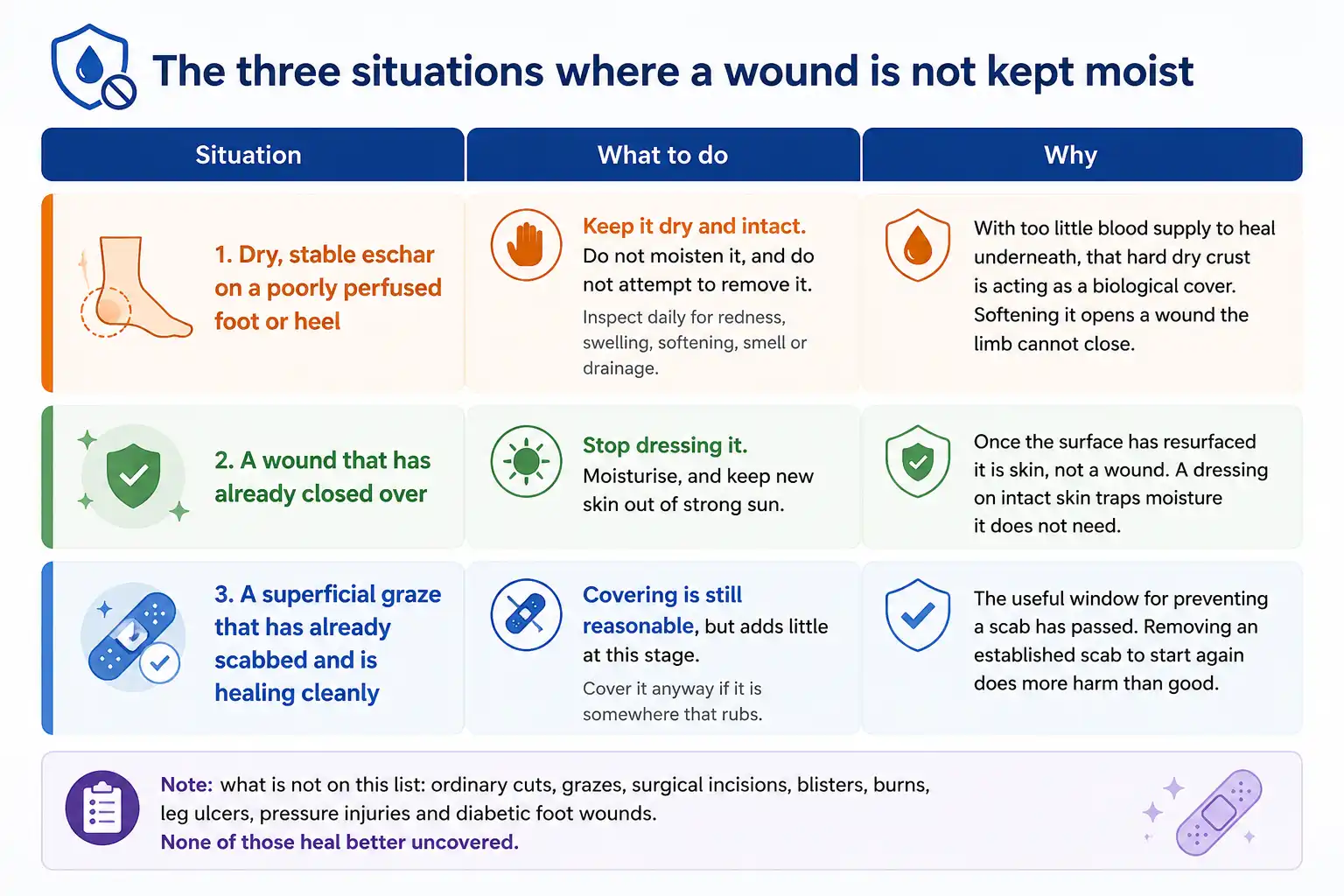
- When leaving it uncovered is right
- Signs the covering plan needs changing
- Covering it without drying it out
- What to avoid
- Living with a wound you keep covered
- When to get it seen
- Questions about covering a wound
- The takeaway
Should a wound be covered or left open to air?
Covered. A clean wound kept lightly moist under a dressing generally closes faster, hurts less and leaves a less noticeable mark than the same wound left open to dry out.
The exceptions exist, they are specific, and they appear further down this page. For almost everything people deal with at home (a scrape, a cut, a torn blister, a surgical incision, an ulcer on the leg), a dressing is the answer.
What muddles the question is the word breathe. Skin does not take in oxygen from the room in any amount that matters to healing. The oxygen a repairing wound uses arrives in the blood, carried through the small vessels growing into the wound bed from underneath. Room air resting on the surface adds close to nothing to that supply. What it does add is evaporation, and evaporation is the thing you are trying to prevent.
Where letting it air out came from
The advice is old, and it was reasonable once. When the only available covering was a thick pad of dry gauze that glued itself to the surface and tore the new tissue away at every change, leaving a small scrape open genuinely produced a better result.
Dressing materials have changed completely since then. The ones used now are designed to hold moisture at the wound surface on purpose, and to release without dragging at what has grown underneath. The advice outlived the problem it was solving.
The second half of the belief is that air kills germs. It does not. Bacteria survive on dry surfaces without difficulty, and an uncovered wound collects whatever it comes into contact with: bedding, clothing, upholstery, hands, pet hair, dust. A dressing is a physical barrier between the wound and all of that, and the barrier is a large part of its value.
There is one place where the drying instinct is correct, and it gets applied to the wrong surface. The skin around a wound does need to stay dry. The wound bed itself does not. Reversing those two is a common error in wound care at home, and both halves of the mistake cause damage.
What a scab actually costs
A scab is not evidence that a wound is healing well. It is what forms when the surface dries out before the repair underneath has finished.
Physically, a scab is dried plasma, blood cells and debris, set hard across the opening. Beneath it, the cells that rebuild skin have to travel inward from the wound edges until they meet in the middle. A hard dry crust sits in their path. They migrate under it and, where the tissue below has also dried, they have to break a route through it, which costs time.
Keep that surface lightly moist and the same cells cross an open, wet plane with nothing obstructing them. That is the mechanism behind moist wound healing, which has been standard practice in wound care for decades, and it is the reason modern dressings are built to trap fluid instead of soaking it all away.
None of which makes a scabbed graze a disaster. Superficial scrapes heal under scabs every day and most people never think about it again. The honest framing is that scabbing is the slower route, with more itching and discomfort along the way and, on skin that shows, often a more visible result at the end.
The four jobs a dressing is doing
Keeping dirt out is only one of them, and arguably not the most useful one.
A dressing holds moisture at the surface so the repairing cells can move. It forms a barrier against bacteria, knocks and friction from clothing. It keeps wound fluid in contact with the wound, and that fluid carries the body’s own growth factors and immune cells, so wiping it all away discards part of the repair kit. And it covers exposed nerve endings, which is why an open wound stings in a draft and calms down once something is over it.
A dressing does one more thing that gets no credit: it keeps a record. Fluid volume, color and smell all show up on the pad at every change, and that record is how a clinician tracks whether a wound is improving or drifting the wrong way. A wound left open gives nobody that information.
How long the covering stays on
Length of time depends on the wound, not on a number of days. The working rule is that a covering stays on until new skin has closed the surface, or until whoever is managing the wound says the job is done.
Surgical incisions are the one situation where a fixed number gets quoted, and the number moves with the procedure, the surgeon and the person. Some teams say keep it dry and covered for two days, some say a week, some say leave the original dressing alone until the follow-up appointment. Discharge instructions beat anything written on a general health page, including this one.
Chronic wounds work differently. A leg ulcer, a pressure injury or a diabetic foot ulcer is covered as part of a treatment plan, and the change interval is set mainly by how much fluid the wound produces. Heavy drainage may mean daily changes. A quiet wound under the right dressing may be left for several days on purpose, because every change cools the surface, disturbs the new tissue and briefly interrupts the process you are waiting on. More frequent is not better.
A dry wound bed makes more work
Here is the part almost nobody gets told. Drying a wound out does not merely slow it down. It manufactures a second problem that the body then has to spend effort clearing.
When the surface of a wound bed dries, the living cells at that surface die. What remains is a thin layer of dead tissue lying on top of healthy tissue. The body’s response is to dismantle that layer and lift it off, using enzymes already present in wound fluid. That takes days, and it consumes resources that would otherwise have gone into closing the gap.
Clearing dead tissue this way has a name, autolytic debridement, and it is genuinely useful when there is dead tissue that needs to go. Creating dead tissue so the body can then remove it is a detour with no destination. There is a fuller account of how that clearance works, and what it looks like day by day, in autolytic debridement.
On a larger or older wound the effect compounds. A wound dried out repeatedly, with the dressing left off for hours, or gauze allowed to dry onto the surface, or the wound cleaned and then left open while someone hunts for supplies, spends a good share of its energy on repair work that never needed doing. That is one of the quieter reasons a wound stalls at the same size week after week with no obvious explanation.
The opposite mistake: too much moisture
Lightly moist is the target. Wet is a different problem with its own damage.
When a dressing cannot hold everything a wound produces, the surplus fluid sits against the skin at the edges. That skin turns pale or gray, softens, wrinkles the way a hand does after a long bath, and eventually breaks apart. The clinical word is maceration, and it is easy to spot once you know to look for it.
The consequence is that the wound gets larger. Its own drainage erodes the border it is trying to grow from, and softened edges give new skin nothing solid to advance across. A wound that has been slowly widening for weeks is often a moisture problem wearing the disguise of a healing problem.
Check the ring of skin immediately around the wound at every single change. Pale, soggy, wrinkled skin means the dressing is not absorbing enough, is being left on too long, or both. A more absorbent product, a shorter interval between changes, or a barrier film on the surrounding skin usually settles it. Damage of the same kind caused by sweat, urine or drainage running down a limb is explained in moisture associated skin damage.
When leaving it uncovered is right
There is a real list of exceptions. It is short, and every entry on it is specific.
Dry, hard, stable dead tissue on a heel. A heel covered by firm black or brown eschar, with no redness at the border, no softness and no drainage, is often deliberately left dry and open to the air. That crust is acting as the body’s own cover over a limb whose circulation may not be able to support an open wound beneath it. The international pressure injury guideline, written jointly by the European, US and Pan Pacific pressure injury bodies and published at internationalguideline.com, advises leaving stable dry eschar in place and keeping it dry. Inspect it daily. If it turns soft, wet or boggy, or the skin around it reddens, swells or begins to drain, that is a same-day call to a clinician. Why a heel gets treated this way is set out in unstageable pressure ulcer.
A wound that has fully closed. Once new skin covers the whole surface, a dressing has nothing left to do. That skin stays fragile for weeks, so it is worth protecting from knocks and from sun, but it no longer needs covering in order to heal.
A surgical incision past the point the surgical team specified. Some incisions are left open to the air after a stated number of days. That instruction comes from the team who made the incision, and nobody should extend it to a different operation on a different person.
Beyond those, an uncovered wound is losing something it could have kept. Even the borderline case, a small graze on a forearm in a clean environment on someone who is otherwise well, heals more comfortably under a dressing than out in the open.
Signs the covering plan needs changing
A dressing that is working is quiet. Problems announce themselves in fairly consistent ways.
Fluid reaching the edge of the pad, or soaking through to clothing and bedding, means the product is under-matched to the wound and the skin at the border is taking damage in the meantime. A dressing that dries hard and has to be pulled free is doing the opposite, and it removes new tissue every time. Pain that arrives during changes and settles afterward usually points at the dressing. Pain that climbs steadily between changes points at the wound.
Then there are the changes that have nothing to do with the covering at all. Redness widening outward from the edges, new warmth, swelling, thicker or discolored drainage, a smell that survives cleaning, or feeling generally unwell all suggest something has taken hold in the wound. For the full set of signals, and what separates ordinary inflammation from something more, see how to tell if a wound is infected.
One reassurance, because the fear is common: covering a wound does not trap an infection inside it. Infection is driven by what is already in the tissue and by the body’s ability to deal with it. Removing the dressing lets nothing out, and it exposes the surface to more bacteria than it had before.
Covering it without drying it out
The practical routine is short, and doing it consistently matters more than doing any single part of it perfectly.
Wash your hands before you start and again before the clean dressing goes on. Have everything open and within reach first, so the wound is not sitting exposed while you hunt for tape. Clean the wound the way you were shown, usually with sterile saline or clean running water. Dry the skin around it properly and leave the wound bed alone, which is the split that trips people up. Then get the new dressing on promptly instead of leaving the wound uncovered to settle.
Match the product to the amount of fluid. A wound producing very little needs something that holds moisture in. A wound producing a lot needs something that absorbs without flooding the edges. That is a judgment a nurse or clinician makes, and it is a reasonable thing to ask about if your dressing keeps failing the same way each time. For everyday cuts and scrapes, the National Library of Medicine’s plain-language page on cuts and puncture wounds covers basic first aid and the signs that mean a wound needs looking at.
If a dressing has stuck, soak it with saline or clean water and wait instead of pulling. Half a minute of patience saves the surface underneath. And write down what you see at each change: how wet the pad was, what color, whether the edges looked soggy. That record answers questions at appointments that memory cannot.
What to avoid
Do not leave a wound open between dressing changes to give it air. There is no benefit waiting on the other side of it, and the surface starts drying within minutes. If you need a pause in the routine, take the pause before you remove the old dressing, not after.
Keep hydrogen peroxide, rubbing alcohol and undiluted antiseptics off an open wound. They kill the cells doing the repair alongside anything else they reach, and a wound cleaned that way is a wound with fewer working cells in it. Plain water or saline does the job that actually needs doing.
Do not pick a scab off to let the wound start again, and do not cut or scrape at dead tissue yourself. Both open the surface to bacteria and can turn a small wound into a considerably larger one.
Household improvisation is worth resisting too. Plastic wrap, tape stuck directly across a wound, cotton balls that shed fibers into the bed, and reused or dried-out dressings all create problems that take longer to fix than they took to cause. If supplies have run short, that is a phone call, not a craft project.
Finally, do not put a dressing onto wet skin. Adhesive that fails at hour two leaves the wound uncovered for the rest of the day, which returns you to the problem this whole page is about.
Living with a wound you keep covered
Weeks of dressing changes wear on people in ways that rarely come up at appointments, and they are worth naming.
Showering becomes a planning exercise. Clothes stop fitting over a bulky pad, and shoes are the worst of it when the wound is on a foot or a lower leg. Sleep gets interrupted by the awareness of it, or by fluid reaching the sheets. Supplies run out on a Sunday. The routine takes over a slot in the day that used to belong to something else, and for a caregiver doing it for someone they love, that slot arrives twice.
People also get self-conscious about the bulk of a dressing under clothing and start turning things down because of it: swimming, the gym, an afternoon at the beach, sometimes work that involves being on their feet all day. That withdrawal happens quietly, and it tends not to get mentioned unless somebody asks.
All of it is worth raising, because a good deal of it is adjustable. A lower-profile product, a longer wear time, a waterproof cover for showering, a different way of securing the edges, or a delivery arrangement that stops the supply running dry are ordinary parts of a care plan, and they get offered to the people who mention the problem. Nobody is going to guess that a dressing is the reason you stopped swimming.
When to get it seen
Arrange an appointment if a wound has not visibly improved across two weeks of sensible care, if the dressing soaks through faster than you can change it, if the skin at the edges is going pale and soft, or if the wound sits on the foot of someone with diabetes or with known circulation trouble. That last group should be looked at early every time, because the margin for waiting is smaller.
Seek same-day care for a raised temperature alongside a wound, redness traveling outward from it, pain climbing quickly, black or rapidly changing tissue, or a sudden sense of being unwell in yourself. Those suggest infection has moved past the wound itself.
A wound still open after a month, whatever it looks like, has earned a specialist opinion. Something is holding it up, and the useful work at that stage is finding out what: pressure, blood supply, moisture balance, infection or an underlying condition, instead of continuing to change the same dressing and hope.
Questions about covering a wound
Should a wound be covered at night?
Yes. Overnight is when a wound is most exposed to bedding, to friction from moving in your sleep, and to hours of uninterrupted drying. Taking a dressing off at bedtime to let the wound breathe hands it the longest dry stretch of the day.
Does a wound heal faster covered or uncovered?
Covered, in general. A moist wound surface lets the cells rebuilding skin move across it freely, while a dry surface forces them to work under or through a crust. Covering also protects against bacteria and knocks, either of which can set healing back.
Is it bad to let a wound scab over?
Not dangerous, just slower. Plenty of minor scrapes heal perfectly well under a scab. A wound kept lightly moist tends to close sooner, itch less and leave a fainter mark, which is why a dressing is still the better choice where comfort or appearance matters.
Can you cover an infected wound?
Yes, and an infected wound should still be covered. A dressing does not seal infection in, because the infection is already in the tissue, and leaving the wound open exposes it to more bacteria. What an infected wound needs is assessment, since the treatment is aimed at the infection and not at the covering.
How often should a dressing be changed?
As often as the amount of fluid demands, and no more. Some dressings are designed to stay on for several days and work better when they are left alone. Change one early if it leaks, lifts at the edges, smells, or the wound becomes more painful under it.
Can I shower with a wound covered?
Usually, though it depends on the wound and the dressing. Waterproof covers and shower sleeves exist for exactly this, and some dressings tolerate water on their own. Ask the person managing your wound before assuming either way, particularly with a recent surgical incision.
The takeaway
So, should a wound be covered or left open to air? Covered, nearly always. Air does not feed a wound, does not disinfect it, and does nothing except dry a surface that heals better damp. A scab is a delay, not a milestone.
Aim for lightly moist, watch the skin at the edges for the opposite problem, and leave a wound uncovered only in the narrow situations where a clinician has said so: dry stable eschar on a heel, a surface that has fully closed, or an incision past the period your surgical team specified. If a wound is not improving after a couple of weeks of that, the question stops being how to cover it and becomes why it is not closing.
Unsure whether your dressing is the right one?
A wound that keeps leaking, keeps drying out, or keeps damaging the skin around it is usually matched to the wrong product. An assessment can sort the covering out and check what else may be holding the wound up.
Dressing selection, moisture balance and the reasons a wound stalls are part of what our advanced wound care service works through at an assessment.
This article is general education and does not replace a clinical assessment. Instructions for a surgical incision, a diabetic foot wound, or any wound already under a care plan come from the team managing it, and those instructions take precedence over general guidance about covering a wound.